Why In News?
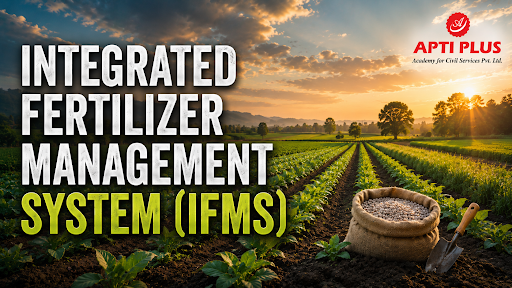
The Department of Fertilizers launched an advanced phase of the Integrated Fertilizer Management System (iFMS).
What is the Integrated Fertilizer Management System (iFMS)?
It is a comprehensive, end-to-end national digital tracking platform developed by the National Informatics Centre (NIC) for the Department of Fertilizers, Ministry of Chemicals and Fertilizers.
It acts as the digital backbone of India's agricultural input supply chain by monitoring every single stage of the fertilizer ecosystem—from domestic manufacturing and port imports to railway/road transit, district stock storage, and biometric retail Point of Sale (PoS) transactions.
Key Features of iFMS
Aadhaar-Linked Farmer Verification: Requires biometric fingerprint or OTP authentication on PoS devices to verify the identity of the purchasing farmer.
Universal Retailer Integration: Connects more than 2.8 lakh fertilizer retail outlets nationwide to a unified central server.
Transparent Sales Transactions: Generates digital, printed receipts for every transaction, specifying the exact subsidized price and the actual subsidy borne by the Government of India.
Multi-Tier Real-Time Monitoring Dashboards: Provides interactive monitoring portals at National, State, District, and Retailer levels, allowing district collectors and agriculture officers to detect artificial shortages immediately.
Direct Benefit Transfer (DBT) Mechanism: Prevents bogus subsidy claims by linking government fiscal payments strictly to genuine, recorded farm sales.
New Digital Initiatives
Integration with AgriStack (Digital Public Infrastructure for Agriculture): Connects fertilizer purchase systems directly to the national AgriStack database, linking farmer IDs with georeferenced land records.
Integration with State Portals (e.g., Haryana’s Meri Fasal Mera Byora - MFMB): Uses state crop-sowing registries to verify the exact acreage and crop type cultivated by a farmer before authorizing fertilizer sales.
Framework for Fertilizer Sale (FFS): Introduces an intelligent framework that calculates dynamic crop-wise fertilizer ceilings to prevent bulk hoarding.
Mobile-Based Advance Fertilizer Booking: Allows farmers to pre-book required fertilizer bags via smartphone apps, checking retailer stock availability from home.
Dynamic QR-Code-Based Pickup: Generates time-bound, secure QR vouchers on farmers' mobile phones for contactless, fast collection at retail counters.
Point-of-Sale (PoS 3.1) Upgrades & Desktop Applications: Deploys faster, multi-lingual PoS software capable of working in offline-sync modes in remote rural areas with poor connectivity.
Vehicle Location Tracking System (VLTS): Installs mandatory GPS trackers on all fertilizer-transporting trucks to monitor transit routes and prevent en-route diversion to non-agricultural factories.
Paperless Electronic Subsidy Processing (e-Bill System): Implements 100% digital audit and approval of multi-crore subsidy claims submitted by fertilizer manufacturing companies.
Source: NEWSONAIR
|
PRACTICE QUESTION Q. With reference to the Integrated Fertilizer Management System (iFMS) in India, consider the following statements: 1. It is a digital platform developed by the Department of Fertilizers in collaboration with the National Informatics Centre (NIC). 2. Subsidies are disbursed to fertilizer companies only after actual sales to farmers are authenticated on Point-of-Sale (PoS) devices. 3. The system completely prohibits the sale of chemical fertilizers to small and marginal farmers. Which of the statements given above are correct? (a) 1 and 2 only (b) 2 and 3 only (c) 1 and 3 only (d) 1, 2, and 3 Answer: (a) 1 and 2 only Explanation: Statement 1 is correct: The Integrated Fertilizer Management System (iFMS) is a comprehensive online platform developed and operated by the Department of Fertilizers (Ministry of Chemicals and Fertilizers) in technical collaboration with the National Informatics Centre (NIC). It tracks end-to-end operations across the supply chain, including manufacturing/imports, dispatch, stock levels, and retail sales. Statement 2 is correct: Under the Direct Benefit Transfer (DBT) mechanism for fertilizers, 100% of the subsidy is disbursed to fertilizer manufacturing/importing companies only after actual sales to farmers are completed and authenticated through biometric/Aadhaar verification on Point-of-Sale (PoS) devices at retail outlets. Statement 3 is incorrect: The system operates primarily on a "no-denial" policy, ensuring that all categories of farmers—including small, marginal, and tenant farmers—have access to subsidized fertilizers without exclusion. In fact, recent digitizations and land registry linkages (such as AgriStack) aim to ensure transparent, equitable distribution so that small and marginal farmers receive their required share rather than being crowded out by large buyers. |