Why In News?
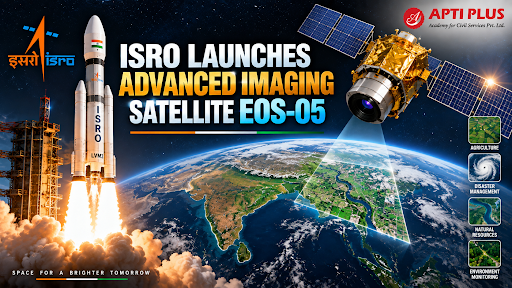
The Indian Space Research Organisation (ISRO) successfully launched the Satellite EOS-05 on September 4, 2026, using the GSLV-F17 rocket from the Satish Dhawan Space Centre in Sriharikota.
About EOS-05 Satellite
EOS-05 (also known as GISAT-1A) is a geo-imaging Earth observation satellite designed to operate from a geosynchronous orbit at an altitude of roughly 36,000 kilometers.
Key Details
-
Launch Date: September 4, 2026
-
Launch Vehicle: GSLV-F17 (19th flight of the GSLV)
-
Orbit: Sub-Geosynchronous Transfer Orbit (Sub-GTO) / Geosynchronous orbit (36,000 km altitude)
-
Weight: 2,367 kg (the heaviest payload ever carried by a GSLV)
-
Significance: Marked the end of an eight-month launch lull for ISRO following earlier setbacks.

Capabilities & Objectives
-
Geostationary Eye in the Sky: EOS-05 is India’s first dedicated Earth observation spacecraft stationed in 36,000-km geostationary orbit.
-
Persistent 24x7 Real-Time Surveillance: Transits from periodic Low Earth Orbit passes to continuous scanning, imaging the entire Indian subcontinent every 30 minutes.
-
Advanced Imaging: Features high-resolution, multispectral, and hyperspectral optics supporting agriculture, forecasting, soil analysis, and Indian Ocean maritime surveillance.
-
Strategic and Disaster Capabilities: Delivers 5-minute rapid-scan imaging during cyclones, floods, and military movements along borders and the Indian Ocean.
Strategic and Socio-Economic Applications
-
Real-Time Disaster Management: Tracks cyclone landfall trajectories, cloudbursts, glacial lake outbursts, and forest fires with zero time-lag.
-
National Security & Maritime Domain Awareness: Monitors tactical troop buildups along the LAC/LoC and tracks naval merchant traffic across the Indian Ocean Region.
Precision Agriculture & Crop Assessment: Provides daily soil moisture indices, vegetative vigor metrics, and drought stress estimates under Pradhan Mantri Fasal Bima Yojana (PMFBY).
-
Hydrological and Oceanographic Mapping: Monitors Himalayan snowmelt runoff, reservoir storage volumes, and marine chlorophyll patterns for fishing fleets.
-
Spatial Governance (PM GatiShakti Integration): Streams high-refresh geospatial layers into the National Master Plan portal for multimodal infrastructure execution.
About Geosynchronous Satellite Launch Vehicle (GSLV)
It is India's fourth-generation, three-stage launch vehicle developed by ISRO to place heavier payloads—primarily communication and advanced geostationary satellites—into the Geosynchronous Transfer Orbit (GTO).
Key Features & Three Stages of GSLV
-
First Stage (Solid): Uses a solid rocket motor combined with four liquid strap-on engines (Vikas engine variant) to provide the massive initial lift-off thrust.
-
Second Stage (Liquid): Employs a high-thrust hypergolic liquid propellant system using an improved Vikas engine.
-
Third Stage (Cryogenic): Features an indigenously developed cryogenic upper stage using super-cooled liquid hydrogen (LH₂) as fuel and liquid oxygen (LOX) as oxidizer, giving it high thrust efficiency for high-altitude orbital placement.
Major Applications & Significance
-
Communication & Navigation: Primarily deployed for INSAT and GSAT communication series, alongside NavIC navigation satellites (NVS series).
-
Geosynchronous Earth Observation: Used for specialized geostationary imaging and Earth observation missions like the recent GSLV-F17 carrying EOS-05.
-
Strategic Space Diplomacy: Famously used for missions like the South Asia Satellite (GSAT-9) to aid neighboring nations.
PSLV vs GSLV
-
PSLV (Polar Satellite Launch Vehicle): Four-stage alternating solid/liquid system; designed for Low Earth Orbit (LEO) or Sun-synchronous Polar Orbits (SSO); acts as ISRO's reliable workhorse for remote-sensing and Earth resource monitoring.
-
GSLV (Geosynchronous Satellite Launch Vehicle): Three-stage solid/liquid/cryogenic system; designed for heavy payloads into high-altitude Geostationary/Geosynchronous Transfer Orbits (36,000 km altitude).

Source: THEHINDU
|
PRACTICE QUESTION Q. In the Geosynchronous Satellite Launch Vehicle (GSLV Mk II), which propellants are utilized in the indigenous Cryogenic Upper Stage (CUS)? (a) Liquid Oxygen (LOX) and Liquid Hydrogen (LH2) (b) Unsymmetrical Dimethylhydrazine (UDMH) and Nitrogen Tetroxide (N2O4) (c) Hydroxyl-Terminated Polybutadiene (HTPB) and Liquid Oxygen (d) Liquid Methane and Liquid Oxygen Answer: (a) Explanation: The CE-7.5 cryogenic upper stage uses liquid hydrogen (LH2) as fuel at -253°C and liquid oxygen (LOX) as oxidizer at -183°C. |