Why In News?
The Ministry of Jal Shakti reviewed the progress of the Jal Sanchay Jan Bhagidari (JSJB) initiative.
What is the Jal Sanchay Jan Bhagidari (JSJB) Initiative?
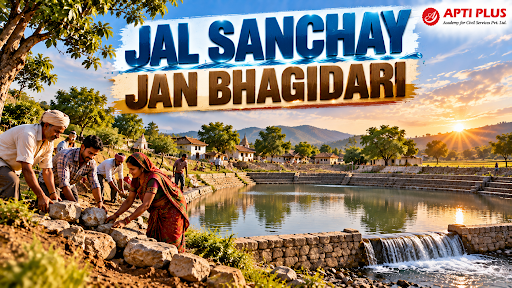
It is a community-driven water conservation program launched by the Union Government in 2024 to boost groundwater recharge and improve local water security.
Key Features and Objectives
-
Core Goal: Promote the construction of low-cost artificial groundwater recharge and storage structures, revive defunct borewells, and harvest rainwater.
-
The 3Cs Mantra: Guided by Community participation, Corporate Social Responsibility (CSR) funding, and optimized Cost.
-
Whole-of-Society Approach: Combines efforts from government bodies, local citizens, industries, NGOs, and resident groups.
-
Nodal Ministry: Implemented under the Ministry of Jal Shakti as part of the Jal Shakti Abhiyan: Catch the Rain campaign
Impact and Progress
-
JSJB 1.0: Surpassed its initial target of 10 lakh structures, reporting over 27 lakh artificial recharge structures built by mid-2025.
-
Scale-Up: Subsequent phases scaled rapidly, with over 1.58 crore structures completed nationwide by September 2026.
-
Local Action: Villages across states like Andhra Pradesh, Telangana, and Rajasthan have adopted community water budgeting, traditional tanka revivals, and local watershed planning.
What are the Major Interventions and Engineering Solutions under JSJB?
Specialized artificial groundwater recharge shafts are being drilled into unconfined shallow aquifers to bypass impermeable surface layers.
The initiative focuses on retrofitting and reviving defunct agricultural tube-wells to serve as reverse water filtration systems.
Modular rooftop rainwater harvesting filters are being rapidly installed across public buildings and rural households to augment supply.
Physical infrastructure includes community check dams, silt detention basins, and village percolation pits designed for local topographies.
Modern monitoring involves geo-tagging and satellite spatial mapping for real-time asset monitoring and performance evaluation.
Source: PIB
|
PRACTICE QUESTION Q. With reference to the 'Jal Sanchay Jan Bhagidari' (JSJB) initiative, consider the following statements: 1. It is a community-driven initiative under the Ministry of Jal Shakti focused on artificial groundwater recharge. 2. The '3Cs' framework refers to Climate, Conservation, and Cooperation. 3. It has been integrated with the 'Catch the Rain' campaign. Which of the statements given above are correct? (a) 1 and 2 only (b) 2 and 3 only (c) 1 and 3 only (d) 1, 2, and 3 Answer: (c) Explanation: Statement 1 is correct: The Jal Sanchay Jan Bhagidari (JSJB) initiative was launched by the Ministry of Jal Shakti to mobilize community participation and ownership (Jan Bhagidari) in constructing low-cost artificial groundwater recharge and water storage structures, reviving defunct borewells, and harvesting rainwater. Statement 2 is incorrect: The '3Cs' framework guiding the JSJB initiative stands for Community, Corporate Social Responsibility (CSR), and Cost (focusing on low-cost, community-led, and sustainably financed interventions), not Climate, Conservation, and Cooperation. Statement 3 is correct: The initiative operates under and has been integrated with the broader umbrella of the Jal Shakti Abhiyan: 'Catch the Rain' (JSA: CTR) campaign to create a mass movement (Jan Andolan) for water security. |