Why In News?
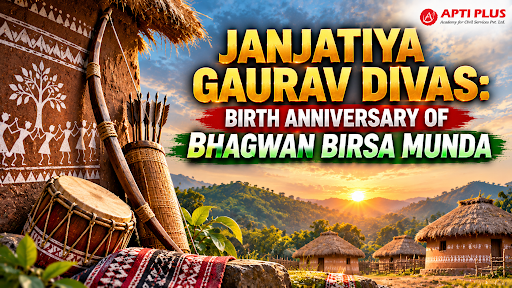
Janjatiya Gaurav Divas is observed across India on November 15 to honor the birth anniversary of tribal freedom fighter Bhagwan Birsa Munda.
About Janjatiya Gaurav Divas
Janjatiya Gaurav Divas (Tribal Pride Day) is celebrated annually in India on November 15.
-
Origin: Officially declared the day in 2021 (by the Union Cabinet) to honor the history, valor, and cultural heritage of India's tribal communities.
-
Significance: The date marks the birth anniversary of Bhagwan Birsa Munda, the iconic tribal leader and freedom fighter who spearheaded the Ulgulan (revolution) against British colonial oppression.
Who Was Birsa Munda?
Birsa Munda (1875–1900) was a tribal leader, folk hero, and freedom fighter from the Munda tribe of the Chhotanagpur plateau (modern-day Jharkhand) who spearheaded a major anti-colonial and agrarian uprising known as the Ulgulan (Great Tumult).
-
Birth & Early Life: Born on November 15, 1875, in Ulihatu (Khunti district, Jharkhand). He briefly attended a German Mission School before leaving due to missionaries' criticisms of traditional tribal culture.
-
Religious & Social Reform (The Birsait Faith):
-
Founded the Birsait sect, promoting monotheism (belief in Singhbonga or one God) and blending elements of tribal belief with moral discipline.
-
Advocated against alcoholism, superstitions, cow slaughter, and forced/unpaid labor (beth begari).
-
Earned the title Dharti Aaba (Father of the Earth) and was venerated as Bhagwan (God) by his followers.
Munda Rebellion (Ulgulan, 1899–1900)
The Munda Rebellion, also known as Ulgulan (the "Great Tumult"), was a major tribal uprising led by Birsa Munda from 1899 to 1900 in the Chotanagpur Plateau (present-day Jharkhand, centered around Ranchi, Khunti, and Singhbhum).
Key Causes
-
Loss of Land Rights: The British colonial administration disrupted the traditional Khuntkatti (collective clan landholding) system, turning indigenous cultivators into rent-paying tenants.
-
Exploitation by Outsiders (Dikus): Zamindars, jagirdars, thikadars, and moneylenders encroached on ancestral lands.
-
Forced Labor (Beth Begari): Tribals were subjected to unremunerated, forced labor and heavy rents.
-
Cultural & Religious Interference: The erosion of traditional customs alongside the pressure from colonial laws and missionaries.
Major Events and Course of the Revolt
-
Leadership & Awakening: Birsa Munda—revered as Dharti Aaba (Father of the Earth)—united the Munda, Oraon, and Kharia communities. He gave the rallying cry: “Abua Raj Ete Jana, Maharani Raj Tundu Jana” ("Let the queen’s kingdom end and our kingdom be established").
-
Militant Phase: On Christmas Eve in 1899, Birsa mobilized thousands of tribal warriors armed with traditional weapons to attack police stations, government offices, churches, and landlords.
-
Battle of Dombari Buru (Hill): A major armed confrontation took place where British forces opened fire, causing heavy casualties among the tribals.
-
Capture and Death: Birsa Munda was captured by the British in February/March 1900 and died in Ranchi Jail on June 9, 1900, officially reported due to cholera (though widely believed by contemporaries to have been poisoned).
Outcomes and Significance
-
Chotanagpur Tenancy Act (1908): In direct response to the uprising, the British passed the Chotanagpur Tenancy Act (CNT Act) of 1908, which legally recognized Khuntkatti rights, restricted the transfer of tribal land to non-tribals, and banned the beth-begari forced labor system.
-
Abolition of Forced Labor: The compulsory begar system was officially ended in the affected regions.
-
Symbol of Tribal Resistance: Birsa Munda and the Ulgulan became a foundational inspiration for India's freedom struggle and tribal identity rights.
Birsa Munda's legacy
-
Protection of Tribal Land Rights: His resistance directly forced colonial authorities to enact the Chota Nagpur Tenancy Act of 1908, which legally restricted the transfer of tribal land to non-tribals.
-
Spiritual & Social Reform: He founded the Birsait faith, uniting Munda traditions with social reform, urging communities to reject alcoholism, superstition, and forced religious conversions.
-
National Recognition: His birth anniversary on November 15 is celebrated nationwide as Janjatiya Gaurav Divas (Honouring Tribal Pride Day), which also coincides with the foundation day of Jharkhand.
-
Modern Development Schemes: His vision continues to inspire government welfare and empowerment initiatives targeted at indigenous communities, such as the PM-JANMAN Yojana and the Dharti Aaba Janjatiya Gram Utkarsh Abhiyan.
-
Public Memorials: His name and memory are honored across India through infrastructure like the Birsa Munda Airport in Ranchi and numerous national memorials.
Source: NEWSONAIR
|
PRACTICE QUESTION Q. Consider the following statements: Statement-I: The Ulgulan movement of 1899-1900 was led by Birsa Munda in the region south of Ranchi. Statement-II: The Chhotanagpur Tenancy Act, 1908 allowed free transfer of tribal land to non-tribals. Which one of the following is correct in respect of the above statements? (a) Both Statement-I and Statement-II are correct and Statement-II explains Statement-I (b) Both Statement-I and Statement-II are correct, but Statement-II does not explain Statement-I (c) Statement-I is correct, but Statement-II is incorrect (d) Statement-I is incorrect, but Statement-II is correct Answer: (c) Explanation: Statement-I is correct: The Ulgulan (Great Tumult) movement of 1899–1900 was led by Birsa Munda in the region south of Ranchi (Chotanagpur area) against British policies and the erosion of the traditional khuntkatti land system by outsiders (dikus). Statement-II is incorrect: The Chhotanagpur Tenancy Act, 1908 did not allow the free transfer of tribal land to non-tribals. In fact, it did the exact opposite: it restricted and prohibited the transfer of tribal/Adivasi land to non-tribal buyers to protect indigenous land rights. |