Why In News?
Japan's Sakurajima Volcano recently blasted a thick plume of volcanic ash into the sky above Kagoshima Bay.
About Sakurajima Volcano
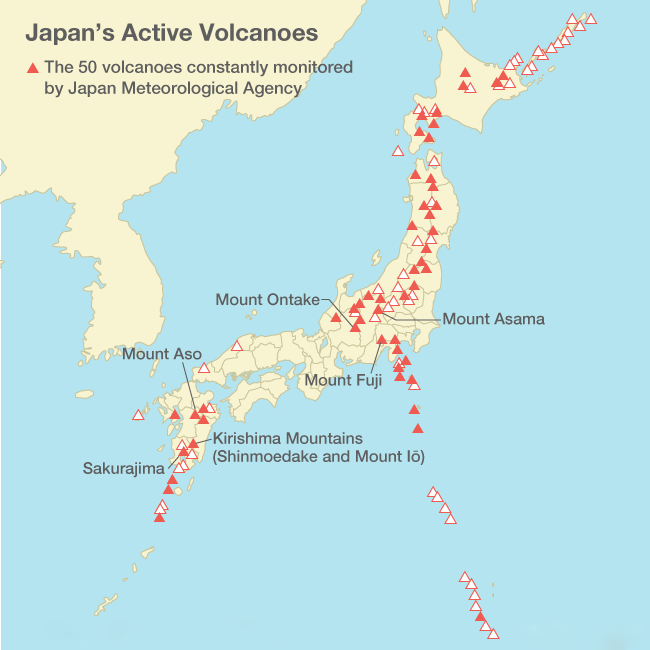
● It is an active stratovolcano located on the southern tip of Kyushu Island in Kagoshima Prefecture, southern Japan.
○ It sits in Kagoshima Bay (Kinkowan Bay) on the southern edge of the Aira Caldera.
○ It lies approximately 4 to 8 km across the water from the major city of Kagoshima, making it one of the most closely monitored volcanoes in the world.
● Type of Volcano: Stratovolcano (composite volcano) characterized by a steep cone-shaped profile built from alternating layers of hardened lava and ash.
● Tectonic Setting: Located on a convergent plate boundary (part of the Pacific Ring of Fire) where the Philippine Sea Plate / Pacific Plate subducts beneath the Eurasian Plate.
● Magma Composition: Andesitic to dacitic magma, which has a high silica/gas content and high viscosity, leading to explosive and Strombolian-type eruptions.
● Peaks: Composed of two principal peaks:
● Kitadake (Northern Peak): Older and currently inactive (last erupted roughly 4,850 years ago).
● Minamidake (Southern Peak): Younger and currently active, which is the source of modern regular eruptions.
● Island to Peninsula: Originally an island in Kagoshima Bay, it became connected to the Osumi Peninsula (mainland) following a major, catastrophic eruption and associated lava flows in 1914.
● Eruption Character: It is one of Japan's most active volcanoes, frequently producing Strombolian eruptions, ash plumes, and volcanic bombs on a regular basis.
Source: REUTERSCONNECT
|
PRACTICE QUESTION Q. With reference to Sakurajima Volcano, consider the following statements:
Which of the statements given above are correct? (a) 1 and 2 only (b) 2 and 3 only (c) 1 and 3 only (d) 1, 2, and 3 Answer: (a) Explanation: Statement 1 is correct: Sakurajima is an andesitic stratovolcano (composite volcano) situated on a convergent plate margin, where the Philippine Sea plate subducts beneath the Eurasian plate. Statement 2 is correct: It was originally a volcanic island located in Kagoshima Bay. During the colossal Taisho eruption in 1914, massive lava flows filled the narrow strait, connecting the island permanently to the Osumi Peninsula on the mainland. Statement 3 is incorrect: The statement has the peaks reversed. The northern peak, Kitadake, is the older peak and is currently inactive/dormant (its activity ended around 4,900 years ago). The southern peak, Minamidake, is the younger peak and is highly active today, exhibiting frequent daily eruptions. |