Why In News?
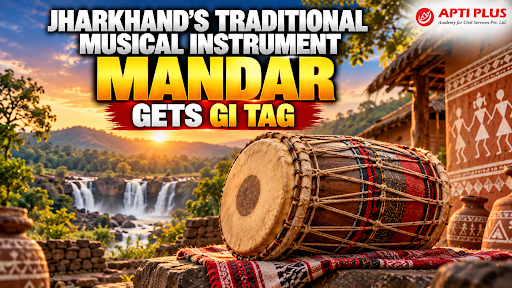
The Geographical Indications Registry under the Department for Promotion of Industry and Internal Trade (DPIIT) has granted the Geographical Indication (GI) Tag to Mandar.
What is Mandar?
Traditional Folk Musical Instrument: An ancient two-sided percussion drum (classified as an Avanaddha Vadya or membranophone) native to the Chota Nagpur plateau.
Jharkhand Tribal Culture: Serves as the cultural heartbeat of indigenous tribal communities, including the Santhal, Munda, Oraon, Ho, and Kharia, accompanying social gatherings, agrarian rites, and spiritual assemblies.
Folk Music and Dance: Centerpiece for traditional tribal dance forms such as Jhumair, Paika, Domkach, and Chhau, and central to harvest and spring festivals like Sarhul, Karma, Sohrai, and Mage Parab.
Indigenous Craftsmanship: Handcrafted using specialized ancestral knowledge handed down across generations, requiring intricate balancing of shell acoustics, hide tensioning, and natural tuning pastes.
Distinctive Sound: Emits a deep, resonant, and earthy acoustic timbre capable of carrying rhythms over vast forest terrains and open village akharas.
What Makes Mandar Unique?
Locally Sourced Red Clay: Unlike conventional wooden percussion drums, the hollow barrel-shaped body of the authentic Jharkhand Mandar is sculpted from locally sourced, alluvial red and black clays fired using indigenous kilns to achieve optimal acoustic resonance.
Traditional Manufacturing Techniques: Fired clay shell is carefully covered and bound with cured animal parchment (goat and cattle hides) secured using hand-twisted leather braiding (chaddar or badhi) running across the body.
Indigenous Craft Skills: Involves a delicate balance between unequal drumhead diameters; the left head (bass) is broader, while the right head (treble) is narrower, each tuned to complementary pitch intervals.
Acoustic Tuning Paste: Treble drum face is treated with a specialized black circular tuning paste (locally known as Kharan or Syahi), traditionally concocted from iron slag, cooked rice, and herbal extracts to create sustained acoustic harmonics.
Cultural Association: Revered as a sacred socio-cultural artifact; in tribal belief systems, playing the Mandar is an invocation of ancestral spirits and an expression of community harmony.

What is a GI Tag?
Geographical Indication: A sign used on goods that have a specific geographical origin and possess qualities, reputation, or characteristics attributable to that place of origin.
Place-Linked Product Identity: Validates the symbiotic relationship between regional raw materials, micro-climates, and traditional community artisan techniques.
Legal Protection: Conferred under the statutory provisions of the Geographical Indications of Goods (Registration and Protection) Act, 1999, administered by the Controller General of Patents, Designs and Trade Marks.
Prevention of Misuse: Confers exclusive commercial rights upon authorized users, legally prohibiting unauthorized commercial exploitation, counterfeit production, and geographical misrepresentation under penal law.
Intellectual Property Right: Operates as a collective intellectual property right conforming with the WTO's Agreement on Trade-Related Aspects of Intellectual Property Rights (TRIPS), valid initially for 10 years with periodic renewal provisions.
What are the Benefits of the GI Tag?
-
Artisan Recognition: Grants formal recognition to indigenous tribal potters and leather craftsmen (Kumhars and Ghasis).
-
Market Identity: Distinguishes authentic clay Mandars from synthetic fiberglass alternatives.
-
Better Market Access: Improves bargaining power, allowing direct sales to cultural troupes, academies, and institutions.
-
Protection of Traditional Knowledge: Safeguards ancestral craftsmanship against biopiracy and unauthorized industrial imitation.
-
Rural Livelihoods: Increases incomes in craft clusters like Ranchi, Gumla, Dumka, and Khunti, curbing seasonal migration.
-
Cultural Preservation: Sustains Jharkhand's living tribal heritage by engaging youth in percussion arts.
-
Export Opportunities: Boosts global visibility and diaspora sales via international expos and fair-trade networks.

Source: NEWSONAIR
|
PRACTICE QUESTION Q. With reference to the traditional musical instrument 'Mandar' and Geographical Indications, consider the following statements: 1. Mandar is an indigenous membranophone whose authentic body is traditionally crafted from fired clay. 2. It is predominantly associated with the tribal festivals and folk dances of the Chota Nagpur plateau region. 3. Geographical Indications in India are granted and regulated under the Copyright Act, 1957 by the Ministry of Culture. Which of the statements given above is/are correct? (a) 1 and 2 only (b) 2 and 3 only (c) 1 and 3 only (d) 1, 2 and 3 Answer: (a) Explanation: Statement 1 is correct: The Mandar (or Mandar of Jharkhand) is a traditional double-headed membranophone (percussion instrument). Its authentic hollow barrel body is uniquely crafted from locally sourced fired red clay (soil) and covered with leather on both ends. Statement 2 is correct: It is the oldest and most prominent folk drum deeply rooted in the cultural life, tribal festivals (like Sarhul and Karma), and traditional community dances of the Chota Nagpur plateau region (primarily Jharkhand). It was recently granted a Geographical Indication (GI) tag. Statement 3 is incorrect: Geographical Indications in India are governed and regulated under the Geographical Indications of Goods (Registration and Protection) Act, 1999 (not the Copyright Act, 1957). Furthermore, they are administered by the Geographical Indications Registry (Chennai) under the Controller General of Patents, Designs and Trade Marks, which falls under the Ministry of Commerce and Industry. |