Why In News?
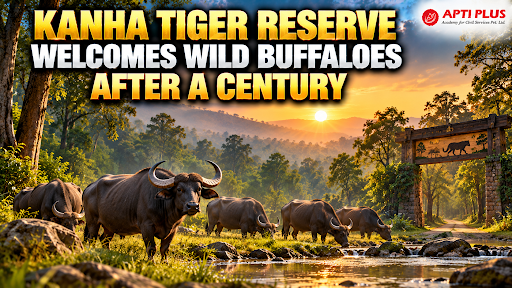
Madhya Pradesh's Chief Minister released eight Asiatic wild water buffaloes in Kanha Tiger Reserve's Supkhar range, reversing their nearly century-long local extinction.
About Wild Water Buffalo
-
Classification: First described as Bos arnee by Robert Kerr in 1792, and placed under the genus Bubalus by Charles Hamilton Smith in 1827.
-
Etymology: The specific epithet arnee derives from the classical Sanskrit word arnī, meaning female wild buffalo. It is designated as the official State Animal of Chhattisgarh.
-
Genetic Progenitor: It is the direct wild ancestor/progenitor of the domestic water buffalo (Bubalus bubalis).
Physical Traits
-
Body Mass & Size: Weighs between 600 kg and 1,200 kg, with a head-to-body length of 240 cm to 300 cm, a shoulder height of 150 cm to 190 cm, and a tail length of 60 cm to 100 cm. It is among the heaviest living bovid species, slightly smaller than the Gaur.
-
Horn Configuration: Both sexes carry massive, backward-curving crescent horns spreading up to 2 metres along the outer edges—the widest horn span among all living bovids.
-
Pelage & Hooves: Ash-gray to black skin covered with sparse, forward-directed hair, a narrow head with small ears, and large, splayed hooves adapted for muddy terrain.
Habitat, Diet & Ecological Role
-
Habitat Preferences: Inhabits low-lying alluvial grasslands, riparian marshes, terai swamps, and river floodplains.
-
Foraging Profile: A generalist bulk grazer feeding primarily on graminoids and coarse tall grasses (such as Themeda triandra, Saccharum spontaneum, and Bothriochloa), sedges (Cyperus), and invasive alien flora like water hyacinth (Eichhornia crassipes) and Mikania micrantha.
-
Ecosystem Engineer: Wallowing behavior creates seasonal wetlands and microhabitats for aquatic species and the Barasingha.
-
Bulk grazing curbs coarse grass dominance, opening forage niches for smaller ungulates like Chital, while its dung enriches soil seed banks and carcasses sustain scavengers like vultures.
Population Profile
-
Global Population: Global mature population of fewer than 4,000 individuals.
-
Distribution in India: Over 90% (roughly 99%) of the global population resides in India, primarily concentrated in Assam (Kaziranga National Park, Manas National Park, Dibru-Saikhowa National Park, Laokhowa Wildlife Sanctuary, and Bura Chapori Wildlife Sanctuary), alongside small pockets in Arunachal Pradesh (D'Ering Memorial WS) and Meghalaya (Balphakram NP).
-
Central Indian Landscape Collapse: Central India's population collapsed to fewer than 50 individuals across isolated patches in Chhattisgarh (Indravati Tiger Reserve, Udanti-Sitanadi Tiger Reserve, and Pamed Wildlife Sanctuary). Udanti-Sitanadi's wild herd dwindled to a single pure female ('Asha') before her death.
Protection Status
-
IUCN Status: Endangered.
-
Wildlife (Protection) Act, 1972: Accorded highest legal protection under Schedule I.
-
CITES: Listed under Appendix III.
About Kanha National Park
-
Location: Situated in the Maikal ranges of the Satpuras across Mandla and Balaghat districts of Madhya Pradesh.
-
Topography: Drained by the Banjar and Halon rivers (key tributaries of the Narmada River basin). Topography features forested shallow undulations, hills, plateau highlands (dadars), and central meadows (maidans).
-
Corridors: Serves as a key source population for tigers and links with Pench Tiger Reserve and Achanakmar Tiger Reserve.
Flora & Vegetation Composition
-
Forest Types: Lowland forests feature a mixture of Sal (Shorea robusta) and mixed species. Highland forests consist of tropical moist/dry deciduous stands with bamboo (Dendrocalamus strictus) on slopes and Indian ghost tree (Sterculia urens).
-
Floristic Species Richness: Contains approximately 850 angiosperm species (across 506 genera and 134 families), 22 pteridophyte species, 50 aquatic plant species, and 18 rare plant species.
-
Central Grasslands (Maidans): Formed on historical relocated village sites, these grasslands are actively maintained through controlled burning, rotational grazing, and weed eradication.
Faunal Diversity & Flagship Species
-
Mammalian Guild: Hosts source populations of the Bengal Tiger (Panthera tigris), Indian Leopard (Panthera pardus), Dhole / Wild Dog (Cuon alpinus), Sloth Bear (Melursus ursinus), Gaur (Bos gaurus), Chital (Axis axis), Sambar (Rusa unicolor), Four-horned Antelope (Tetracerus quadricornis), Nilgai, and Wild Pig.
-
Avifauna: Supports over 300 bird species (including the Malabar Pied Hornbill, Crested Serpent Eagle, and Lesser Adjutant).
Achievements
-
First Official Mascot: First tiger reserve in India to officially launch an official mascot, "Bhoorsingh the Barasingha".
-
Hardground Barasingha Resurrection: Saved the world's last surviving population of the endemic Hardground Barasingha (Rucervus duvaucelii branderi), recovering numbers from fewer than 66 individuals in 1970 to over 800 individuals through predator-proof breeding exclosures.
Source: THEHINDU
|
PRACTICE QUESTION Q. With reference to the Wild Water Buffalo (Bubalus arnee), consider the following statements:
Which of the statements given above are correct? (a) 1 and 2 only (b) 1 and 3 only (c) 2 and 3 only (d) 1, 2, and 3 Answer: (b) Explanation: Statement 1 is correct: The Wild Water Buffalo (Bubalus arnee) has been classified as Endangered on the IUCN Red List of Threatened Species since 1986 due to a severe decline in population, loss of wetland habitat, and interbreeding/hybridization with domestic water buffaloes. Statement 2 is incorrect: It is designated as the official state animal of Chhattisgarh (locally called Van Bhainsa), not Madhya Pradesh. The state animal of Madhya Pradesh is the Barasingha (Swamp Deer). Statement 3 is correct: Assam harbors the vast majority of the world's remaining wild water buffaloes, with Kaziranga National Park holding the single largest surviving global population of the species. |