Why In News?
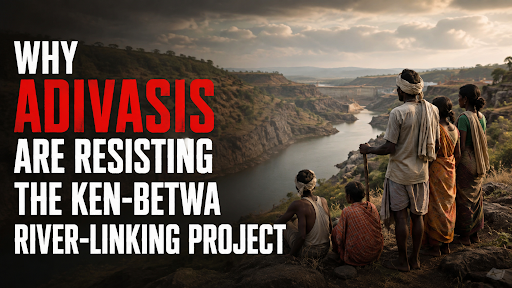
Adivasis resist the Ken-Betwa river-linking project as land submergence and forest loss threaten ancestral territories and livelihoods.
What is the Ken-Betwa Link Project?
-
It is India's first river interlinking project, transferring surplus water from the Ken River (source basin) to the Betwa River (recipient basin), both tributaries of the Yamuna.
-
The project is the pilot scheme under the National Perspective Plan (1980), prepared by the National Water Development Agency (established 1982), and covers the Peninsular Rivers Development component.
-
Its centrepiece is the Daudhan Dam, roughly 77 metres high and about 2 km long, built on the Ken River inside the Panna Tiger Reserve, designed to store around 2,853 million cubic metres of water.
-
A link canal of about 221 km, including tunnels, carries water from the Ken basin into the Betwa basin.
-
The Union Cabinet approved the project in December 2021, at an estimated cost of ₹44,605 crore, to be implemented through a Special Purpose Vehicle, the Ken-Betwa Link Project Authority (KBLPA).
-
It targets Bundelkhand's water security, spanning 10 districts of Madhya Pradesh and 4 districts of Uttar Pradesh.

Significance of the Project
-
Irrigation: The project aims to provide annual irrigation to about 10.62 lakh hectares of drought-prone farmland.
-
Drinking water security: It is designed to supply 194 million cubic metres (MCM) of drinking water annually to about 62 lakh people across both states.
-
Power generation: The project will generate 103 MW of hydropower and 27 MW of solar power.
-
Agricultural productivity: Assured canal irrigation is expected to reduce dependence on erratic monsoon rainfall in Bundelkhand, a region long associated with farmer distress and seasonal migration.
-
Regional development: The scheme is projected as a template for 29 further river links planned across India, making its outcome nationally significant.
What are the Major Concerns of Adivasis?
-
Loss of ancestral land: The Daudhan Dam alone is set to displace 5,288 families in Chhatarpur and 1,400 families in Panna district — a total of 7,193 families across 22 villages.
-
Displacement without adequate rehabilitation: Tribal residents at Dhondhan and Palkoha villages allege forced relocation and demolitions carried out during the monsoon, before verification and compensation were finalised.
-
Compensation disputes: Protesters allege gender disparity in payouts and irregularities in compensation disbursal, demanding individual family compensation of ₹12.5 lakh.
-
Loss of livelihoods: Communities depend on forest produce and rain-fed farming; displacement threatens both without assured alternative livelihoods.
-
Cultural disruption: Villages like Dhondhan have centuries-old tribal settlements, and displacement risks breaking community and cultural continuity.
-
The project is expected to primarily benefit farmers in Uttar Pradesh, while tribal residents of the submergence zone in Madhya Pradesh are not direct beneficiaries, deepening the sense of inequity.
Tribal Rights Framework
|
Development vs Conservation Debate
Infrastructure vs Livelihoods: Large dams can expand irrigation and drinking-water access, but displacement can disrupt land, MFP, grazing, fishing and community forest rights recognised under FRA.
National Benefits vs Local Costs: Irrigation and water benefits may spread across multiple districts, while displacement, forest diversion and livelihood losses remain concentrated around project-affected villages, creating an equity dilemma.
Development vs Rights: FRA recognises habitation, cultivation, grazing, MFP and community forest-resource rights, requiring development planning to account for more than monetary land compensation.
Gram Sabha: FRA makes the Gram Sabha the authority for initiating and verifying forest-right claims, making genuine community participation central to project decisions affecting forest-dependent communities.
Conservation Governance: FRA Section 5 empowers Gram Sabhas to protect forests, biodiversity, catchments and water sources, linking tribal participation with ecological conservation rather than treating communities only as beneficiaries.
Rehabilitation First: Forest-dependent communities should not face displacement without rights recognition, rehabilitation and livelihood restoration; FRA explicitly links forest rights with protection against unlawful eviction.
The objective should be “development with rights + rehabilitation before displacement + ecological safeguards + genuine Gram Sabha participation”, rather than treating conservation and development as mutually exclusive.
What Alternatives Can Complement River Linking?
|
Way Forward
Rights-Based Rehabilitation: Implement individual, asset-based compensation and livelihood restoration, covering landowners, landless workers and forest-dependent households under the RFCTLARR framework.
Gram Sabha Consent: Ensure Gram Sabha participation and recognition of forest rights before displacement or forest diversion, particularly in Scheduled Areas and FRA-covered villages.
Independent SIA: Make Social Impact Assessment evidence-based, covering livelihoods, common property, grazing land, water sources, schools and community infrastructure.
Alternatives First: Compare smaller reservoirs, demand management, watershed development and local water-storage options before accepting large-scale displacement.
Ecological Restoration: Treat compensatory afforestation as ecosystem restoration, with species diversity, habitat connectivity and survival monitoring rather than plantation targets alone.
Wildlife Protection: Where critical habitats are affected, integrate wildlife-clearance conditions, habitat restoration and landscape-level mitigation into the project design before construction.
Resettlement Quality: Make rehabilitation measurable through housing, drinking water, roads, schools, healthcare and livelihood indicators, with time-bound implementation and Gram Sabha review.
Independent Monitoring: Establish a multi-stakeholder monitoring mechanism involving affected communities, district administration, independent experts and project authorities.
Benefit Sharing: Link affected villages with irrigation, drinking-water, fisheries, employment and local infrastructure benefits, ensuring displaced communities become beneficiaries rather than merely project-affected persons.
No-Go Principle: Avoid irreversible displacement where ecological costs, livelihood losses and social disruption substantially outweigh demonstrable water-security gains, applying the least-displacement principle.
Conclusion
The Ken-Betwa Link Project shows that sustainable development demands ecological caution and social justice alongside infrastructural ambition.
Source: THEHINDU
|
PRACTICE QUESTION Q. Examine the ecological implications of locating a major dam within a tiger reserve, with reference to the Ken-Betwa Link Project. Suggest measures to balance river-interlinking initiatives with biodiversity conservation. (250 words) |