Why In News?
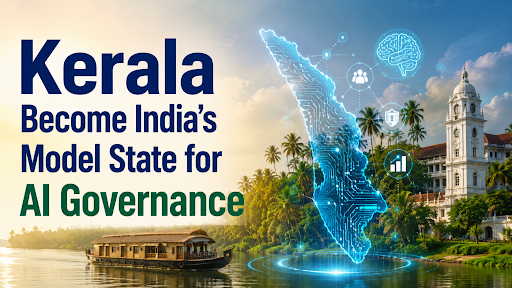
Kerala launched an AI-led governance initiative, introducing AI-assisted administration, digital public service delivery, faster land acquisition, and integrated planning systems.
What is AI Governance?
AI governance is the system of laws, institutions, standards and accountability mechanisms that governs how AI is developed, deployed and monitored, particularly where automated decisions affect citizens.
Core Principles
Safety & risk management: High-impact AI should undergo risk assessment, testing, monitoring and human override before deployment.
Fairness: AI systems must prevent algorithmic discrimination based on gender, caste, disability, language or socio-economic status.
Human oversight: Critical decisions should retain meaningful human review rather than becoming fully automated.
Transparency: Citizens should know when AI is being used and, where feasible, understand the basis of consequential decisions.
Accountability: Responsibility must remain traceable to a department, official or deploying institution even when an AI system makes an error.
Privacy & data governance: AI deployment must follow purpose limitation, data minimisation, security and lawful processing principles.
Auditability: High-risk systems require continuous impact assessment, independent audits and grievance mechanisms.
Applications of AI in Governance
Policy & Decision-making: NITI Aayog uses an AI tool developed by IIT-Delhi to predict socio-economic trends.
Public Service Delivery: Bhashini delivers services in multiple regional languages; DigiLocker uses AI for document verification.
Law Enforcement: Delhi Police's Facial Recognition System (FRS) aids in solving crimes and finding missing persons, though it raises privacy concerns; RBI's MuleHunter.ai detects mule accounts used in financial fraud.
Healthcare: Niramai (Bengaluru startup) uses machine learning for early breast cancer detection; Ayushman Bharat Digital Mission (ABDM) enables AI-driven health research.
Agriculture: Kisan e-Mitra chatbot assists farmers with PM-KISAN queries in 11 languages; National Pest Surveillance System (NPSS) enables early infestation detection.
Justice Delivery: Supreme Court's SUPACE assists judges with AI-powered legal research.
Urban Governance: Bengaluru's Adaptive Traffic Control System (ATCS) manages traffic flow automatically.
What is the Kerala AI Mission (K-AIM)?
K-AIM is Kerala's dedicated mission to implement AI across administration and public service delivery.
K-AI Initiative: A flagship platform uniting government, innovators, startups, and researchers for public-good AI projects.
VidyAI Program: A "Smart Officers, Smarter Governance" initiative training officials to use Generative AI tools (ChatGPT, Gemini, Copilot) in daily administrative work.
e-Sevanam portal: Already digitises 900+ citizen services, forming the service-delivery backbone onto which AI capabilities are layered.
Kerala Fibre Optic Network (KFON): Delivers high-speed connectivity as a right to every household — the infrastructural precondition for AI-led governance to actually reach citizens.
2031 Vision: Positions Kerala as a global AI hub and complete knowledge economy, targeting fully paperless governance by December 2026.
Why Can Kerala Become a Model?
Strong Human Development Indicators: Kerala consistently tops India in literacy, health, and social development indices, providing a receptive population base for tech-driven governance.
High Digital Literacy: A legacy digital ecosystem dating to Kerala's 1990s IT revolution, including ICFOSS (International Centre for Free and Open Source Solutions).
Decentralised Governance: Kerala's strong panchayati raj tradition provides institutional depth for AI rollout to reach the grassroots, not just state capitals.
Existing Innovation Infrastructure: Kerala Startup Mission (KSUM) is ranked the World's No. 1 Public Business Accelerator, supporting 4,000+ startups across 63+ incubators.
Dedicated Institutional Architecture: Maker Village (India's largest hardware deep-tech incubator) and the upcoming Digital Science Park, Thiruvananthapuram, give Kerala technical R&D depth most states lack.
First-mover political commitment: The cabinet-level AI portfolio signals sustained political ownership, addressing the common governance risk of tech initiatives losing priority after launch.
Challenges Related to AI Governance
Job Displacement: World Economic Forum projected AI could displace 75 million jobs in India by 2025; Nasscom found only 17% of the current workforce has AI-era skills; TCS laid off 12,000 employees, citing skill mismatch.
Algorithmic Bias: AI trained on historically biased data amplifies discrimination — Uttar Pradesh's Trinetra platform was criticised for marking Dalit-majority villages "high-risk" based on discriminatory Criminal Tribes Act-era data.
Privacy and Surveillance: Delhi Police's facial recognition use raises mass data collection concerns.
Deepfakes: Cases surged 550% since 2019; fraudsters created fake videos of N.R. Narayana Murthy and Mukesh Ambani to promote investment scams.
Digital Divide: Only 24% of rural households have internet access versus 66% urban (Source: NSSO); NITI Aayog estimates only 22% of Indian firms use AI in any business process.
Regulatory Gap: Absence of a comprehensive AI law creates accountability and liability uncertainty.
Cybersecurity Vulnerabilities: Indians lost ₹22,800 crore to cyber scams in 2024 (Source: GIREM Report); I4C projects losses could exceed ₹1.2 lakh crore in 2025; cybercrime complaints hit about 20 lakh in 2024, up from 15.6 lakh in 2023.
|
Safeguards Needed
|
Way Forward
Comprehensive AI Law: A risk-classified AI law with clear accountability and bias-mitigation rules, expected partly through the Digital India Act.
National AI Regulatory Authority: Establish an AI Governance Authority (AIGA) for ethics, compliance, and risk oversight.
Boost Indigenous AI: IndiaAI Mission strengthens digital sovereignty via domestic supercomputing and sovereign AI models.
Regulatory Sandboxes: Allow controlled testing of new AI applications with temporary regulatory relaxation.
Explainable AI (XAI): Mandate transparency and a "right to explanation" for AI-driven public service decisions.
Bridge Skill Gap: Expand Digital India Mission, INDIAai FutureSkills, and Responsible AI for Youth, especially in Tier 2/3 cities; WEF projects 40 million new AI-era jobs in India by 2030.
Strengthen Cybersecurity: Build AI-enabled defences against AI-powered threats to critical infrastructure.
Learn from Global Lessons
-
EU AI Act: World's first comprehensive AI law, using a risk-based model (unacceptable/high/limited/minimal risk) — a template India could adapt selectively.
-
USA (SR-11-7): Sector-specific regulation for financial-sector AI models — useful for high-stakes domain regulation in India.
-
Canada: Directive on Automated Decision-Making uses a scoring system to determine required human oversight — a practical public-sector AI oversight model.
-
Singapore: Generative AI framework applied effectively to urban planning and public transport.
Conclusion
Kerala's combination of digital literacy, decentralised governance, and dedicated AI institutions gives it a genuine head start, but becoming a true national model depends on finalising the ethical safeguards.
Source: THEHINDU
|
PRACTICE QUESTION Q. Discuss the key safeguards necessary for ensuring ethical and accountable use of Artificial Intelligence in public governance. (150 words) |