Why In News?
The Ministry of Tribal Affairs' Adi Kalakar portal has formally documented Kommu Koya as a traditional bison-horn dance of the Koya community.
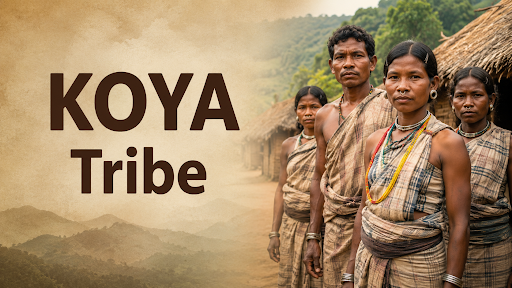
Who Are the Koya?
Koya are one of India's few multi-racial and multi-lingual tribal communities, inhabiting forests, plains, and valleys on both sides of the Godavari River.
The Koya call themselves "Koitur" in their own dialect, a self-identifier they share structurally with the Gond community, reflecting historic Gondi-Koya cultural proximity.
Major Presence in Telangana, Andhra Pradesh, Chhattisgarh, Odisha
-
Telangana Tribal Welfare Department identifies the Koya as the state's largest Adivasi tribe, with a 2011 Census population of 3.8 lakh in Telangana.
Historical and ethnographic accounts suggest the Koya migrated to central India from an original home in Bastar, in present-day Chhattisgarh.
What Is Kommu Koya?
Kommu Koya (also called Kommu Nrityam or Permakok Aata, meaning "bison horn dance") is performed by Koya communities primarily in the coastal Godavari districts.
Male dancers wear bison/bull horns and peacock feathers on their headgear, with the dance choreography imitating two bulls engaging in combat.
Performance group includes around 20 participants, both men and women, with women dancing the "Rela" rhythm while men manage percussion and lead the horned headdress performance.
The central instrument is a large cylindrical drum, roughly one metre long and one foot in diameter, traditionally covered in cowhide, locally called "Dolu Koya".
The Ministry of Tribal Affairs' Adi Kalakar platform formally identifies Kommu Koya as a traditional dance performed by the Koya community in scheduled areas of Andhra Pradesh, listing it into the national repository of vanishing performing art forms.
The dance's origin is linked to the Bhudevi festival celebrated in the Chaitra month, performed traditionally to mark a successful return from a communal hunting expedition.
Major Features of Koya Culture
Traditional dance: beyond Kommu Koya, Koya cultural life includes multiple ritual and festival dance forms tied to agricultural and hunting cycles.
Oral traditions: Koya history, genealogy, and religious practice are transmitted primarily through oral narrative and song, including "Rela" performance songs.
Community festivals: major festivals include Vijji Pandum (a seed-charming festival marking the agricultural cycle) and Kondala Kolupu (a festival to appease hill deities)
Traditional knowledge: extensive ecological and medicinal knowledge is embedded in everyday Koya forest-based practice.
Forest-based livelihoods: historical dependence on forest produce collection remains a core part of Koya economic life.
Indigenous social institutions: the Koya community is structured into functional, endogamous divisions further split into exogamous phratries — Mudava gatta, Nalgava gatta, Idava gatta, Arava gatta, and Yedava gatta — which regulate marriage alliances and kinship relations.
Economic Life of the Koya
Agriculture: settled and shifting cultivation forms a core part of Koya livelihoods in forest-fringe villages.
Forest produce: collection of minor forest produce remains economically significant, particularly in areas where Community Forest Resource rights have been recognised under the Forest Rights Act.
Bamboo-based crafts: traditional craft production, including bamboo work, supplements agricultural income in many Koya households.
Traditional livelihoods: fishing along the Godavari and its tributaries supplements both diet and income for riverine Koya communities.
Millet cultivation: traditional millet-based cropping patterns remain part of Koya agricultural practice.
Source: THEHINDU
|
PRACTICE QUESTION Q. With reference to the Koya tribal community, consider the following statements:
Which of the statements given above is/are correct? (a) 1 only (b) 2 only (c) Both 1 and 2 (d) Neither 1 nor 2 Answer: (c) Explanation: Statement 1 is correct: Koya tribe is the largest Adivasi (scheduled tribe) community native to Telangana. They primarily live in the Godavari river valley region. Statement 2 is correct: The Koya language (Koya Basha) is officially classified as a member of the Dravidian language family. Within this family, it shares close structural, vocabulary, and linguistic roots with the Gondi language. |