Why In News?
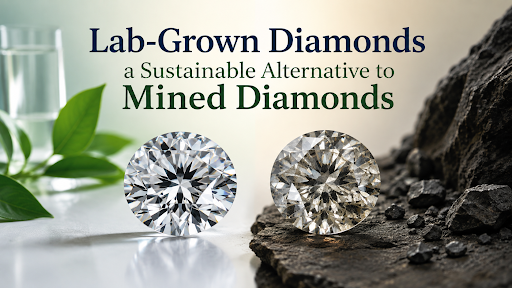
Lab-grown diamonds are considered a sustainable alternative to mined stones because they eliminate the environmental destruction, forced labor, and conflict associated with traditional mining.
What are Lab-Grown Diamonds (LGDs)?
LGDs are synthetic diamonds produced in controlled laboratory settings that exhibit the identical crystal structure, chemical composition, and physical properties as natural, earth-mined diamonds.
-
Both varieties consist of pure carbon organized in an isometric-tetrahedral crystal lattice, as confirmed by the Gemological Institute of America (GIA).
Under the Bureau of Indian Standards (BIS) Standard IS 15766:2007, manufacturers cannot sell synthetic stones under the unqualified term "diamond" and must explicitly label them as "synthetic diamonds."
Manufacturing Methods
High Pressure High Temperature (HPHT): Process replicates the Earth’s upper mantle conditions.
-
A microscopic diamond seed sits in a capsule with graphite and a molten transition metal catalyst (iron or cobalt).
-
The system reaches temperatures of 1300°C to 1600°C and pressures exceeding 870,000 psi. HPHT growth yields cuboctahedron-shaped crystals with 14 distinct growth directions.
Chemical Vapour Deposition (CVD): Replicates low-pressure astronomical diamond formation.
-
Diamond seeds reside in a vacuum chamber filled with a hydrocarbon gas mixture (methane and hydrogen) heated to 900°C to 1200°C.
-
A microwave plasma beam breaks down gas molecules, forcing carbon atoms to deposit layer-by-layer.
-
CVD produces cubic-shaped crystals grown in single directional layers.

How are Lab-Grown Diamonds Different from Natural Diamonds?
|
Feature |
Natural Diamonds |
Lab-Grown Diamonds (LGD) |
|
Formation Timeline |
1 to 3 billion years in the mantle |
3 to 4 weeks in a reactor |
|
Growth Morphology |
Octahedral geological crystal habits |
Cuboctahedron (HPHT) or Cubic (CVD) |
|
Lattice Catalysts |
Natural nitrogen/boron impurities |
Metallic flux residues (HPHT) or growth strains (CVD) |
|
Market Cost |
$1,800 to $12,000 per carat |
~$800 per carat |
|
Carbon Footprint |
Massive fuel-driven open-pit excavation |
High electrical energy but lower geological footprint |
Applications of Lab-Grown Diamonds
High-Power Semiconductors: LGD substrates enable electronic chips to operate at higher speeds with lower power consumption, supporting 5G networks and space electronics.
Defence and Space: LGDs serve as heat sinks and radiation-hardened window panes for satellites and advanced laser optics.
Quantum and Medical: Pure CVD-grown diamonds with nitrogen-vacancy centers integrate into quantum magnetic sensors and industrial surgical scalpel coatings.
India's Role in the Lab-Grown Diamond Industry
Global Polishing Hub: Surat, Gujarat cuts and polishes over 90% of the world’s diamonds, employing over 2 million to 5 million people.
Indigenous Technological Transition: The Ministry of Finance’s Union Budget 2023-24 allocated a five-year research grant of Rs. 242.96 crores to IIT-Madras to establish the India Centre for Lab-Grown Diamond (InCent-LGD).
Export Growth Acceleration: According to data from the Department of Commercial Intelligence and Statistics (DGCIS), India's exports of cut and polished lab-grown diamonds grew rapidly from $237.89 million in 2017-18 to $1,348.24 million in 2021-22
Source: THEHINDU
|
PRACTICE QUESTION Q. With reference to Lab-Grown Diamonds (LGDs), consider the following statements:
Which of the statements given above is/are correct?A) 1 and 2 onlyB) 3 onlyC) 2 and 3 onlyD) 1, 2 and 3Answer: B) 3 onlyExplanation:Statement 1 is incorrect: HPHT crystals generally form in a cuboctahedron shape, whereas CVD growth yields a cubic or tabular shape.Statement 2 is incorrect: The Bureau of Indian Standards mandates that the unqualified word "diamond" can only be used for natural diamonds; lab-grown versions must explicitly use terms like "laboratory-grown diamond".Statement 3 is correct: Lab-grown diamonds share the identical chemical composition (pure carbon), crystal lattice, and physical-optical properties as natural diamonds. |