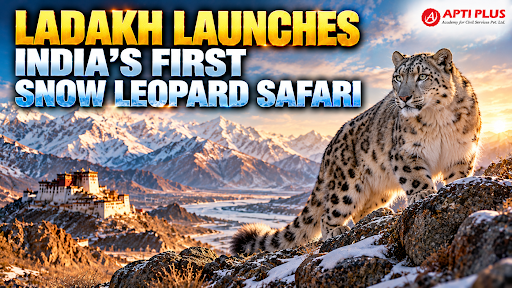
Why In News?
The Union Territory Administration of Ladakh inaugurated India's first high-altitude snow leopard wildlife safari.
About Snow Leopard
The snow leopard (Panthera uncia) is a large wild cat native to high-altitude mountain ranges in Central and South Asia.
-
Scientific Name: Panthera uncia
-
Common Name: Ghost of the Mountains
-
Roaring: Cannot roar (unlike the "big four" of the genus Panthera)
-
IUCN Red List Status: Vulnerable (VU)
-
CITES: Appendix I
-
Wildlife (Protection) Act, 1972: Schedule I
-
CMS (Convention on Migratory Species): Appendix I
-
Ecological Role: Flagship, keystone, and indicator species of high-altitude alpine/subalpine ecosystems.
-
State Animal: Himachal Pradesh
Habitat
-
Altitude Range: Found between 3,000 and 5,500 meters in alpine and subalpine zones.
-
Global Range: Spread across 12 countries (including India, China, Nepal, Bhutan, Pakistan, Mongolia, and Russia).
-
Distribution in India: Found in the Himalayan and Trans-Himalayan cold deserts across Ladakh, Jammu & Kashmir, Himachal Pradesh, Uttarakhand, Sikkim, and Arunachal Pradesh.
-
Population in India: 718 individuals (as per the first-ever scientific Snow Leopard Population Assessment in India [SPAI] report coordinated by the Wildlife Institute of India [WII]).
-
Ladakh: 477 (highest in India)
-
Uttarakhand: 124
-
Himachal Pradesh: 51–83 (updated state counts)
-
Arunachal Pradesh & Sikkim: 57–61 combined
-
Jammu & Kashmir: 9 (excluding Ladakh)
-
Hemis National Park (Ladakh) is known as the Snow Leopard capital of the world.
Key Conservation Initiatives
-
Project Snow Leopard: Launched in 2009 by the Ministry of Environment, Forest and Climate Change (MoEFCC) to safeguard the species and its habitat.
-
Global Snow Leopard and Ecosystem Protection Program (GSLEP): An inter-governmental alliance across 12 range countries.
-
International Snow Leopard Day: Celebrated annually on October 23.
-
SECURE Himalaya: Global Environment Facility (GEF)–UN Development Programme (UNDP) project focusing on high-altitude biodiversity.
-
Captive Breeding: Padmaja Naidu Himalayan Zoological Park (Darjeeling) runs a pioneer captive breeding program.
Source: THEHINDU
|
PRACTICE QUESTION Q. With reference to the Snow Leopard, consider the following statements:
Which of the statements given above are correct? (a) 1 and 2 only (b) 1 and 3 only (c) 2 and 3 only (d) 1, 2, and 3 Answer: (b) Explanation: Statement 1 is correct: According to the first Snow Leopard Population Assessment in India (SPAI), the total estimated population in India is 718 individuals, with Ladakh hosting 477 snow leopards—which is more than half (over 66%) of the national total. Statement 2 is incorrect: The snow leopard is classified as "Vulnerable" (and was downgraded from Endangered to Vulnerable in 2017) on the IUCN Red List, not Critically Endangered. Statement 3 is correct: In India, the snow leopard is listed under Schedule I of the Wildlife (Protection) Act, 1972, granting it the highest level of legal protection. |