Why In News?
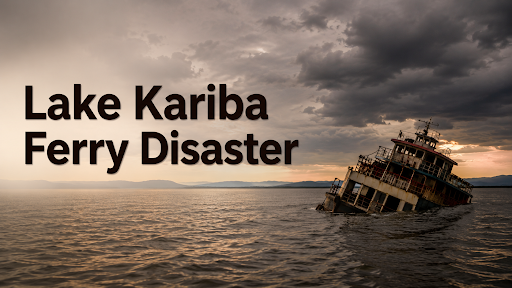
A ferry capsized on Lake Kariba in Zimbabwe, while travelling from Kariba town toward remote fishing communities in the country's northwest.
About Lake Kariba
-
Lake Kariba is an artificial lake on the Zambezi River, formed by damming the river in the late 1950s and early 1960s.
-
It is shared between Zimbabwe and Zambia, with the international border running through the middle of the lake.
-
Kariba is the world's largest man-made lake by volume, stretching more than 200 km in length and up to 40 km in width.
-
It is a major inland water resource in Southern Africa, supporting power generation, fisheries, and transport.
-
The lake serves as an important fisheries and transport corridor, connecting Kariba town to remote lakeside and island communities.

Source: HINDUSTANTIMES
|
PRACTICE QUESTION Q. Consider the following statements regarding Lake Kariba:
Which of the statements given above is/are correct? (a) 1 and 2 only (b) 2 and 3 only (c) 1, 2 and 3 (d) 3 only Answer: (b) Statement 1 is incorrect: Lake Kariba is not a natural lake, nor is it located entirely within Zimbabwe. It is an artificial (man-made) reservoir located along the border between Zambia and Zimbabwe. Statement 2 is correct: The lake was formed between 1958 and 1963 following the construction of the Kariba Dam, which dammed the Zambezi River at the Kariba Gorge. Statement 3 is correct: With a storage capacity of approximately 185 billion cubic metres, Lake Kariba holds the record as the world's largest man-made lake and reservoir by volume. |