Why In News?
Iran's Islamic Revolutionary Guard Corps (IRGC) launched retaliatory strikes after US forces bombed Iranian military rocket launch positions on Larak Island.
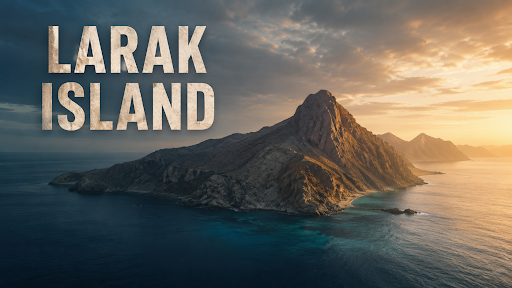
About Larak Island
Location: Larak Island (Jazireh-ye Larak) is an Iranian island situated in the Persian Gulf, lying southeast of Qeshm Island and southwest of Hormuz Island in the Hormozgan Province of southern Iran.
Proximity to the Strait of Hormuz: The island is on the northern edge of the narrowest throat of the Strait of Hormuz, overlooking the international shipping channels.
Area: An arid, volcanic island covering approximately 49 square kilometers, surrounded by coral reefs and deep maritime channels that accommodate ultra-large crude carriers (ULCCs).
Significance: During the 1980–1988 Iran-Iraq "Tanker War", Larak Island served as a major floating oil transshipment terminal, allowing Iranian crude tankers to load outside the range of Iraqi fighter jets.

Why is Larak Island Strategically Important?
Command of the Strait: Adjacent to the Traffic Separation Scheme (TSS), Larak provides Iran with surveillance and interdiction capabilities over Persian Gulf shipping.
Energy Route Control: Stationed weaponry on Larak can directly target oil tankers transiting the 2-nautical-mile wide shipping lanes.
IRGC Naval Staging Base: Operates as a forward base for the IRGC Navy, housing missile boats, mine-layers, and radars.
Asymmetric Warfare Hub: Coastal caverns and natural anchorage allow launches of swarming boats, cruise missiles, and drones.
Regional Deterrence: Serves as an unyielding platform to deter foreign naval task forces in the Gulf region.

What are the Major Geopolitical Issues in the Region?
Escalating Iran-US Military Confrontations: Direct airstrikes on Iranian coastal installations (such as Larak Island) and retaliatory missile/drone strikes against US bases across Jordan, Syria, and Iraq heighten the danger of an open regional war.
Gulf Maritime Security & Asymmetric Threats: Frequent incidents of commercial tanker harassment, drone strikes, GPS spoofing, and limpet mine sabotage disrupt safe maritime transit.
Regional Military Build-up: The presence of the US Fifth Fleet (headquartered in Bahrain), combined with multi-nation maritime task forces (Combined Maritime Forces - CMF), creates a high-stakes standoff with Iranian naval forces.
Lack of Bypass Pipelines: Very few alternative overland pipelines exist to bypass the Strait of Hormuz; existing pipelines (like Saudi Arabia's East-West Petroline and UAE's Habshan-Fujairah pipeline) can bypass only a small fraction (~4 to 5 million bpd) of total oil flows.
Proxy Conflicts & Red Sea Spillover: Linkages between Gulf tensions and Houthi maritime attacks in the Bab el-Mandeb strait create simultaneous chokepoint vulnerabilities across the entire Middle Eastern maritime rim.
Why is the Region Important for India?
Critical Crude Oil & LNG Imports: India imports over 87% of its domestic crude oil requirements; approximately 50% to 55% of India's crude imports and 60% of its LNG originate from Persian Gulf suppliers (Iraq, Saudi Arabia, UAE, Qatar) and must pass through the Strait of Hormuz.
Massive Indian Diaspora Welfare: More than 9 million Indian expatriate workers and professionals live across the Gulf Cooperation Council (GCC) countries, constituting the largest non-resident Indian community worldwide.
Huge Remittance Inflows: The Indian diaspora in the Gulf remits over $35 to $40 billion annually back to India, supporting rural household incomes and strengthening India's foreign exchange balance.
Strategic Bilateral Trade & Investments: The GCC represents one of India's largest trading partner blocs (with annual bilateral trade exceeding $160 billion) and a major source of sovereign wealth fund investments in Indian infrastructure.
Preserving Strategic Autonomy: India maintains close, balanced diplomatic partnerships with Iran, the GCC monarchies (Saudi Arabia, UAE), the United States, and Israel, requiring a delicate diplomatic posture during regional conflicts.
Source: HINDUSTANTIMES
|
PRACTICE QUESTION Q. Which of the following water bodies are connected by the Strait of Hormuz? (a) Red Sea and Gulf of Aden (b) Persian Gulf and Gulf of Oman (c) Mediterranean Sea and Black Sea (d) Arabian Sea and Bay of Bengal Answer: (b) Persian Gulf and Gulf of Oman Explanation: The Strait of Hormuz is a narrow waterway connecting the Persian Gulf in the west with the Gulf of Oman and the Arabian Sea in the east. |