Why In News?
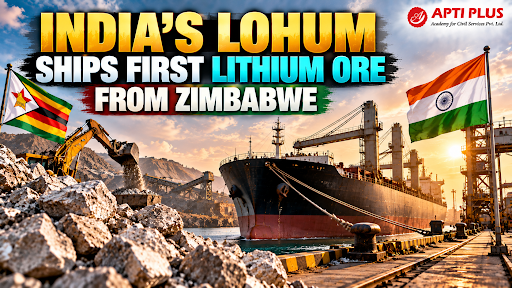
Indian battery materials, refining, and recycling major Lohum announced the dispatch of its first commercial tranche of lithium ore from its mining assets in Matabeleland South Province, Zimbabwe.
What is Lithium?
Critical Mineral: Often termed "White Gold", lithium is a soft, silvery-white alkali metal classified globally as a strategic critical mineral due to high supply risks and economic vulnerability.
Core Battery Material: Possessing the highest electrochemical potential and lowest atomic mass among metals, it provides unparalleled energy density in rechargeable lithium-ion cells.
Energy Storage Resource: Essential for grid-scale Battery Energy Storage Systems (BESS) required to stabilize variable renewable generation from solar and wind farms.
Indispensable Electric Vehicle Component: The standard power pack across modern electric two-wheelers, passenger vehicles, and commercial electric buses relies heavily on lithium nickel manganese cobalt oxide (NMC) or lithium iron phosphate (LFP) chemistries.
Renewable Energy Transition Anchor: A prerequisite for decarbonization, facilitating national transitions away from fossil fuels toward clean, electrified transport networks
What is Spodumene?
|
Why is Lithium Important for India?
Electric Vehicle Acceleration (FAME & PM E-DRIVE): Sustaining India's EV adoption targets—including 30% private car and 80% two-wheeler EV penetration by 2030—demands reliable, uninterrupted access to lithium feedstocks.
Advanced Battery Manufacturing: Anchors the government's ₹18,100-crore Production Linked Incentive (PLI) scheme for Advanced Chemistry Cells (ACC), which targets 50 GWh of domestic cell manufacturing capacity.
Renewable Energy Grid Integration: Crucial for achieving India’s pledge of 500 GW of non-fossil installed power capacity by 2030, necessitating over 40 GW / 160 GWh of utility-scale battery storage.
Consumer Electronics Self-Reliance: Supplies battery raw materials for domestic smartphone, laptop, and electronic device manufacturing under the Make in India initiative.
Strategic and Defence Technologies: Powers telecommunications infrastructure, aerospace avionics, guided defense systems, and naval unmanned underwater vessels.
What is Lohum’s Zimbabwe Project?
Acquisition of Ten Spodumene Mining Blocks: Lohum secured statutory concession rights over ten spodumene-bearing lithium mining blocks located in Zimbabwe's mineral-rich Matabeleland South Province.
Integration with Indian Refining Infrastructure: Establishes a captive supply pipeline where initial ore concentrates undergo local value addition in Zimbabwe before feeding Lohum’s advanced chemical refining and cell precursor facilities in India.
Zimbabwe Important for Critical Minerals
-
Africa's Top Lithium Reserves: Zimbabwe possesses Africa's largest hard-rock lithium deposits.
-
Battery Supply Chain Hub: Serves as a key global destination for battery material investments outside Australia.
-
Indo-African Partnership Catalyst: Strengthens South-South trade by connecting African minerals with Indian industry.
-
Supply Diversification: Mitigates global market reliance on Australia and South America.
-
Rich Critical Minerals: Great Dyke region also holds major platinum group metals (PGMs), chromium, nickel, and cobalt reserves.

Strategic Significance for India
Reduced Vulnerability to Supply-Chain Disruptions: Buffers Indian battery manufacturers against unilateral export controls, trade sanctions, and ocean shipping bottleneck vulnerabilities.
Strengthened Battery Supply-Chain Security: Direct equity and offtake control over overseas mineral assets guarantees predictable volumes of raw ore, stabilizing domestic battery production lines.
Accelerating Domestic EV Manufacturing: Lowers cell manufacturing costs by bypassing speculative international middlemen and commodity brokers, fostering affordable consumer EV adoption.
Critical Mineral Diversification: Supports the mandate of the Ministry of Mines and KABIL (Khanij Bidesh India Ltd) to acquire upstream equity assets across diverse global geographies.
Overseas Asset Ownership by Indian Industry: Demonstrates the ability of Indian private capital to acquire, develop, and operate high-value extractive assets in competitive international markets.
Stimulating Domestic Chemical Refining: Fuels India’s domestic chemical conversion capacity, ensuring high-value processing, precursor synthesis, and cathode manufacturing remain within Indian borders.
Source: ECONOMICTIMES
|
PRACTICE QUESTION Q. The global shift towards clean energy is creating a transition from fossil-fuel geopolitics to critical mineral geopolitics. Discuss (15 Marks, 250 Words) |