Why In News?
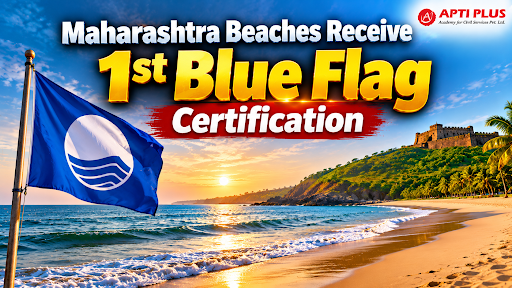
Three Maharashtra beaches have been awarded the international Blue Flag certification for the 2026–27 season, marking Maharashtra's first entry into the programme.
What Are The Key Details Of The Certification?
|
Feature |
Details |
|
Beaches |
Ladghar and Guhagar (Ratnagiri), Shrivardhan (Raigad) |
|
Season |
Begins 15 November 2026 |
|
Awarded by |
International Blue Flag Jury |
|
Criteria met |
Water quality, environmental management, biodiversity, cleanliness, tourist safety, infrastructure and sustainable tourism |
|
Next step |
Official flags being brought from the Netherlands for a hoisting ceremony |
What Is The Blue Flag Programme?
It is a globally recognized, voluntary eco-label awarded to beaches, marinas, and sustainable boating tourism operators that meet strict environmental, educational, safety, and water quality standards.
|
Feature |
Details |
|
Run by |
Foundation for Environmental Education (FEE), a non-profit based in Copenhagen, Denmark |
|
Started |
1985 in France, expanded across Europe from 1987 |
|
Covers |
Beaches, marinas and sustainable boating tourism operators |
|
Criteria |
33 criteria under four areas |
|
Validity |
One season; must be renewed every year |
The Four Criteria Areas
|
Area |
Examples |
|
Environmental education and information |
Public display of water quality data, local ecosystem information |
|
Water quality |
Regular sampling meeting bathing water standards |
|
Environmental management |
Waste bins, sewage control, no illegal construction |
|
Safety and services |
Lifeguards, first aid, access for persons with disabilities |
Global Reach: Over 5,000 sites in around 50 countries hold the Blue Flag, with Spain having the largest number of certified beaches.
How India's Blue Flag Journey Evolved?
India’s Blue Flag journey evolved from a 2018 pilot initiative into a nationwide movement with 22 Blue Flag-certified beaches recognized for the 2026–27 season.
-
The Launch (2018): India began its journey in 2018 by selecting pilot beaches—one in each coastal state and Union Territory—to pursue the prestigious international Blue Flag eco-label awarded by the Foundation for Environmental Education (FEE), Denmark.
-
The BEAMS Program: The Ministry of Environment, Forest and Climate Change (MoEFCC), through the Society of Integrated Coastal Management (SICOM), rolled out the BEAMS (Beach Environment & Aesthetics Management Services) program under the World Bank-backed Integrated Coastal Zone Management (ICZM) project. BEAMS was built to abate coastal marine pollution, manage waste, and upgrade beach infrastructure.
-
Historic First Breakthrough (2020): India made history by getting 8 beaches certified in a single attempt—becoming the first country in the Asia-Pacific region to achieve this feat in roughly two years.
India's First Eight Blue Flag Beaches
|
Beach |
State / UT |
|
Shivrajpur |
Gujarat |
|
Ghoghla |
Diu |
|
Kasarkod and Padubidri |
Karnataka |
|
Kappad |
Kerala |
|
Rushikonda |
Andhra Pradesh |
|
Golden |
Odisha |
|
Radhanagar |
Andaman and Nicobar Islands |
Why Is This Certification Significant?
-
Tourism Boost: Puts the Konkan coast on the global eco-tourism map and attracts international visitors.
-
Environmental Standards: Pushes local bodies to maintain clean water, proper waste disposal and sewage treatment.
-
Safety And Accessibility: Requires lifeguards, emergency services and disabled-friendly access.
-
Local Livelihoods: Supports homestays, guides and small businesses in coastal villages.
-
Model For Coastal Management: Encourages sustainable practices that can be replicated on other beaches.
What Are The Key Challenges In Maintaining Blue Flag Standards On Indian Beaches?
Marine Litter And Plastic Pollution
-
Plastic Waste: Beaches receive plastic from rivers, fishing activity and tourists, requiring constant clean-up.
-
Fishing Gear: Discarded nets and ropes add to litter on fishing beaches like those on the Konkan coast.
Untreated Sewage And Water Quality
-
Sewage Discharge: Untreated wastewater from coastal towns can fail strict bathing water standards, which must be met every season.
Coastal Erosion
-
Shrinking Shores: About 33.6% of India's coastline was eroding between 1990 and 2018, according to the National Centre for Coastal Research.
-
Long Coastline: India's coastline, recalculated in 2023 at about 11,098 km, is difficult to protect uniformly.
Over-Tourism
-
Carrying Capacity: Certification can draw large crowds, adding to waste and pressure on fragile ecosystems such as sand dunes.
Biodiversity Conflicts
-
Turtle Nesting: The Konkan coast hosts Olive Ridley turtle nesting, such as at Velas in Ratnagiri, which can be disturbed by lights, noise and crowds.
Annual Renewal And Costs
-
Recurring Compliance: Certification lasts only one season, so beaches must invest every year in lifeguards, cleaning and water testing.
-
Local Capacity: Gram panchayats and municipal councils often lack funds and trained staff.
Monsoon Disruptions
-
Seasonal Limits: Heavy monsoon rains and rough seas on the west coast make beaches unsafe for part of the year, limiting tourism.
What Is The Way Forward For Expanding And Sustaining Blue Flag Beaches In India?
Scale Up Certification
-
More Beaches: Expand BEAMS to more States to meet the target of 100 additional certified beaches.
-
Learn From Spain: Spain built a large Blue Flag network through strong local government involvement and regular water monitoring.
Community-Led Management
-
Local Ownership: Involve gram panchayats, fishers and self-help groups in beach cleaning, lifeguard services and eco-tourism.
Tackle Pollution At Source
-
Sewage Treatment: Build sewage treatment plants in coastal towns and stop untreated discharge.
-
Plastic Control: Enforce Extended Producer Responsibility for plastic packaging and set up plastic collection points on beaches.
Protect Coastal Ecosystems
-
Nature-Based Defences: Restore sand dunes, mangroves and beach vegetation to reduce erosion.
-
Turtle-Friendly Practices: Regulate lighting and visitor access during nesting seasons.
Manage Tourist Numbers
-
Carrying Capacity Limits: Set visitor limits and entry fees to fund maintenance and prevent overcrowding.
Sustainable Financing
-
User Fees And CSR: Use parking fees, tourism revenue and CSR funds to cover the annual costs of meeting standards.
Awareness And Education
-
Environmental Education: Run regular awareness programmes for tourists and schools, as required by Blue Flag criteria.
Conclusion
The Blue Flag for Ladghar, Guhagar and Shrivardhan puts the Konkan coast on the global eco-tourism map. Keeping the flag will need year-round pollution control, community participation and protection of fragile coastal ecosystems.
Source: THEHINDU
|
PRACTICE QUESTION Q. With reference to the Blue Flag Certification, consider the following statements:
Which of the statements given above is/are correct? (a) 1 and 2 only (b) 2 only (c) 1 and 3 only (d) 2 and 3 only Answer: (b) 2 only Explanation: Statement 1 is incorrect: Blue Flag is a voluntary international eco-label. It is awarded by the Foundation for Environmental Education (FEE), a non-profit organization headquartered in Copenhagen, Denmark—not UNEP (though UNEP is a member of the international jury). Statement 2 is correct: The certification is accorded to beaches, marinas, and sustainable boating tourism operators that meet strict standards. Statement 3 is incorrect: The certification is not permanent. It is valid for one year/bathing season and must be renewed annually through strict audits and compliance checks. |