Why In News?
The formalization of the Mecca Joint Defence Agreement (MJDA) marks the emergence of a new Middle Eastern security architecture.
What is the Mecca Joint Defence Agreement?
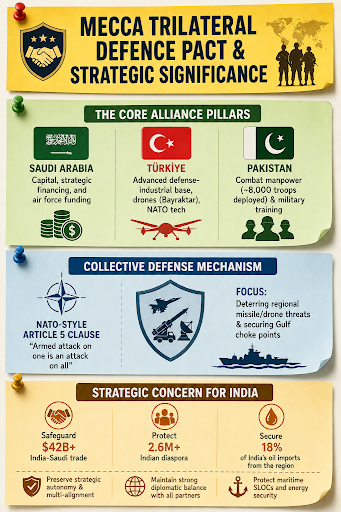
It is a binding trilateral mutual defense treaty establishing collective security commitments, defense-industrial cooperation, and joint military planning among Saudi Arabia, Türkiye, and Pakistan.
Signatories: Concluded in Mecca in August 2026, by Saudi Crown Prince Mohammed bin Salman, Turkish President Recep Tayyip Erdoğan, and Pakistani Prime Minister Shehbaz Sharif.
Evolution from 2025 Bilateral Pact: Expands the bilateral Strategic Mutual Defence Agreement (SMDA) signed between Saudi Arabia and Pakistan in September 2025 to formally incorporate Türkiye into a trilateral defense framework.
Collective Security Commitment: Incorporates a mutual assistance clause stating that an armed attack against any one of the three signatory states shall be considered an armed attack against all three.
Symbolism of Mecca: Signed in Islam’s holiest city during the Makkah Al-Mukarramah Summit for Joint Defence, lending religious and civilizational legitimacy to the strategic axis.
What are the Key Features of the Agreement?
Collective Response to Armed Attack: Obligates the three nations to coordinate military, logistical, and defensive responses in the event of foreign aggression against any member state.
Division of Strategic Capabilities:
-
Saudi Arabia: Provides sovereign financial capital, energy backing, and defense procurement funding.
-
Türkiye: Delivers advanced defense hardware, armed unmanned aerial vehicles (UAVs like Bayraktar TB2 and Akinci), electronic warfare systems, and naval shipbuilding expertise.
-
Pakistan: Supplies experienced frontline military personnel, specialized pilot training, and air defense operational crews.
Integrated Joint Military Exercises: Institutionalizes regular tri-service war games, intelligence-sharing cells, and standardized defense communication protocols.
Joint Defence Production & Technology Transfer: Establishes co-production facilities for missile defense systems, armored combat vehicles, and munitions across the three nations.
Regional Security Coordination: Establishes a permanent trilateral strategic committee to monitor maritime navigation in the Red Sea, Arabian Sea, and Persian Gulf.
Why was the Agreement Signed?
Erosion of Faith in the US Security Umbrella: Unchecked drone and missile attacks on Gulf energy installations have heightened Saudi perceptions that Washington’s security guarantees are conditional and unpredictable.
Escalating West Asian Conflicts: Prolonged regional hostilities involving state and non-state actors (such as Houthi missile strikes and regional militia escalations) threaten critical maritime transit routes.
Pursuit of Strategic Autonomy: Gulf monarchies are actively diversifying defense partnerships beyond traditional Western suppliers to develop indigenous military capabilities.
Turkish Geopolitical & Economic Ambitions: Ankara seeks lucrative export markets for its expanding aerospace defense sector while strengthening its footprint in the Arabian Peninsula.
Pakistan’s Quest for Economic & Diplomatic Capital: Islamabad leverages its military manpower and nuclear status to secure vital Saudi financial deposits ($3 billion cash infusion in 2026) and concessionary oil supplies.
What is the Geopolitical Significance?
Emergence of a Non-Western Sunni Middle-Power Axis: Unites three of the largest military and economic powers in the Islamic world into a formalized defense alliance.
Consolidation of Saudi-Türkiye Rapprochement: Seals the complete reconciliation between Riyadh and Ankara following years of regional rivalry across North Africa and the Levant.
Institutionalising Pakistan’s Security Role in the Gulf: Formalizes Pakistan’s historical role as a security provider to Gulf monarchies under an institutional treaty framework.
Shift Toward Multipolarity in Middle Eastern Security: Highlights the decline of unipolar Western dominance in Gulf security architecture as regional powers create self-reliant deterrence mechanisms.
Impact on Iran and Regional Balance: While ostensibly defensive, the pact serves as a conventional deterrent against regional missile threats while navigating ongoing diplomatic normalization tracks.
What are the Implications for India?
India-Saudi Strategic Partnership
-
Saudi Arabia is India's 5th largest trading partner with bilateral trade reaching about $42 billion in FY 2024–25.
-
Saudi Arabia remains India's 3rd largest crude oil supplier, providing approximately 14%-18% of India’s total petroleum imports.
-
Host to over 2.6 million Indian expatriates, sending over $10 billion in annual remittances back to India.
India-Türkiye Bilateral Dynamics:
-
Bilateral trade stood at $8.71 billion in FY 2024–25 and $6.88 billion in FY 2025–26, with major Indian exports of petroleum products, mineral oils, iron, and steel.
-
Türkiye’s close defense-industrial ties with Pakistan and political stance on Jammu & Kashmir require continuous diplomatic monitoring by New Delhi.
India-Pakistan Security Balance:
-
The pact raises concerns regarding the potential diversion of advanced Turkish military technology or Gulf financial aid to Pakistan's armed forces.
-
However, Saudi Arabia has maintained a strict de-hyphenation policy, ensuring its defense ties with Pakistan do not compromise its strategic economic partnership with India.
Energy Security: Over 60% of India's crude oil imports transit the Persian Gulf, Strait of Hormuz, and Red Sea; any regional polarization impacting maritime chokepoints directly threatens Indian energy security.
India-Middle East-Europe Economic Corridor (IMEC): Regional instability and shifting security alignments pose potential risks to the implementation of the IMEC connectivity initiative announced at the G20 New Delhi Summit.
What are the Challenges for India?
The Pakistan Factor & Technology Inflow: Risk of advanced Turkish drone and electronic warfare technologies finding operational utility along India’s western borders.
Türkiye’s Stance on Kashmir: Ankara’s repeated references to the Kashmir issue at multilateral forums (UNGA) complicate deeper strategic convergence with New Delhi.
Risk of Regional Polarization: Potential polarization of West Asia into competing security blocs could complicate India's multi-aligned foreign policy.
Balancing Divergent Regional Partnerships: India must simultaneously preserve its deep strategic ties with Saudi Arabia, the UAE, Israel, and Iran without being drawn into regional rivalries.
Safety of the Indian Diaspora: Escalating regional military friction puts the safety and livelihood of over 9 million Indian citizens living in the Gulf at risk.
Maritime Security Vulnerabilities in the Western Indian Ocean: Increased military activity around Bab-el-Mandeb and the Arabian Sea elevates risks to merchant shipping.
What is India's Strategic Approach?
Principled Strategic Autonomy & Multi-Alignment: Engaging all major poles in West Asia independently based on issue-based convergences and mutual core interests.
Consolidating the India-Saudi Strategic Partnership Council (SPC): Deepening high-level ministerial collaboration under the Political-Security and Economic-Investment pillars.
Bilateral Defence Diplomacy: Conducting joint naval exercises (such as Exercise Al-Mohed Al-Hindi with the Royal Saudi Navy) to build high-level interoperability.
Energy Sourcing Diversification: Diversifying crude imports across Russia, Iraq, Saudi Arabia, the UAE, and North America to buffer against Gulf supply disruptions.
Maritime Security in the Arabian Sea (Operation Sankalp): Deploying Indian Navy destroyers and frigates to safeguard Indian-flagged merchant vessels across the Gulf of Oman and Red Sea.
Advancing Continental-Maritime Connectivity: Steadfastly pursuing the IMEC and the International North-South Transport Corridor (INSTC) to anchor India's long-term trade connectivity.
Way Forward For India
Deepen Comprehensive Security Dialogue with Riyadh: Sensitize Saudi leadership to India’s core security sensitivities regarding cross-border terrorism and defense technology transfers to Pakistan.
Accelerate India-Saudi Bilateral Trade to $100 Billion: Fast-track negotiations for the proposed India-GCC Free Trade Agreement (FTA) and mobilize Saudi Public Investment Fund (PIF) capital into Indian green energy and semiconductor sectors.
Pragmatic Diplomatic Engagement with Türkiye: Expand trade, pharmaceutical exports, and cultural exchanges with Ankara while insulating core commercial ties from political differences.
Expand Information-Sharing via IFC-IOR: Leverage the Information Fusion Centre – Indian Ocean Region (IFC-IOR) at Gurugram to exchange white-shipping and maritime intelligence with Gulf coast guards.
Institutionalize Diaspora Welfare & Evacuation Mechanisms: Strengthen consular contingency protocols with Gulf Cooperation Council (GCC) governments to protect Indian expatriates during crises.
Avoid Entanglement in Regional Bloc Alliances: Maintain a neutral, constructive posture that positions India as a trusted economic and trade partner for all West Asian states.
Conclusion
India must navigate the emerging Mecca defense axis by leveraging economic and energy partnership with Saudi Arabia, practicing calibrated multi-alignment, and safeguarding critical Indian Ocean trade corridors.
Source: INDIANEXPRESS
|
PRACTICE QUESTION Q. With reference to the 'Mecca Joint Defence Agreement' and West Asian geopolitics, consider the following statements: 1. It is a trilateral mutual defense pact signed among Saudi Arabia, Türkiye, and Pakistan in August 2026. 2. It incorporates a collective defense commitment declaring that an armed attack on one signatory shall be regarded as an attack on all three. 3. The agreement formally dissolves the Gulf Cooperation Council (GCC) collective security framework. Which of the statements given above are correct? (a) 1 and 2 only (b) 2 and 3 only (c) 1 and 3 only (d) 1, 2, and 3 Answer: (a) 1 and 2 only Explanation: Statement 1 is correct: The Mecca Joint Defence Agreement is a trilateral mutual defense pact signed by Saudi Arabia, Türkiye, and Pakistan In August 2026. Statement 2 is correct: The pact includes a collective security commitment. It states that an armed attack on one signatory is treated as an attack on all three, which is similar to NATO's Article 5. Statement 3 is incorrect: The agreement does not dissolve or replace the Gulf Cooperation Council (GCC) collective security framework. |