Why In News?
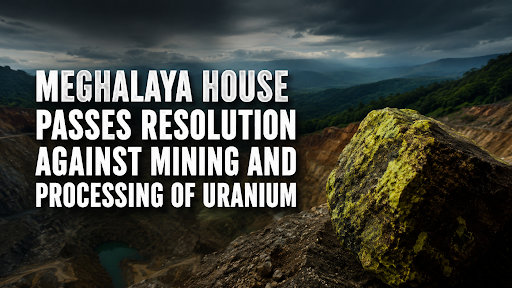
The Meghalaya Legislative Assembly unanimously passed a resolution opposing the exploration, mining, and processing of uranium in the state.
Key Highlights of the Meghalaya Assembly Resolution
Urging Central Disengagement: The resolution formally calls upon the Ministry of Mines, Department of Atomic Energy (DAE) not to permit, pursue, or undertake any uranium exploration, mining, or ore-processing activities in Meghalaya.
Preservation of Water Security: The House observed that radioactive leachate and mining runoff from the Domiasiat-Mawthabah sandstone plateau would contaminate major drainage systems flowing into Assam and Bangladesh.
Respecting Sixth Schedule and Community Land Ownership: The Assembly reaffirmed that in Meghalaya, land belongs to tribal clans and community dorbars under the Sixth Schedule of the Constitution, making state or central expropriation socially unviable without absolute community consent.
What is Uranium?
-
Basic Properties: Uranium (Chemical symbol U, Atomic number 92) is a dense, silvery-white, naturally occurring radioactive heavy metal.
-
Key Isotopes:
-
Uranium-238 (U-238): Constitutes 99.27% of natural uranium; fertile material that converts into fissile Plutonium-239 in breeder reactors.
-
Uranium-235 (U-235): Constitutes 0.72% of natural uranium; the only naturally occurring fissile isotope capable of sustaining a nuclear chain reaction.
-
Uranium-234 (U-234): Trace isotope (0.005%).
-
Processing Cycle: Mined ore is crushed, chemically leached, and converted into Yellowcake ($U_3O_8$), which is then processed into fuel bundles for nuclear power reactors.
Why is Uranium Important for India?
Fueling the Three-Stage Nuclear Power Programme: Natural uranium is the essential primary fuel for India's Pressurised Heavy Water Reactors (PHWRs) in Stage 1, which produce electricity while generating Plutonium-239 for Stage 2 Fast Breeder Reactors.
Net-Zero Baseload Clean Energy: India aims to expand its nuclear power capacity from 8.1 GW to 22.4 GW by 2031–32 to provide firm, non-fossil baseload power complementing solar and wind energy.
Energy Security & Strategic Autonomy: Domestic uranium production insulates India from global geopolitical supply shocks, export cartels, and Nuclear Suppliers Group (NSG) conditionalities.
Medical, Agricultural, and Industrial Radioisotopes: Uranium byproducts provide essential radioisotopes (e.g., Cobalt-60, Iodine-131, Molybdenum-99) for cancer radiation therapy, food irradiation, and industrial radiography.
Sources of Uranium in India
According to the Atomic Minerals Directorate for Exploration and Research (AMD), India possesses approximately 4.0 lakh tonnes of in-situ uranium resources ($U_3O_8$) across several key geological belts:
-
Meghalaya (Sandstone-Type Deposits)
-
Andhra Pradesh (Cuddapah Basin)
-
Jharkhand (Singhbhum Shear Zone)
-
Rajasthan (Albitite Belt)
-
Karnataka (Bhima Basin)

Why is Uranium Mining Controversial?
Radiation and Radon Gas Hazards: Uranium mining releases radioactive Radon-222 gas and radioactive dust particles, increasing long-term risks of lung cancer and respiratory ailments among mine workers and nearby inhabitants.
Tailings Dam Management & Water Contamination: Mined residue (tailings) retains ~85% of original ore radioactivity (containing Radium-226 and Thorium-230). Heavy rainfall can breach tailings ponds, leaching uranium into drinking water aquifers and river networks.
Meghalaya's Extreme Hydro-Geological Vulnerability: The Domiasiat region lies in the wettest ecological zone on Earth (receiving >11,000 mm annual rainfall), characterized by porous sandstone and high seismicity (Zone V), multiplying erosion and landslide risks.
Violation of Tribal Land Tenure & Social Alienation: Under Khasi customary law, land is vested in clans (Kur) and village councils (Dorbar Shnong). Mining proposals triggered intense grassroots opposition from the Khasi Students' Union (KSU) fearing demographic influx and land loss.
Inter-Generational Ecological Injustice: Local communities carry the health burdens and radioactive residues, while the generated electricity powers distant national power grids without local economic transformation.
|
Core Dilemma: Energy Security vs Environmental and Indigenous Rights
|
Way Forward
Strict Adherence to Free, Prior, and Informed Consent (FPIC): Respect tribal land ownership and autonomous council jurisdictions under the Sixth Schedule, ensuring that no mining or exploratory activity proceeds without formal community consent.
Adoption of In-Situ Recovery (ISR) and Non-Entry Mining Technologies: Transition away from open-cast uranium mining in fragile mountain topographies, exploring closed-loop In-Situ Leaching where hydrogeologically viable to eliminate surface tailings dams.
Independent Multi-Disciplinary Environmental and Health Impact Audits: Establish joint monitoring committees comprising independent medical experts, AERB scientists, civil society representatives, and tribal elders to conduct transparent baseline epidemiological and radiological studies.
Comprehensive Mine Site Rehabilitation and Ecological Restoration: Legally mandate that project developers maintain escrow-backed environmental restoration funds to restore mined topsoils and cap exploratory boreholes permanently.
Diversification of Domestic and International Uranium Sourcing: Accelerate deep underground mining in ecologically stable belts (Tummalapalle in Andhra Pradesh and Rohil in Rajasthan) while expanding bilateral long-term fuel procurement pacts with international partners.
Conclusion
Balancing India's clean nuclear energy goals with constitutional federalism requires respecting Meghalaya's tribal land autonomy while adopting state-of-the-art closed-loop mining technologies in geologically stable regions.
Source: THEHINDU
|
PRACTICE QUESTION Q. Consider the following pairs of uranium deposit sites and their corresponding Indian states: 1. Domiasiat — Meghalaya 2. Tummalapalle — Andhra Pradesh 3. Rohil — Rajasthan 4. Gogi — Karnataka How many of the pairs given above are correctly matched? (a) Only one pair (b) Only two pairs (c) Only three pairs (d) All four pairs Answer: (d) All four pairs Explanation: Domiasiat — Meghalaya: This sandstone-type uranium deposit is located in the West Khasi Hills district of Meghalaya. Tummalapalle — Andhra Pradesh: This massive uranium mine is situated in the YSR Kadapa district of Andhra Pradesh. Rohil — Rajasthan: Significant albitite-hosted uranium deposits are located at Rohil in the Sikar district of Rajasthan. Gogi — Karnataka: This high-grade uranium deposit occurs in the Bhima Basin of the Yadgir district in Karnataka. |