Why In News?
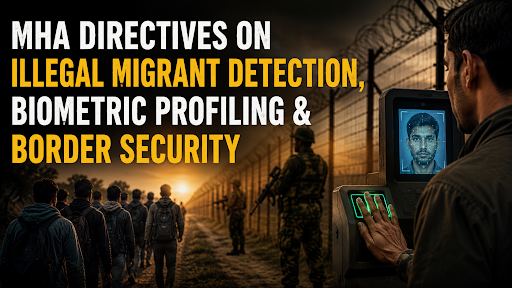
The Union Home Minister directed State Police Chiefs to launch a mission-mode campaign to detect and deport illegal immigrants using nationwide biometric profiling and intelligence fusion through the Multi-Agency Centre.
Home Ministry Directives on Detection and Deportation of Illegal Migrants
The Ministry of Home Affairs (MHA) strengthened security directives due to concerns over human trafficking, fake identity documents, border demographic changes, and related national security risks.
Directive on "Detect and Deport": Instructed State and Union Territory police forces to identify undocumented foreign nationals systematically and initiate time-bound deportation proceedings under the Foreigners Act, 1946.
Comprehensive Biometric Profiling Mandate: Directed the mandatory recording of 10-digit fingerprints, iris scans, and facial recognition data for all detected illegal migrants to prevent identity forgery.
Purging Fraudulent Identity Documents: Mandated a coordinated drive with state revenue and electoral authorities to cancel forged citizenship documents and eliminate ineligible entries from electoral rolls.

Who is Illegal Migration?
Under Section 2(1)(b) of the Citizenship Act, 1955, an "illegal migrant" is defined as a foreigner who has entered India without a valid passport or travel documents, or who entered with a valid passport/visa but continues to stay beyond the permitted time period.
-
Illegal Entry: Unauthorized clandestine crossing over porous land borders, riverine frontiers, or sea coasts bypassing designated immigration checkposts.
-
Overstaying on Expired Visas: Foreign nationals lawfully entering on tourist, medical, student, or business visas who fail to depart upon visa expiry and melt into domestic populations.
-
Use of False Documents: Procuring fake birth certificates, forged land records, and illicit identity proofs to acquire Indian passports and social security benefits.
-
Unauthorized Residence: Establishing permanent settlements in urban slums and border belts without statutory foreigner registration.
What are the Major Security Concerns?
National Security & Border Vulnerability: Infiltration corridors exploited by economic migrants are simultaneously utilized by hostile foreign intelligence agencies, insurgent cadres, and cross-border terrorists.
Organised Human Trafficking Syndicates: Transnational criminal syndicates operate lucrative human smuggling networks across the 4,096 km Indo-Bangladesh border and the 1,643 km Indo-Myanmar frontier.
Identity & Financial Fraud (Hawala Networks): Illegal settlements run parallel illicit financial operations, tax evasion rings, and Hawala networks to transmit undocumented remittances abroad.
Demographic Distortions in Border Belts: Rapid demographic transformations in strategic border districts of West Bengal, Assam, Tripura, and Bihar exert severe socio-political strains on local indigenous communities.
Pressure on Civic Infrastructure & Welfare Resources: Puts unsustainable pressure on subsidized food rations, public healthcare, municipal water supplies, and urban employment markets.

What is the Legal Framework Governing Foreigners in India?
Citizenship Act, 1955: Defines citizenship acquisition and explicitly bars illegal migrants from acquiring Indian citizenship by registration or naturalization.
Foreigners Act, 1946 (Section 3): Empowers the Union Government to make orders restricting, prohibiting, and regulating the entry, presence, movement, and deportation of foreigners.
Passport (Entry into India) Act, 1920: Mandates that all persons entering India must possess valid passports and penalizes undocumented entries.
Registration of Foreigners Act, 1939: Mandates the compulsory registration of foreign nationals residing in India beyond specified durations.
Foreigners Order, 1948: Confers powers on civil authorities to arrest, detain, and restrict the movement of suspected illegal aliens.
Immigration and Foreigners Regulatory Governance: Empowers District Magistrates and State Police Commissioners as competent civil authorities to establish holding centers and execute deportation orders.
What are the Major Challenges?
Porous Borders and Extreme Topography: 4,096 km of Indo-Bangladesh border features dense jungles, marshy riverine channels (Char lands), and shifting sandbars that complicate physical fencing.
Scrapping of Free Movement Regime (FMR) on Indo-Myanmar Border: Fencing the 1,643 km mountainous Myanmar border faces severe logistical, geographical, and local ethnic challenges.
Deeply Entrenched Document Forgery Rackets: Local organized syndicates generate fraudulent Aadhaar and birth certificates using counterfeit stamps and forged local certificates.
Reluctance of Origin Countries to Verify Nationality: Neighboring countries often delay or reject consular verification of intercepted illegal migrants, creating deportation bottlenecks.
Inter-Agency and Federal-State Coordination Friction: Political differences between central border guarding agencies (BSF) and state local police occasionally delay land acquisition for border fencing.
Data Privacy and Biometric Protection: Safeguarding biometric repositories from unauthorized cyber intrusions under the Digital Personal Data Protection (DPDP) Act, 2023.
Way Forward
Expedite 100% Physical and Technological Border Fencing: Complete land acquisition for BSF border fencing in West Bengal and fast-track the CIBMS smart-fencing grid along vulnerable sectors.
Institutionalize Centralized National Biometric Illegal Migrant Registry: Create a secure, interoperable database linking IVFRT, CCTNS, and UIDAI to cross-check all identity applications automatically.
Strengthen Institutional Capacity of Foreigners Tribunals: Modernize e-Foreigners Tribunals with digitized case tracking to adjudicate citizenship determination cases within a statutory 60-day timeframe.
Establish Fast-Track Standard Operating Procedures (SOPs) for Deportation: Conclude formal bilateral repatriation agreements with neighboring countries establishing standardized consular verification timelines.
Strengthen Grassroots Intelligence at Multi-Agency Centre (MAC): Form dedicated Border Intelligence Units (BIUs) at the police station level to dismantle local document-forging syndicates.
Enforce Robust Data Protection & Constitutional Due Process: Ensure all biometric capture adheres to strict data privacy standards under the DPDP Act 2023, upholding basic human dignity under Article 21.
Conclusion
India’s national security framework balances stringent border management and biometric detection of illegal migrants with constitutional due process under Article 21, safeguarding sovereign integrity while upholding the rule of law.
Source: THEHINDU
|
PRACTICE QUESTION Q. "Porous international borders combined with organized cross-border human trafficking cartels pose significant internal security and demographic challenges for India." Discuss. (15 Marks, 250 Words) |