Why In News?
Indonesia’s active volcano Mount Anak Krakatau erupted violently in the Sunda Strait, sending massive ash plumes that disrupted regional aviation.
About Mount Anak Krakatau
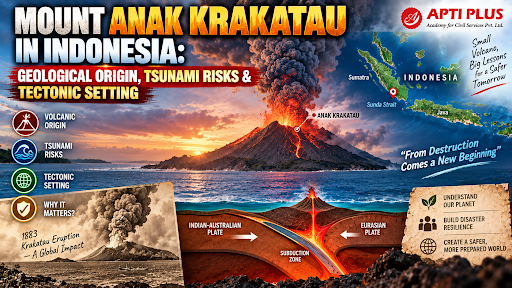
It is an active stratovolcano located in the Sunda Strait between the islands of Java and Sumatra in Indonesia.
-
Tectonic Setting: Part of the Pacific Ring of Fire and formed along the subduction zone where the Indo-Australian Plate moves beneath the Eurasian Plate.
-
Classification: It is a stratovolcano (composite volcano), characterized by steep sides and explosive eruptions due to viscous, sticky magma.
-
Origin: "Anak Krakatau" translates to the "Child of Krakatau". It emerged from the sea in 1927–1928 within the caldera left behind by the eruption of the original Krakatau volcano in 1883.

Volcanic Ash: Aviation & Health Hazards
-
Engine Flameouts: Microscopic silicate ash melts at 1,100°C in jet turbines, coating blades with molten glass and stopping thrust.
-
Cockpit Sandblasting: Abrasive volcanic glass shards scour windshields, rapidly blinding pilots.
-
Sensor Chokage: Ash clogs external pitot-static sensors, giving false altitude data to autopilot systems.
-
Respiratory Risks: Airborne PM2.5 and sulfur dioxide trigger asthma, silicosis, and eye irritation nearby.
Broader Climate Impacts
-
Slope Instability & Tsunamis: Steep submarine slopes of loose tephra risk underwater landslides and tsunamis.
-
Solar Radiation Scattering: Stratospheric sulfur dioxide aerosol injections reflect sunlight, temporarily cooling the hemisphere.
-
Acid Rain & Ecosystem Damage: Leached halogens and sulfur induce local ocean acidification and bleach nearby coral reefs.
Source: TIMESOFINDIA
|
PRACTICE QUESTION Q. Why is volcanic ash considered a catastrophic hazard to commercial jet aircraft flying through ash plumes?
Select the correct answer using the code given below: (a) 1 and 2 only (b) 2 and 3 only (c) 1 and 3 only (d) 1, 2, and 3 Answer: (d) 1, 2, and 3 Explanation:
|