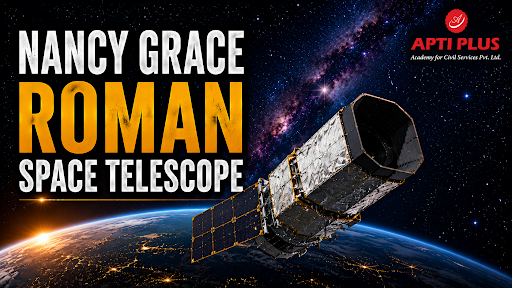
Why In News?
A SpaceX Falcon Heavy rocket launched the 2.4-meter Nancy Grace Roman Space Telescope from Kennedy Space Center.
What is the Nancy Grace Roman Space Telescope?
The Nancy Grace Roman Space Telescope is NASA's next-generation space observatory.
-
Formerly Known as WFIRST: Originally conceived as the Wide Field Infrared Survey Telescope, NASA officially renamed the observatory to honour Dr. Nancy Grace Roman, NASA’s first Chief of Astronomy.
It is designed to unravel cosmic mysteries related to dark energy, dark matter, exoplanets, and infrared astrophysics.

Key Technical Specifications
-
Primary Mirror: Features a 2.4-meter primary mirror. While it matches the resolution and size of the Hubble Space Telescope, its field of view is 100 times larger.
-
Operational Orbit: Operating near the Sun-Earth Lagrange Point 2 (L2), roughly 1.6 million kilometres from Earth. This is the same orbital neighbourhood that hosts the James Webb Space Telescope (JWST).
-
Core Scientific Instruments:
-
Wide Field Instrument: A 300-megapixel infrared camera capable of capturing vast swaths of the sky. It will map more than two billion galaxies during its primary lifetime.
-
Coronagraph Instrument: An advanced technology demonstration tool that blocks out intense starlight. This allows the telescope to directly image and observe exoplanets and planet-forming disks.
-
Mission Lifespan: Designed for a 5-year primary mission, with an operational goal stretching up to 10 years.

Source: THEHINDU
|
PRACTICE QUESTION Q. The technique of 'Gravitational Microlensing' is primarily utilized for which of the following scientific investigations? (a) Measuring the surface temperature of solar flares. (b) Detecting exoplanets and cold dark objects that do not emit bright starlight. (c) Cleaning space debris in geosynchronous transfer orbits. (d) Neutralizing harmful cosmic rays entering planetary atmospheres. Answer: b Explanation: Gravitational microlensing occurs when the gravitational field of a foreground star or planet bends and magnifies the light of a background star, allowing astronomers to detect low-mass exoplanets and rogue planets across galactic distances. |