Why In News?
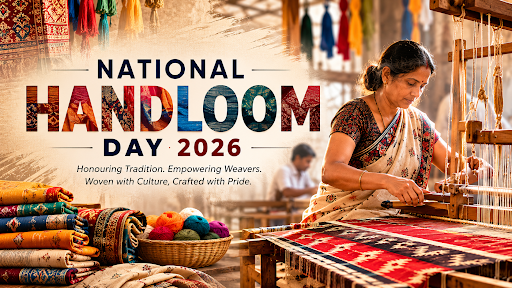
The Ministry of Textiles is observing the 12th National Handloom Day on 7 August 2026, with President Droupadi Murmu as Chief Guest.
What is National Handloom Day?
National Handloom Day is observed every year on 7 August to honour India's handloom weavers and promote indigenous, handwoven textiles.
The day commemorates the Swadeshi Movement, launched on 7 August 1905 at the Calcutta Town Hall, which encouraged people to use indigenous products and boycott foreign goods.
-
The date directly links the freedom struggle's self-reliance spirit to the modern "Vocal for Local" and Atmanirbhar Bharat vision.
The day was first observed in 2015 by the Government of India; 2026 marks its 12th edition.
Indian Handloom Sector
Traditional weaving clusters: States like Tamil Nadu, West Bengal, Uttar Pradesh, Assam, and Andhra Pradesh host dense handloom clusters with distinct regional weaving styles.
GI-tagged handloom products: Products such as Banarasi Sarees, Pochampally Ikat, Kancheepuram Silk, and Chanderi Fabric hold Geographical Indication (GI) tags, protecting their authenticity and boosting export value.
Eco-friendly production: Handloom weaving has a low carbon footprint compared to powerloom and mechanised textile production.
Export potential: The Handloom Export Promotion Council (HEPC), a nodal body under the Ministry of Textiles, facilitates trade promotion and global marketing of Indian handloom products.
Artisan-based economy: Most production remains household-based, with 64.1% of weavers selling directly in the open market, while only 8.8% sell through co-operative societies — showing weak formal market linkage.
Importance of the Handloom Sector
Employment generation: The handloom sector employs 35.22 lakh workers, making it one of India's largest unorganised economic activities after agriculture. (Source: PIB)
Women-led livelihoods: Over 72% of handloom workers are women — the Handloom Census recorded 25.46 lakh women out of 35.22 lakh total workers (72.29%). (Source: PIB)
Rural economy: 88.7% of weaver households are located in rural areas, making handloom a key rural non-farm income source.
Cultural heritage: Handloom preserves region-specific weaves like Banarasi, Kanjeevaram, Pochampally, Chanderi, and Pashmina, each carrying centuries-old craftsmanship and identity.
Sustainable textile production: Handlooms use minimal or no electricity, making them one of the most eco-friendly textile production methods, aligned with global demand for sustainable fashion.
Government Initiatives
Handloom Development Programme (NHDP): Provides financial and technical support for cluster development, design innovation, and yarn access.
India Handloom Brand: A certification and branding initiative to promote high-quality, authentic handloom products in domestic and export markets.
Yarn Supply Scheme: Ensures subsidised yarn availability to weavers to reduce input costs.
Raw Material Supply Scheme: Supports weavers with timely and affordable access to raw materials.
Handloom Marketing Assistance: Facilitates weavers' participation in exhibitions, e-marketing, and trade fairs to expand market reach.
National Handloom Awards: Recognise outstanding weavers, designers, and entrepreneurs; 22 awards were conferred for 2025, including 3 Sant Kabir Handloom Awards.
Source: PIB
PRACTICE QUESTIONQ. Consider the following statements regarding National Handloom Day:
Which of the statements given above is/are correct? (a) 1 and 3 only (b) 2 only (c) 1, 2 and 3 (d) 3 only Answer: (a) 1 and 3 only Explanation: Statement 1 is correct: National Handloom Day is observed annually on 7 August to commemorate the Swadeshi Movement launched on the same date in 1905. The day was designated by the Government of India in 2015 to honor the handloom weaving community. Statement 2 is incorrect: The Handloom Export Promotion Council (HEPC) functions under the aegis of the Ministry of Textiles, not the Ministry of Commerce and Industry. It is a nodal agency constituted for the promotion of handloom exports. Statement 3 is correct: The 4th All India Handloom Census (2019-20) was conducted by the Ministry of Textiles (specifically the Office of the Development Commissioner for Handlooms). |