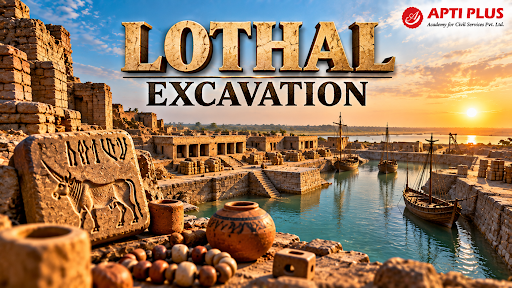
Why In News?
Phase 1A of the National Maritime Heritage Complex at Lothal has crossed 82% completion with 13 partner nations joining the project.
What is the National Maritime Heritage Complex?
The National Maritime Heritage Complex (NMHC) is a mega-project currently under construction in Lothal, Gujarat.
Developed under the Government of India’s Sagarmala Programme by the Ministry of Ports, Shipping and Waterways.
It is designed to be one of the largest maritime museum complexes in the world, dedicated to showcasing India's 5,000-year-old seafaring legacy.
Key Features & Attractions
Spread across nearly 400 acres with an estimated cost of ₹3,500 to ₹4,500 crore, the complex is being built in a phased manner:
-
The NMHC Museum: The core attraction featuring several themed galleries, including a massive gallery curated by the Indian Navy & Coast Guard.
-
Lothal City Recreation: A real-time, digital and physical recreation of the ancient Harappan port town to give visitors an immersive look into life 4,000 years ago.
-
World's Tallest Lighthouse Museum: A proposed landmark structure tracing the history of navigation markers along India's coastline
-
Coastal States Pavilion: Dedicated spaces where Indian coastal states and Union Territories can showcase their distinct regional maritime heritage and artifacts.
-
Theme Parks: Four distinct parks focused on different visitor experiences—a Maritime & Navy Park, a Climate Change Park, a Memorial Park, and an Adventure & Amusement Park.
-
Eco-Resorts & Hospitality: A "Museumotel", eco-resorts, and a maritime institute to support multi-day tourism and research.
Why is Lothal Historically Important?
Discovered in 1954 and excavated by the Archaeological Survey of India (ASI) between 1955 and 1962, this Indus Valley Civilization (Harappan) city served as a vital global trade hub connecting ancient India to Mesopotamia, Persia, and Egypt.
The World’s First Dockyard: Lothal's engineers built a massive, trapezoidal brick basin (measuring roughly 218 x 37 meters) designed to counter tidal mechanics. It allowed ships to sail in from the Arabian Sea via the Bhogavo River, berth safely, and load or unload cargo even during low tides.
Global Trade Hub: Artifacts found at the site—such as Persian Gulf seals, Egyptian beads, and foreign pottery—prove that Lothal was an international port. In return, India exported gemstones, ivory, cotton, and copper wares.
Advanced Civil Engineering & Town Planning: Like other major Harappan cities (Harappa and Mohenjo-daro), Lothal was divided into an upper town (the Acropolis for rulers) and a lower town. It featured a sophisticated underground drainage system, grid-patterned streets, public baths, and kiln-burnt brick houses.
Industrial and Craft Speciality: Lothal was a major manufacturing center. It housed a large bead-making factory that processed semi-precious stones (like carnelian and agate). Its metalsmiths were highly skilled in bronze and copper tools, and its potters created distinct, glossy redware.
Sophisticated Weights & Measures: Excavations revealed precise stone weights and an ivory scale capable of measuring tiny fractions, indicating a highly regulated commercial market and strict quality control.
Mystery of its Decline
Around 1900 BC, severe Bhogavo and Sabarmati river floods silted channels and severed deep-water access. Although a reduced population remained briefly, the great port city lost its trade standing and was ultimately abandoned.

Source: DDNEWS
|
PRACTICE QUESTION Q. With reference to the ancient Harappan site of 'Lothal', consider the following statements: 1. It is located near the Gulf of Khambhat along the ancient floodplains of the Bhogavo River in Gujarat. 2. Archaeological excavations at the site revealed a trapezoidal burnt-brick structure identified as a tidal dockyard. 3. Lothal is the only Indus Valley Civilization site where stone was used as the primary building material for residential architecture. 4. Persian Gulf seals discovered at Lothal provide material evidence of ancient trans-oceanic trade. Which of the statements given above are correct? A) 1, 2, and 4 only B) 1 and 3 only C) 2, 3, and 4 only D) 1, 2, 3, and 4 Answer: A Explanation: Statement 1 is correct: Lothal is situated in Gujarat between the Bhogavo and Sabarmati rivers, close to the Gulf of Khambhat. Statement 2 is correct: Excavations revealed a large trapezoidal/rectangular baked-brick basin widely identified by archaeologists as an ancient tidal dockyard. Statement 3 is incorrect: Mud bricks and kiln-burnt burnt bricks were the primary building materials at Lothal and other Indus Valley sites; stone was not the primary material for standard residential architecture anywhere exclusively. Statement 4 is correct: The discovery of Persian Gulf seals confirms maritime and trans-oceanic trade links between the Harappans and Western regions like Mesopotamia and Bahrain. |