Why In News?
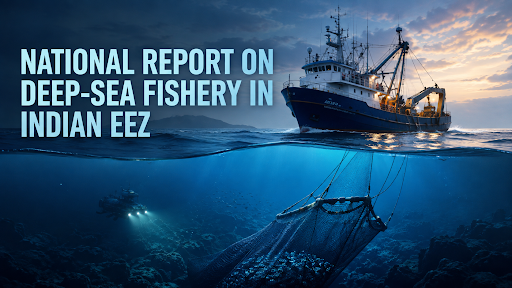
The Ministry of Earth Sciences (MoES) unveiled the "National Report on Deep-Sea and Distant-Water Fishery Resources of the Indian EEZ", prepared by the Centre for Marine Living Resources and Ecology (CMLRE), under the Ministry of Earth Sciences (MoES).
Highlights of the National Report on Deep-Sea Fishery in Indian EEZ
Unlocking the Mesopelagic "Twilight Zone" (200m to 1,000m depth): Identifies vast, unharvested biomass of lanternfishes (myctophids), deep-sea oceanic squids, and non-conventional pelagic organisms whose nightly vertical migration powers the ocean's "biological carbon pump", sequestering surface atmospheric carbon into the deep abyss to stabilize global climate.
Underexploited Continental Slope Demersal Stocks: Documents substantial harvestable populations of deep-sea caridean shrimps (Plesionika spinipes, Aristeus alcocki), deep-water perches (Epinephelus spp.), and scombroids beyond the 200-meter isobath, providing an alternative to depleted nearshore trawling grounds.
High-Value Oceanic Pelagic Fisheries: Quantifies export-grade distant-water resources, including Yellowfin Tuna (Thunnus albacares), Skipjack Tuna, Swordfish, and oceanic squids across the central Arabian Sea and the Bay of Bengal.
Mapping Vulnerable Marine Ecosystems (VMEs): Designates critical marine biodiversity hotspots requiring spatial protection, including the Kollam Bank off Kerala, Angria Bank off Maharashtra, the Mangalore Deep-Sea Slope, the Trivandrum Terrace, and the coral reef ridges of the Lakshadweep and Andaman-Nicobar Archipelagos.
Vertical Zonation of Marine Fisheries
|
Zone |
Depth Range |
Key Characteristics & Resources |
|
Coastal / Nearshore Zone |
0 - 50m |
Heavily exploited; Mackerel, Sardines, Coastal Prawns (Primary trawling zone). |
|
Offshore Shelf Zone |
50 - 200m |
Ribbonfishes, Threadfin Breams, Cephalopods (Target for mechanized fleets). |
|
Mesopelagic / Twilight Zone |
200 - 1,000m |
Lanternfishes (Myctophids), Oceanic Squids; critical for the Biological Carbon Pump. |
|
Deep-Sea Continental Slope |
>200m to Floor |
Deep-sea Red Shrimps, Deep-water Perches, Oceanic Tuna Longlining. |
Types of Fisheries
Inland vs Marine Fisheries:
-
Inland Fisheries: Encompasses aquaculture in freshwater ponds, rivers, reservoirs, and brackish water wetlands, contributing over 75% of India's total fish production.
-
Marine Fisheries: Covers capture fisheries in open seas and oceans, contributing ~25% of national fish output but generating over 80% of marine export values.
Coastal/Nearshore vs Deep-Sea/Offshore Fisheries:
-
Coastal Fisheries (0–50m depth): Confined within 12 nautical miles of territorial waters; faces intense congestion, artisanal gill-netting, and bottom trawling.
-
Deep-Sea Fisheries (>200m depth): Operates in the open ocean and continental slopes, requiring specialized motorized multi-day longliners and refrigerated sea vessels.
Pelagic vs Demersal Species:
-
Pelagic Fisheries: Surface and mid-water swimmers like Indian Mackerel, Oil Sardines, Ribbonfish, and Yellowfin Tuna.
-
Demersal Fisheries: Bottom-dwelling sea life living on or near the ocean floor, such as Groupers, Snappers, Flatfishes, and deep-sea prawns.
About Exclusive Economic Zone (EEZ)
Legal Definition under UNCLOS (1982): Under the United Nations Convention on the Law of the Sea (UNCLOS), a coastal state exercises sovereign rights over the exploration, exploitation, conservation, and management of marine living and non-living resources in its Exclusive Economic Zone (EEZ).
Maritime Boundaries of India:
-
Territorial Waters (0 to 12 Nautical Miles): Full state sovereignty governed by coastal state administrations under State Marine Fisheries Regulation Acts (MFRAs).
-
Contiguous Zone (12 to 24 Nautical Miles): Jurisdiction over customs, fiscal, immigration, and sanitary laws.
-
Exclusive Economic Zone (Up to 200 Nautical Miles): Extends over 2.02 million sq. km (0.86 million sq. km in Arabian Sea, 0.56 million sq. km in Bay of Bengal, and 0.60 million sq. km around Andaman-Nicobar), governed by the Union Government.
-
High Seas (Beyond 200 NM): Global ocean commons governed by international agreements like the High Seas Treaty / BBNJ Agreement (2023).

Evolution of the Indian Fisheries Sector
Pre-1970s (Subsistence Era): Characterized by non-motorized wooden catamarans and country crafts restricted to nearshore waters.
1970s–1990s (The First Blue Revolution): Introduction of mechanized bottom trawlers, synthetic nylon gillnets, and the establishment of dedicated fishing harbors along coastal states.
2000s–Present (Commercialization & Deep-Sea Transition): Scaling modern brackish-water shrimp aquaculture (Vannamei boom), launching the Pradhan Mantri Matsya Sampada Yojana (PMMSY), and transitioning fishers from bottom trawling to deep-sea tuna longlining.
Significance of the Indian Fisheries Sector
Economic Contribution: Contributes approximately 1.09% to total national Gross Value Added (GVA) and 6.72% to Agricultural GVA, generating annual fish production exceeding 17.5 million metric tonnes.
Foreign Exchange Earnings: Marine export revenues cross ₹60,000+ crore ($7.4+ billion) annually, with frozen shrimp and frozen fish dominating shipments to the USA, China, and the European Union.
Livelihood & Food Security: Sustains over 30 million fishers and coastal fish workers, serving as an indispensable low-cost source of animal protein, omega-3 fatty acids, and micronutrients for millions.
Key Government Schemes Supporting Fisheries
Pradhan Mantri Matsya Sampada Yojana (PMMSY): Operating with an unprecedented investment outlay of ₹20,050 crore (2020–2025) to modernize fishing harbors, establish cold chains, and provide up to 60% capital subsidies for deep-sea tuna longliners.
Fisheries and Aquaculture Infrastructure Development Fund (FIDF): Manages a dedicated fund of ₹7,522 crore providing concessional finance to state governments and private enterprises for modernized fish landing centers and ice plants.
Palk Bay Deep-Sea Fishing Scheme: Replaces destructive bottom trawlers operating in the sensitive Palk Strait with deep-sea tuna longline vessels, resolving transboundary fishing friction between Tamil Nadu and Sri Lanka.
Kisan Credit Card (KCC) for Fishers: Extends working capital loan support of up to ₹2 lakh at subsidized interest rates for boat fuel, nets, and recurring operational costs.
Sagar Parikrama Initiative: A coastal outreach initiative spanning all coastal states and UTs to deliver government schemes directly to grassroots fisherfolk communities.
|
State of World Fisheries (SOFIA) on Illegal, Unreported, and Unregulated (IUU) Fishing
|
Challenges in India's Fisheries Sector
Severe Nearshore Overcapacity vs. Deep-Sea Underutilization: Over 80% of India’s 2.5 lakh fishing vessels operate in shallow coastal waters (<50m depth), leading to overfishing of coastal stocks while valuable deep-sea EEZ tuna and squid resources remain largely unharvested.
Shortage of Specialized Deep-Sea Vessels and Cold Chains: Artisanal fishers lack multi-day longliners equipped with blast freezers (-40°C) and slurry ice systems needed to preserve high-value oceanic tuna for premium export markets.
Ecological Devastation from Bottom Trawling: Widespread bottom trawling scrapes the seabed, destroys coral habitats, and triggers persistent transboundary conflicts in geopolitical hotspots like the Palk Strait.
High By-Catch and Juvenile Mortality: Rampant use of small-mesh cod-end nets and illegal LED-light purse seining causes massive juvenile fish discards, depleting future commercial fish generations.
Significant Post-Harvest Losses: Lack of hygienic landing berths, solar cold rooms, and cold-chain transport at minor fish landing centers causes 15% to 20% post-harvest spoilage, costing the economy ₹15,000+ crore annually. (Source: NITI Aayog)
Climate Change & Tropical Sea Warming: Rapid warming of the Arabian Sea and Bay of Bengal induces marine heatwaves and alters the seasonal migration paths of pelagic sardine and mackerel shoals, impacting fisher livelihoods.
Way Forward
Accelerate Deep-Sea Longliner Fleet Modernization: Scale up capital subsidies under PMMSY to replace coastal bottom trawlers with modern, fuel-efficient tuna longlining-cum-gillnetting vessels fitted with onboard chilling facilities.
Operationalize Satellite Ocean Advisory Services: Integrate INCOIS Potential Fishing Zone (PFZ) advisories with CMLRE deep-sea biodiversity datasets, transmitting real-time oceanographic charts directly to boat navigation consoles via the indigenous NAVIC-GEMINI satellite network.
Enact the National Marine Fisheries Regulation & Management (NMFRM) Bill: Establish a clear statutory governance framework for regulating fishing vessels operating in the EEZ beyond 12 nautical miles to combat IUU fishing.
Enforce Strict Mesh-Size Regulations & Turtle Excluder Devices (TEDs): Mandate standard square-mesh cod-ends and TEDs across all mechanized fleets to eliminate juvenile by-catch and protect endangered Olive Ridley sea turtles along Odisha and Andhra coasts.
Establish Deep-Water Marine Protected Areas (MPAs): Legally notify ecologically sensitive oceanic zones (such as Angria Bank and Kollam Bank) as marine conservation reserves to preserve deep-sea breeding stocks.
Sustainable Exploitation of Mesopelagic Resources: Formulate cautious, science-backed harvesting protocols for lanternfishes (myctophids) to support fishmeal/aquaculture feeds without disrupting the ocean's biological carbon pump.
Expand Coastal Mariculture and Seaweed Cultivation: Scale up open-sea cage farming and dedicated multi-purpose Seaweed Parks (such as the PMMSY project in Tamil Nadu) to provide alternative, climate-resilient incomes for coastal women.
Modernize Minor Fish Landing Harbors: Upgrade coastal landing jetties with solar power, automated slurry ice plants, and traceability certification systems to reduce post-harvest losses below 5%.
Conclusion
The National Report on Deep-Sea Fishery in the Indian EEZ provides a robust scientific roadmap to transition India from overfished nearshore waters into a high-value, sustainable deep-sea Blue Economy, balancing marine conservation with coastal community prosperity.
Source: PIB
|
PRACTICE QUESTION Q. Discuss the socio-economic and ecological significance of the Pradhan Mantri Matsya Sampada Yojana (PMMSY) in modernizing India's fisheries infrastructure. (10 Marks, 150 Words) |