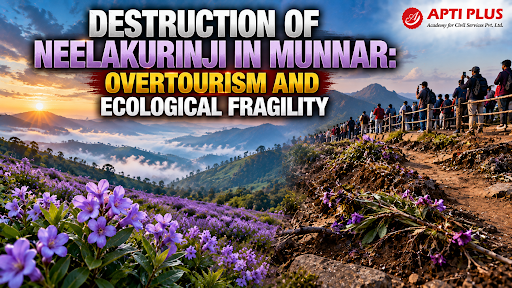
Why In News?
Forest officials in Kerala have raised alarms over the large-scale trampling, uprooting, and destruction of blooming Neelakurinji (Strobilanthes kunthiana) plants by crowds of unregulated tourists.
What is Neelakurinji?
-
Neelakurinji (Strobilanthes kunthiana) is an endemic, monocarpic shrub native to montane grasslands.
-
It belongs to the family Acanthaceae and exhibits synchronous mass flowering once every 12 years.
-
The purplish-blue blossom blankets hillsides, historically giving the Nilgiri Hills their designation as the "Blue Mountains".
-
The species thrives exclusively at elevations between 1,300 and 2,400 meters on exposed, mist-laden slopes.
Botanical And Ecological Adaptations
-
Plietesial Growth Cycle: The plant grows vegetatively for 12 years, blooms simultaneously, produces seeds, and undergoes mass die-back.
-
Mast Seeding Strategy: Synchronized blooming satiates seed predators and secures optimal seedling survival.
-
Keystone Floral Resource: The blossom supports native pollinators, particularly the Asiatic honeybee (Apis cerana) and giant bee (Apis dorsata).
-
Indigenous Ecological Marker: Indigenous communities like the Toda and Muthuvan historically track human age and seasonal events by kurinji flowering cycles.
|
Plietesial Species vs Regular Perennial Plants
|
Challenges In Kurinji Conservation
Invasive Exotic Tree Expansion: Fast-growing exotics alter montane grassland hydrology and displace native vegetation.
-
Example: Eravikulam National Park Vegetation Survey, black wattle (Acacia mearnsii) and eucalyptus plantations degraded over 40% of natural grassland cover.
Severe Habitat Fragmentation: Commercial land conversions break contiguous grassland corridors into isolated patches.
-
Example: Kurinji Sanctuary Boundary Assessment, commercial tea estates and tourism construction fragmented vital montane micro-habitats.
Unregulated Ecotourism Pressure: Heavy footfall during flowering seasons causes severe soil compaction and seedling trampling.
-
Example: Nilgiri Biosphere Ecotourism Audit, high tourist footfall destroyed unsprouted seed beds along high-altitude trekking trails.
Conservation Status
-
IUCN Status: Vulnerable under criteria A2c (indicating a population size reduction).
-
Wildlife Protection Act: Listed under Schedule III of India's Wildlife (Protection) Act, 1972.
-
Penalties: Uprooting, destroying, possessing, or cultivating the plant attracts a fine of ₹25,000 and up to three years of imprisonment.
Source: THEHINDU
|
PRACTICE QUESTION Q1. With reference to the plant species Strobilanthes kunthiana (Neelakurinji), consider the following statements:
Which of the statements given above are correct? (a) 1 and 2 only (b) 2 and 3 only (c) 1 and 3 only (d) 1, 2, and 3 Answer: (a) Explanation: Statement 1 is correct: Strobilanthes kunthiana is a plietesial (monocarpic) shrub that grows vegetatively for roughly 12 years before blooming synchronously, setting seed, and dying. Statement 2 is correct: The species is endemic to the Shola-grassland montane landscapes of the Western Ghats (Nilgiri Hills, Palani Hills, and Anamalai Hills) above 1,500 metres. Statement 3 is incorrect: Neelakurinji is a native, protected plant listed under Schedule III of the Wildlife (Protection) Act, 1972. Section 17A explicitly prohibits its uprooting, collection, or damage, carrying statutory criminal penalties under Section 51. |