Why In News?
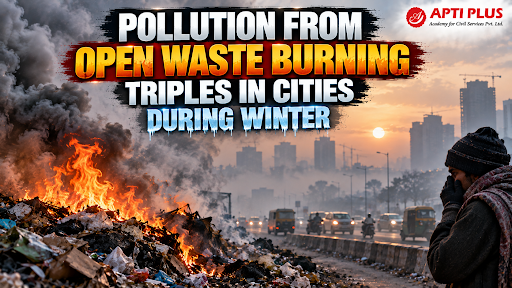
According to World Resources Institute (WRI) India, open waste burning in Indian cities triples during winter compared to summer, drastically elevating localized toxic smoke and emissions in lower-income neighborhoods.
What is Open Waste Burning?
Burning of Uncollected Waste: The low-temperature, uncontrolled combustion of uncollected municipal solid waste in open pits, vacant plots, and drains without air pollution controls.
Household Waste Burning: Backyard burning of domestic refuse by households in peri-urban fringes and unserved colonies lacking regular municipal garbage collection.
Roadside Waste Burning: Sweepers and local commercial vendors burning dry street leaf litter, cardboard packaging, and sweepings on pavements rather than transporting them to secondary transfer stations.
Municipal Waste Burning at Dumpsites: Spontaneous combustion or deliberate setting of fires at municipal landfill sites (such as Ghazipur and Bhalswa) fueled by accumulating, un-vented methane gas.
Plastic Waste Burning: The toxic burning of mixed polymers, plastic bags, and synthetic packaging, which releases persistent organic pollutants (POPs) including dioxins and furans.
Why Does Waste Burning Increase in Winter?
Drop in Temperatures: Night-watchmen, outdoor laborers, sanitation workers, and homeless populations burn waste paper, wood scraps, and plastics as an accessible source of heating and warmth.
Poor Atmospheric Dispersion: Winter meteorology brings dense, cold air and low boundary layer mixing heights, preventing the vertical dilution of smoke.
Stagnant Air and Calm Winds: Low horizontal wind speeds create stagnant atmospheric conditions across urban basins, causing local smoke plumes to linger at breathing level.
Seasonal Leaf Litter and Biomass Accumulation: Post-monsoon vegetation shedding and street dry leaf accumulation generate high volumes of garden biomass that municipal sweepers routinely burn.
Seasonal Weather Inversions: Calm anticyclonic atmospheric pressure systems suppress natural ventilation across the Indo-Gangetic Plains and inland urban valleys.
What Pollutants are Released?
Particulate Matter (PM 2.5 and PM 10): High concentrations of fine inhalable and respirable carbonaceous particles that penetrate deep into the alveolar regions of human lungs.
Carbon Monoxide (CO): A poisonous gas generated through incomplete combustion of dense, un-aerated waste piles that reduces the oxygen-carrying capacity of blood.
Nitrogen Oxides (NOx) and Sulfur Dioxide (SO2): Acidic precursor gases generated from the combustion of nitrogenous organic matter, rubber, and sulfur-containing domestic debris.
Volatile Organic Compounds (VOCs): Benzene, toluene, ethylbenzene, and xylene (BTEX) compounds released into the air that act as potent human carcinogens and precursors to ground-level ozone.
Black Carbon: High-albedo-reducing fine elemental carbon particles resulting from smoldering, low-temperature combustion, acting as a powerful short-lived climate pollutant (SLCP).
Toxic Carcinogens and Dioxins: Incomplete incineration of chlorinated plastics (PVC) produces polychlorinated dibenzo-p-dioxins (PCDDs) and polychlorinated dibenzofurans (PCDFs), which are highly toxic, bioaccumulative compounds.
Why is Winter Pollution More Dangerous?
Surface Temperature Inversion: Cool air becomes trapped beneath a layer of warm air, forming an atmospheric "lid" that halts vertical convection and seals toxic emissions near the surface.
Low Wind Velocity and Calm Conditions: Near-zero surface wind speeds prevent horizontal advection, causing emissions from neighborhood waste fires to accumulate locally.
Ground-Level Pollutant Trapping: Because open waste burning occurs directly at ground level, toxic smoke remains trapped within the human breathing zone (0–2 meters) rather than dispersing aloft.
Intensified Human Exposure: Stagnant winter conditions expose urban residents, street vendors, and slum communities to high peak concentrations of carcinogenic fumes for hours.
Acute Respiratory and Cardiovascular Illness: Fine particles combined with toxic gases trigger severe asthma attacks, chronic bronchitis, acute respiratory infections (ARI), and cardiovascular distress.
Reduced Atmospheric Visibility: Particulates interact with moisture in cool air to create toxic winter smog, severely degrading road, rail, and aviation visibility.
What are the Major Causes of Open Waste Burning?
Deficits in Door-to-Door Waste Collection: Inadequate municipal collection vehicles and personnel leave low-income unauthorized colonies and peri-urban slums without daily waste lifting.
-
Case Study: The WRI India study found that poorer areas in Tier 2 cities recorded the highest burning incidence, reaching nearly 84 incidents per square kilometer per day due to municipal service disparities.
Absence of Source Segregation: Wet, dry, hazardous, and plastic wastes are dumped together in mixed bins, rendering composting impossible and making burning the easiest disposal choice.
-
Case Study: CAG audits across municipal corporations in Uttar Pradesh and Bihar revealed that less than 30% of collected urban solid waste was segregated at source.
Weak Local Solid Waste Infrastructure: Tier 2 and Tier 3 urban local bodies (ULBs) lack adequate Material Recovery Facilities (MRFs), baling machines, and scientific composting pits.
-
Case Study: WRI India observed that in Tier 2 cities, the quantity of waste burned nearly doubled from 21 tonnes per day in summer to 41 tonnes per day in winter due to infrastructure deficits.
Prevalence of Informal Disposal and Dumping Pits: Commercial marketplaces and vegetable mandis discard large piles of packaging material in open drains and vacant plots, which are subsequently burned.
-
Case Study: Wholesale agricultural produce markets (APMC mandis) generate tons of wooden crates and plastic sacks that are burned nightly.
Poor Municipal Enforcement and Accountability: Fines under the Solid Waste Management Rules 2016 are rarely imposed due to shortages of municipal sanitation inspectors and lack of geo-tagged monitoring.
-
Case Study: National Green Tribunal (NGT) benches have repeatedly imposed environmental compensation fines on municipal commissioners for failing to prevent open burning in public spaces.
Way Forward
Universalizing 100% Door-to-Door Waste Collection: Expand decentralized collection fleets and mechanized tippers to achieve 100% waste collection across informal settlements and peripheral colonies.
-
Example: Indore Municipal Corporation Model, achieving zero open dumpsites through 100% segregated door-to-door waste collection and real-time GPS fleet tracking.
Mandating Strict Source Segregation at Household Level: Enforce three-way segregation (Wet, Dry, and Domestic Hazardous waste) with nominal user fees and spot fines for mixed waste disposal.
-
Example: Ambikapur Zero Waste Model (Chhattisgarh), where women Self-Help Groups segregate solid waste into 17 categories at decentralized Solid and Liquid Resource Management (SLRM) centers.
Decentralized Biomass Composting and Horticulture Waste Management: Establish ward-level compost pits and biomass shredders to convert fallen leaves and garden pruning waste into organic manure instead of burning.
-
Example: Mysuru Ward Composting Units, processing horticultural and vegetable market waste into municipal bio-compost within 48 hours.
Setting up Semi-Automated Material Recovery Facilities (MRFs): Construct modern MRFs equipped with optical sorters, magnetic separators, and baling machines to divert paper, cardboard, and recyclable plastics to certified recyclers.
-
Example: Surat Municipal Corporation MRF Infrastructure, processing over 400 tonnes of dry municipal waste daily through private-public partnerships.
Deploying Satellite Remote Sensing and Drone Surveillance : Utilize high-resolution thermal imaging cameras, aerial drones, and mobile squads under 'Operation Clean Air' to detect and penalize illegal waste fires.
-
Example: Gurugram Smart City Integrated Command and Control Centre (ICCC), using AI-enabled CCTV feeds to detect municipal waste smoke in real time.
Formulating Ward-Level Micro Action Plans: Formulate hyperlocal ward-level air pollution mitigation plans identifying "waste-sensitive" hotspots, supported by community reporting through mobile apps.
-
Example: Sameer App by CPCB & Delhi Green App, allowing citizens to geotag and report open garbage burning, with mandatory municipal resolution within 24 hours.
Conclusion
WRI India shows winter open waste burning triples, driven by municipal service inequities harming the urban poor. Solutions require universal waste collection, clean heating, ward composting, and NCAP enforcement beyond fines.
Source: THEHINDU
PRACTICE QUESTIONQ. Open waste burning in Indian cities is both an environmental pollution crisis and an indicator of deep urban service inequalities. Analyze (15 Marks, 250 Words) |