Why In News?
Operation Trident successfully dismantled a cross-border drug cartel across Assam, Mizoram, and Manipur.
What is Operation Trident?
It is a multi-agency anti-drug and financial crackdown led by the Narcotics Control Bureau (NCB) to dismantle a transnational drug and hawala trafficking network in Northeast India.
● Lead Agency: Narcotics Control Bureau (NCB) in coordination with the Enforcement Directorate (ED), Mizoram Police, and police forces from Assam and Manipur.
● Geographical Scope: 38 simultaneous locations across Assam, Mizoram (Aizawl, Champhai, Lawngtlai), and Manipur (Churachandpur), targeting the cross-border "Death Triangle Corridor" (India, Myanmar, and Bangladesh).
● Strategic Shift: Unlike traditional enforcement focused solely on small drug seizures, Operation Trident targets the corporate-style financial and supply-chain infrastructure of cartels (hawala channels, bank accounts, and shell entities).
● Policy Alignment: Operationalises the Vision Document on Narcotics Control (2026–2029), which aims to eliminate drug networks completely by 31 December 2029.
About Narcotics Control Bureau (NCB)
It is India's apex nodal drug law enforcement and intelligence agency operating under the Ministry of Home Affairs.
● Origin:Established in 1986, under Section 4(3) of the Narcotic Drugs and Psychotropic Substances (NDPS) Act, 1985.
● Headquarters: New Delhi.
● Constitutional Link: Grounded in Article 47 of the Constitution, which directs the State to bring about the prohibition of the consumption (except for medicinal purposes) of intoxicating drugs and-drugs injurious to health.
● Head of Agency: Headed by a Director-General, an Indian Police Service (IPS) officer.
Core Functions & Role
● Apex Coordination: Coordinates actions between central agencies, state police forces, customs, and international organizations.
● Intelligence & Interdiction: Collects, analyzes, and disseminates intelligence data regarding drug seizures, trafficking routes, and modus operandi.
● International Liaison: Acts as India's national contact point for global bodies like Interpol, the UN Office on Drugs and Crime (UNODC), and International Narcotics Control Board (INCB).
● Enforcement Limitations: It does not replace state police; rather, it supplements and coordinates multi-agency enforcement under the NDPS Act, Customs Act, and Drugs and Cosmetics Act.
Significance
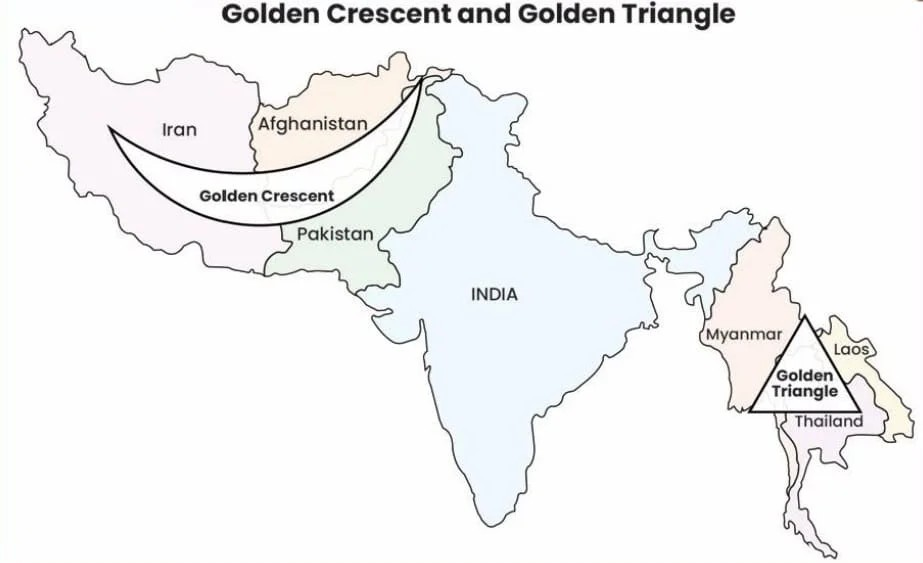
● Vulnerability Zones: India is sandwiched between the Golden Crescent (Iran, Afghanistan, Pakistan) in the west and the Golden Triangle (Myanmar, Laos, Thailand) in the east.
● Emerging Trends: Increased shift toward synthetic drugs, darknet/cryptocurrency drug networks, maritime/coastal trafficking, and drone-based smuggling across western borders (such as Punjab).
● Key Interventions: Initiatives like Nasha Mukt Bharat Abhiyaan, PITNDPS Act 1988 (Prevention of Illicit Traffic in Narcotic Drugs and Psychotropic Substances), and targeted operations like Operation Trident.
About Enforcement Directorate (ED)
It is India's premier financial investigation and economic intelligence agency. It operates under the Department of Revenue, Ministry of Finance.
● Origin: Established in 1956, as an 'Enforcement Unit' in the Department of Economic Affairs to handle exchange control law violations under the Foreign Exchange Regulation Act (FERA 1947).
● Renamed & Transferred: It was renamed the Enforcement Directorate in 1957 and transferred to the Department of Revenue in 1960.
● Current Mandate: With the repeal of FERA and the introduction of economic liberalization, it now enforces modern fiscal and criminal laws.
Core Acts Enforced by the ED
● FEMA 1999 (Foreign Exchange Management Act): A civil law aimed at external trade and payments, promoting the orderly development and maintenance of foreign exchange markets in India.
● PMLA 2002 (Prevention of Money Laundering Act): A criminal law designed to prevent money laundering and to provide for the confiscation of property derived from, or involved in, money laundering.
● FEOA 2018 (Fugitive Economic Offenders Act): A law targeted at holding economic offenders who have fled the jurisdiction of Indian courts accountable by attaching and confiscating their properties.
● COFEPOSA 1974 (Conservation of Foreign Exchange and Prevention of Smuggling Activities Act): Empowers the agency with powers of preventive detention in certain cases.
Source: PIB
|
PRACTICE QUESTION Q. The term “Death Triangle Corridor”, occasionally seen in the context of security affairs, relates to illicit cross-border trafficking connecting India with which of the following countries? (a) Pakistan and Afghanistan (b) Myanmar and Bangladesh (c) Nepal and Bhutan (d) Thailand and Laos Answer: (b) Explanation: The “Death Triangle Corridor” is a transnational trafficking route through which syndicates move illicit consignments of methamphetamine and heroin across India, Myanmar, and Bangladesh. |