Why In News?
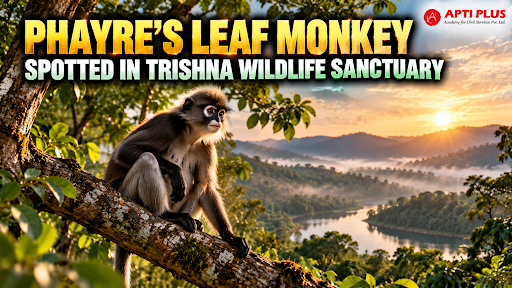
A rare pair of Phayre’s Leaf Monkeys, popularly known as the Spectacle Monkey, was photographically documented in Trishna Wildlife Sanctuary.
About Phayre’s Leaf Monkey
-
Common Name: Also known as the Spectacled Leaf Monkey or Spectacled Langur, it is an arboreal primate species native to South and Southeast Asia.
-
Physical Traits: Easily recognized by prominent pale/white rings surrounding its eyes that resemble spectacles, along with lighter pigmentation around its mouth.
-
Habitat: Dense tropical semi-evergreen forests and moist mixed deciduous forests. In India, its primary stronghold is in Tripura, particularly within protected areas like Trishna Wildlife Sanctuary and Sepahijala Wildlife Sanctuary.
-
Behavior & Diet:
-
Arboreal & Diurnal: Spends the majority of its time in upper forest canopies and is active during the day.
-
Folivorous Diet: Primarily feeds on young leaves, plant shoots, seeds, flowers, and fruits.
-
Conservation Status:
-
IUCN Red List: Endangered.
-
Wild Life (Protection) Act, 1972: Protected under Schedule I.
-
Threats: Rapid habitat destruction, forest fragmentation, canopy degradation, encroachment, and local poaching pressures.
About Trishna Wildlife Sanctuary
-
Location: Located in the South Tripura district of Tripura, close proximity to the international border with Bangladesh.
-
Establishment & Area: Officially notified as a wildlife sanctuary in 1988.
-
Core Protected Zone: In 2009, a core section of the sanctuary was notified as Rajbari (Bison) National Park to enhance habitat protection for wild bovids.
-
Vegetation & Ecosystem Types:
-
Comprises three major forest types: Tropical Semi-Evergreen Forest, Moist Mixed Deciduous Forest, and Savannah Woodland.
-
Houses 230 tree species, 400 herb species, 110 shrub species, and 150 climber species.
-
Medicinal Flora: Abundant in indigenous medicinal plants such as Tulsi, Kurcha, Vasak, Sarpagandha, Rudraksha, Bel, and Kalmegh.
-
Endemic Bamboo: Characterized by dense patches of Oxytenanthera nigrociliata (locally called Kaillai bamboo), which serves as a vital dietary resource for local herbivores.
-
Faunal Diversity & Primate Haven:
-
Flagship Species: Popularly known as the "Eden of Bison" for harboring a key population of the Indian Gaur (Bos gaurus gaurus), listed as Vulnerable on the IUCN Red List and under Schedule I of the Wild Life (Protection) Act, 1972.
-
Primate Diversity: Serves as a vital refuge for 5–6 primate species, including the Western Hoolock Gibbon (India's only native ape species), Phayre’s Leaf Monkey, Capped Langur, Golden Langur, Pig-tailed Macaque, Rhesus Macaque, and Bengal Slow Loris.
-
Avifauna & Reptiles: Supports bird species like the Pheasant-tailed Jacana, White-breasted Kingfisher, Black Drongo, Tailorbird, Jungle Myna, and Hornbills, as well as reptiles like the Python and King Cobra.
-
Key Eco-Tourism & Conservation Features: Includes the Butterfly Eco-Park (Joychandpur), natural water bodies like Trishna Lake, and border security management measures (e.g., barbed-wire habitat fencing) to curb transboundary poaching.
Source: THEHINDU
|
PRACTICE QUESTION Q. Which of the following protected areas houses the "Rajbari National Park" within its core area? (a) Sepahijala Wildlife Sanctuary (b) Trishna Wildlife Sanctuary (c) Rowa Wildlife Sanctuary (d) Gumti Wildlife Sanctuary Answer: (b) Explanation: Rajbari National Park (formally known as Bison National Park), covering an area of approximately 31.63 sq. km, was established in 2007 within the core zone of Trishna Wildlife Sanctuary in South Tripura district to conserve the Indian Gaur (Bos gaurus). |