Why In News?
A recent study of the Pichavaram mangrove ecosystem estimated its Total Economic Value (TEV) at ₹2,485.38 crore, reflecting the ecological, economic and social benefits it provides.
About Pichavaram Mangroves
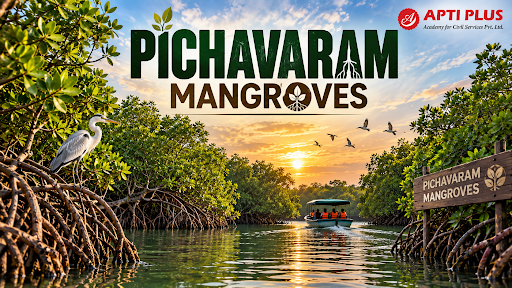
It spans over 1,400 hectares between the Vellar and Coleroon river estuaries in the Cuddalore district of Tamil Nadu.
-
Ramsar Status: Designated as Ramsar Wetland of International Importance in 2022.
-
Unique Island Archipelago Topography: Features over 1,770 permanent islands separated by an intricate labyrinth of tidal waterways and mudflats.
-
Prominent Mangrove Halophytes: Houses dense colonies of Rhizophora apiculata, Rhizophora mucronata, Avicennia marina, and Avicennia officinalis.
-
Specialized Morphological Adaptations: Exhibits stilt prop roots, pencil-like breathing pneumatophores, viviparous seedlings, and leaf salt-excretion glands.
-
Commercial Fisheries Support: Functions as a vital breeding and feeding nursery for commercially valuable tiger prawns, mud crabs, and finfishes.
-
Ecotourism: Generates sustainable municipal tourism revenue through boating safaris and migratory waterbird observation.

Total Economic Value (TEV) of Pichavaram Mangrove

Ecological and Climate Resilience Functions
Blue Carbon Sequestration: Dense mangrove soils sequester organic carbon at rates up to 10 times higher than mature terrestrial tropical forests.
Shoreline Stabilization & Soil Erosion Control: Traps riverine sediments in estuarine intertidal zones, preventing severe sea-water intrusion and coastal land loss.
Historical Tsunami Shield Verification: Pichavaram's dense canopy blunted the lethal force of the 2004 Indian Ocean Tsunami, shielding inland hamlets from devastation.
Avian Refugium on Central Asian Flyway: Sustains over 177 species of resident and migratory waterbirds, including threatened spot-billed pelicans and painted storks.
Estuarine Water Filtration & Bioremediation: Bio-accumulates toxic heavy metals and absorbs agricultural agrochemical runoff before it enters the Bay of Bengal.
Microclimate Temperature Regulation: High evapotranspiration rates generate regional evaporative cooling, moderating coastal thermal extremes.
Primary Threats to Pichavaram Mangroves
Upstream Freshwater Starvation: Dams on the Cauvery and Coleroon rivers trap freshwater and alluvial silt, increasing estuarine hyper-salinity.
Commercial Aquaculture Encroachment: Unauthorized chemical prawn farming discharges toxic effluents and encroaches directly onto intertidal mudflats.
Sea-Level Rise & Coastal Squeeze: Anthropogenic infrastructure prevents mangroves from migrating naturally landward as sea levels rise.
Plastic Pollution & Solid Waste Inundation: Upstream urban discarded non-biodegradable plastics choke breathing pneumatophore root systems.
Invasive Insect & Pathogen Infestations: Prolonged hyper-salinity stresses forest stands, leaving Avicennia trees vulnerable to catastrophic defoliator caterpillar outbreaks.
Government Conservation Initiatives
MISHTI Scheme: The Mangrove Initiative for Shoreline Habitats & Tangible Incomes promotes intensive mangrove afforestation along 5,400 km of coastline.
Tamil Nadu Coastal Restoration Mission: Implemented with World Bank support to restore degraded coastal ecosystems and expand blue-carbon mangrove buffers.
Coastal Regulation Zone (CRZ) Notification, 2019: Designates mangrove ecosystems as environmentally critical CRZ-IA zones where all commercial construction is strictly prohibited.
Ramsar Wetland Site Conservation Action Plan: Coordinates multi-agency research and surveillance funding to preserve Pichavaram's ecological character under international treaty norms.
Way Forward
Guarantee Environmental Environmental Flows (e-Flows): Mandate minimum seasonal freshwater releases from the Lower Anaicut dam to preserve optimal estuarine salinity balances.
Scale Fish-Bone Canal Bank Reforestation: Excavate artificial tidal canals in degraded saline flats to restore twice-daily seawater flushing for mangrove saplings.
Institutionalize Domestic Blue Carbon Trading: Establish certified blue-carbon offset credits under India's Carbon Credit Trading Scheme (CCTS) to fund local mangrove stewardship.
Crackdown on Unauthorized Aquaculture: Enforce statutory demolitions of illegal shrimp hatcheries violating CRZ-IA protection buffers.
Empower Grassroots Village Forest Committees: Replicate participatory mangrove management by granting local fishing panchayats legal co-management stewardship rights.
Learn from Successful Models
-
Sundarbans Bio-Shield Coastal Wall: Planted 15 crore mangrove seedlings across West Bengal delta islands, drastically dampening Cyclone Amphan storm damage.
-
Mikoko Pamoja Community Carbon Project (Kenya): World's first community-led mangrove carbon project selling verified carbon credits to fund village drinking water and school systems.
-
Matang Mangrove Forest Reserve (Malaysia): Implemented a sustainable 30-year rotational harvesting and replanting framework preserving biodiversity while yielding stable timber revenue.
Conclusion
Integrating scientific total economic valuation into coastal development policies ensures that India's mangrove bio-shields are preserved as indispensable natural capital against climate disasters.
Source: thehindu
|
PRACTICE QUESTION Q. Discuss the natural disaster mitigation role played by mangrove bio-shields along the Indian coastline. 150 words |