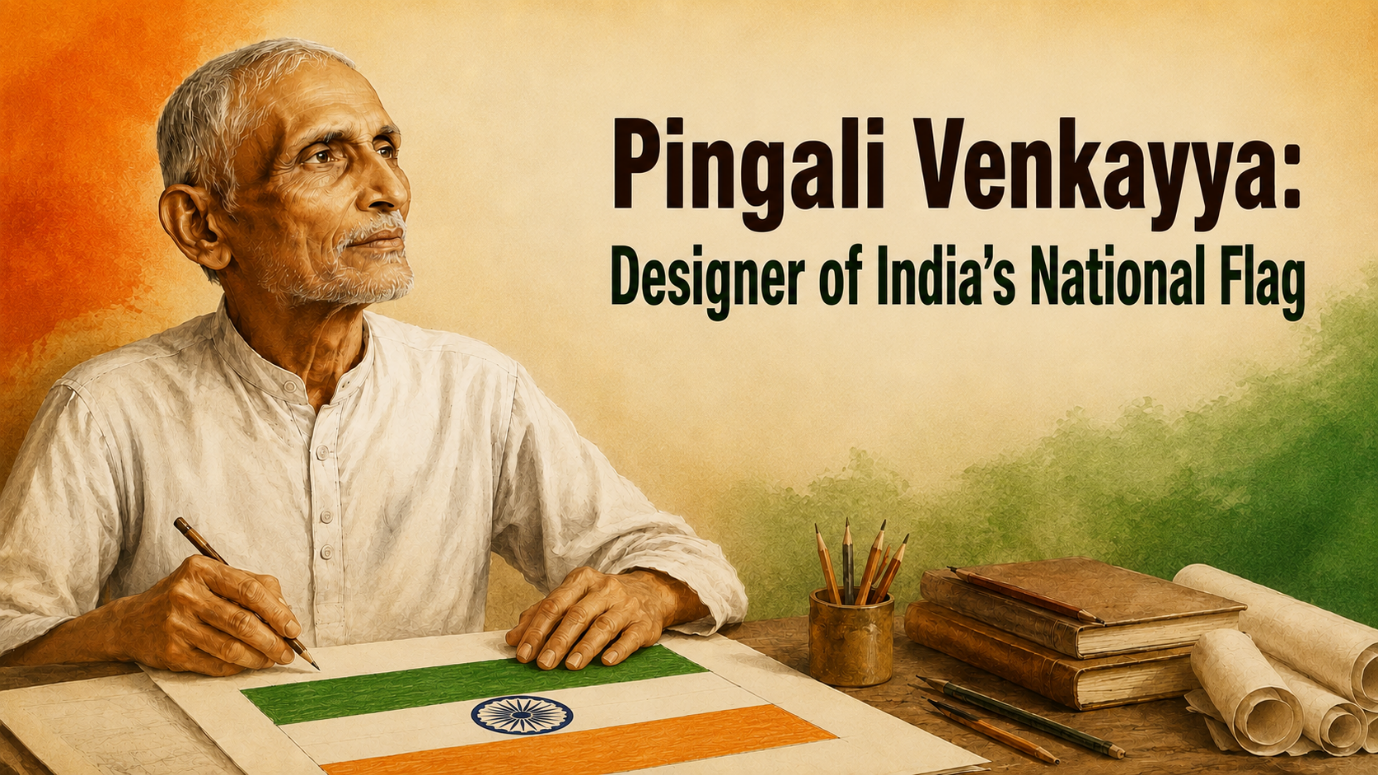
Why In News?
The Prime Minister praises freedom fighter Pingali Venkayya on his 150th birth anniversary on August 2.
Who was Pingali Venkayya?
Pingali Venkayya (1876–1963) was a freedom fighter, educationist and the principal designer of India's National Flag (Tiranga).
Early Life: Born on August 2, 1876, in Bhatlapenumarru, Andhra Pradesh, he received his education at Hindu High School and City College, Colombo.
Polymathic Genius: He earned the title "Japan Venkayya" for his fluency in Japanese, "Patti Venkayya" for his cotton research, and "Diamond Venkayya" for his expertise in geology.
Gandhian Association: He served as a soldier in the British Indian Army during the Anglo-Boer War (1899–1902), where he met Mahatma Gandhi.
Contribution to the National Flag
Design Evolution: He published a book in 1916 titled "A National Flag for India", which featured 24 different flag designs
Swaraj Flag: During the 1921 All India Congress Committee (AICC) session in Bezwada (Vijayawada), he designed the Swaraj Flag with red and green stripes and a spinning wheel.
Modern Tricolour: Following Mahatma Gandhi’s suggestion to include white for religious equality, the design evolves into the current tricolour, with the Dharma Chakra replacing the spinning wheel. The Indian National Congress adopted this design in 1931.
Symbolism of the National Flag
-
Saffron: Represents strength, courage, and sacrifice.
-
White: Signifies peace and absolute truth.
-
Green: Highlights growth, fertility, and auspiciousness.
-
Dharma Chakra: Indicates continuous progress within the white band.
The National Flag was adopted by the Constituent Assembly on 22 July 1947, symbolising India's sovereignty, unity and democratic values.
Other Contributions
-
Freedom Movement: He participated in the Vande Mataram and Home Rule movements between 1906 and 1922.
-
Nation Building: He serves as an advisor to the Mineral Research Department and publishes the book "The Mother of Diamonds" in 1955.
Source: PIB
|
PRACTICE QUESTION Q. Consider the following statements regarding Pingali Venkayya: 1. He met Mahatma Gandhi during the Anglo-Boer War in South Africa. 2. He presented the first draft of the National Flag at the Lahore Session of the Indian National Congress in 1929. Which of the statements given above is/are correct? (A) 1 only (B) 2 only (C) Both 1 and 2 (D) Neither 1 nor 2 Answer: (A) Explanation: Statement 1 is correct: Pingali Venkayya joined the British Indian Army at a young age and was deployed to South Africa during the Second Anglo-Boer War (1899–1902). It was during this period that he met Mahatma Gandhi for the first time, forging a lifelong association based on Gandhian principles. Statement 2 is incorrect: Pingali Venkayya did not present the draft at the Lahore Session in 1929. Instead, he presented the first basic design of the national flag (the Swaraj Flag) to Mahatma Gandhi during the Vijayawada (Bezwada) Session of the All India Congress Committee (AICC) in 1921. His original design consisted of red and green bands representing the two major religious communities, which later evolved into the tricolour. |