Why in News?
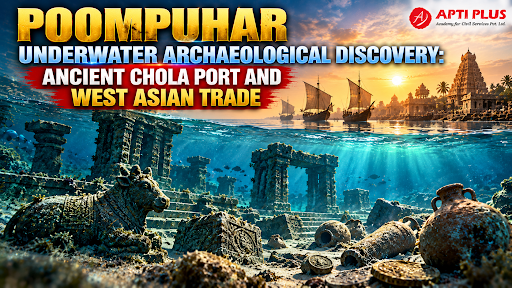
Marine archaeologists and researchers exploring the seabed approximately two kilometres off the coast of Poompuhar in Tamil Nadu have retrieved significant underwater archaeological remains.
Key Discoveries
Offshore Survey Findings |
Historical / Archaeological Significance |
|
|
Geographic Location |
2 km off the modern coast of Poompuhar, Mayiladuthurai district, Tamil Nadu |
Corroborates historical littoral migration and deep-sea coastal submergence of the ancient Chola port. |
|
Key Ceramic Finds |
Torpedo jar fragments, coarse earthenware, and black-and-red ware |
Definitive material signature of direct maritime trade links with the Sasanian and Early Islamic Persian Gulf/West Asia. |
|
Submerged Structures |
Boulder alignments, stone anchors, brick masonry, and wharf structures |
Demonstrates sophisticated harbor engineering, port-based urbanism, and offshore anchorage facilities. |
|
Chronological Range |
Early Historic (Sangam era, 3rd century BCE) to Early Medieval (9th–12th century CE) |
Confirms continuous maritime utilization of the Kaveri delta by early and imperial Chola seafaring networks. |
About Poompuhar
Poompuhar (also known as Kaveripoompattinam, Kaveripattinam, or Puhar) was an ancient port city and secondary capital of the Early Chola Kingdom during the Sangam Age.
-
Current Location: It is located in the Mayiladuthurai district of Tamil Nadu. It sits precisely at the estuary ('Puhar' in Tamil) where the Cauvery River empties into the Bay of Bengal on the Coromandel Coast.
Historical Significance
-
Chola Capital & Engine: It served as a political centre and secondary capital for the early Cholas. Legendary Chola King Karikala Chola is traditionally credited with expanding and constructing the port city, along with building massive embankments across the Cauvery River.
-
The Tiger Emblem: As a Chola hub, it operated under their royal standard featuring the tiger emblem.
-
Submergence and Natural Disasters: Geodynamic historical studies suggest the city was destroyed and submerged multiple times between the 4th and 5th centuries CE by rising sea levels, land subsidence, and catastrophic tsunami waves.
Literary References
-
Pattinappaalai: A Sangam poem composed by Katiyalur Uruttiran Kannanar that provides an elaborate layout of Poompuhar's busy docks, its customs officials, extensive markets, and heavy cargo.
-
Silappatikaram & Manimekalai: These twin Tamil epics are completely anchored in Poompuhar. Silappatikaram (by Ilango Adigal) chronicles the lives of Kovalan and Kannagi who belonged to the rich merchant community of this very city.
-
Foreign Accounts:
-
Named Kamara in the Greek travelogue Periplus of the Erythraean Sea.
-
Named Khaberis by the ancient geographer Ptolemy.
Maritime Trade Networks
-
Economic Gateway: Poompuhar functioned as an intermediate node connecting the agricultural hinterland of the Cauvery Basin to the Indian Ocean trade network.
-
Trade Partners: It maintained extensive overseas trade links with Sri Lanka, Southeast Asia, China, and the Western Roman Empire.
-
Commodities: Major exports included fine textiles, native spices (like pepper), gemstones, and pearls.
Archaeology & Recent Developments
-
Project Digital Poompuhar: Initiated by the Department of Science and Technology (DST), this project uses remote sensing, underwater robotics, and 3D geodynamic visualizations to digitally reconstruct the submerged layout of the port.
-
Key Artifact Finds: Marine excavations have unreeled ancient pottery dating back to the 4th century BCE and pieces of West Asian torpedo jars, verifying deep inter-continental timelines.
-
Sunken Infrastructure: Underwater explorations have identified elliptical and U-shaped brick structures on the seabed, along with what appear to be ancient dockyards, human settlements, and the remains of a sunken lighthouse at a depth of 50 metres.

Source: INDIANEXPRESS
|
PRACTICE QUESTION Q. With reference to the ancient port city of Poompuhar (Kaveripattinam) and maritime trade, consider the following statements: 1. Poompuhar served as the principal maritime emporium of the Early Cholas and is prominently described in the Sangam epic Silappadikaram. 2. Torpedo jars are characteristic transport vessels originating from the Greco-Roman Mediterranean used exclusively for olive oil. 3. The port was situated at the mouth of the Kaveri River as it emptied into the Bay of Bengal. Which of the statements given above is/are correct? (a) 1 and 2 only (b) 2 and 3 only (c) 1 and 3 only (d) 1, 2 and 3 Answer: (c) Explanation Statement 1 is correct: Poompuhar (also known as Kaveripoompattinam) operated as the primary economic gateway, maritime emporium, and secondary capital of the Early Cholas [INDEX]. It serves as the primary geographical setting for the great Tamil Sangam epic Silappatikaram (authored by Ilango Adigal), which provides comprehensive details regarding its wealthy merchant community, including Kovalan and Kannagi. Statement 2 is incorrect: Torpedo jars are characteristic unrepresented, long-range transport vessels that originate from West Asia (specifically the Persian Gulf / Sasanian Empire networks), not the Greco-Roman Mediterranean. Furthermore, archeological residue analysis shows they were primarily utilized for carrying wine, bitumen, and specific oils across ancient inter-continental trade networks, making the claim of Greco-Roman origin and exclusive olive oil utility factually incorrect. Statement 3 is correct: Poompuhar sat precisely at the estuary of the Cauvery (Kaveri) River as it emptied into the Bay of Bengal on the Coromandel Coast (modern-day Mayiladuthurai district, Tamil Nadu), providing a sheltered harbor for incoming international fleets. |