Why In News?
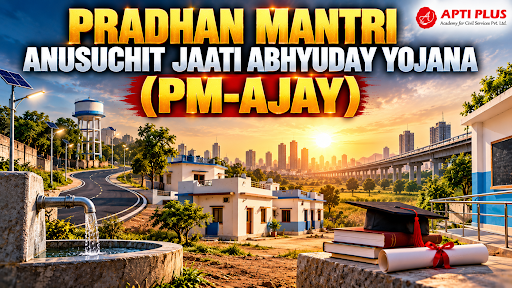
The Ministry of Social Justice and Empowerment (MoSJE) reported that the Pradhan Mantri Anusuchit Jaati Abhyuday Yojana (PM-AJAY) has established 18,093 Adarsh Grams and completed 785 student hostels nationwide.
What Is PM-AJAY?
Launched in FY 2021–22, PM-AJAY is a Centrally Sponsored Scheme formulated by merging three erstwhile schemes:
-
Pradhan Mantri Adarsh Gram Yojana (PMAGY);
-
Special Central Assistance to Scheduled Castes Sub-Plan (SCA to SCSP); and
-
Babu Jagjivan Ram Chhatrawas Yojana (BJRCY)
Nodal Implementing Ministry: Administered by the Department of Social Justice and Empowerment under the Ministry of Social Justice and Empowerment.
Target Group & Income Ceiling: Focuses on the socio-economic elevation of Scheduled Caste (SC) communities, giving priority to households with an annual income not exceeding ₹2.50 lakh.
Holistic Development Model: Combines infrastructure development, financial grants, residential educational hostels, and sustainable livelihood support into a single delivery framework.
Core Components Of PM-AJAY
-
Development of SC-Dominated Villages as "Adarsh Gram": Focuses on saturating critical public infrastructure and social welfare services in villages with high SC concentrations to bridge developmental disparities.
-
Grants-in-Aid for District and State-Level Socio-Economic Projects: Provides dedicated capital subsidies, skill-training grants, and asset creation support for individual and group livelihood ventures.
-
Construction and Repair of Hostels: Finances the establishment of modern residential hostels for SC boys and girls attending schools and higher educational institutions, reducing dropout rates.
Key Objectives Of The Scheme
-
Poverty Alleviation through Sustainable Livelihoods: Generates incremental employment opportunities via market-oriented skill training, micro-enterprise incubation, and income-generating assets.
-
Infrastructure Saturation in SC Localities: Bridges historical deficits in drinking water, internal roads, sanitation, electricity, anganwadis, and digital access in SC-dominated habitations.
-
Enhancing Literacy and Educational Retention: Provides secure, free residential school and hostel accommodations to SC students, especially in aspirational districts and remote blocks.
-
Reducing Inter-Group Disparities: Improves human development indicators (health, nutrition, literacy) among SC populations to align them with state and national averages.
Adarsh Gram Component
-
Village Eligibility Benchmark: Villages having 40% or more SC population and a total population of 500 or more are eligible for selection under the Adarsh Gram component.
-
Village Development Plan (VDP): Local administrative committees formulate a tailored VDP based on baseline socio-economic household surveys to identify infrastructure and service gaps.
-
Convergence Architecture: Leverages funds from existing Central and State flagship programs (e.g., Jal Jeevan Mission, PMGSY, Saubhagya, Swachh Bharat Mission) for basic infrastructure, using PM-AJAY funds as gap-filling capital.
-
Declaration of "Adarsh Gram": A village is formally declared an Adarsh Gram once it achieves baseline saturation across predefined socio-economic indicators and universal access to basic amenities.
Fragmented Schemes (Pre-2021) vs The Unified PM-AJAY Framework
|
What Are The Key Achievements Of PM-AJAY?
Financial Mobilisation: Over ₹11,186 crore has been released under the three components to State Governments and implementing agencies.
Adarsh Gram Component:
-
₹3,545.103 crore released specifically for gap-filling infrastructure in selected villages.
-
48,811 villages selected across participating States and Union Territories since FY 2014–15.
-
16,022 villages successfully saturated and declared as Adarsh Grams.
Grants-in-Aid Component:
-
More than ₹1,730 crore disbursed directly to States between FY 2021–22 and FY 2025–26.
-
Supported over 2.5 lakh beneficiaries through skilling, micro-enterprise funding, and livelihood toolkits.
Total Beneficiary Outreach: Over 34.61 lakh individuals across SC communities have directly benefited from educational, livelihood, and community assets.
Source: PIB
|
PRACTICE QUESTION Q. Examine the role of PM-AJAY in promoting socio-economic empowerment and inclusive development among Scheduled Caste communities. 150 words |