Why In News?
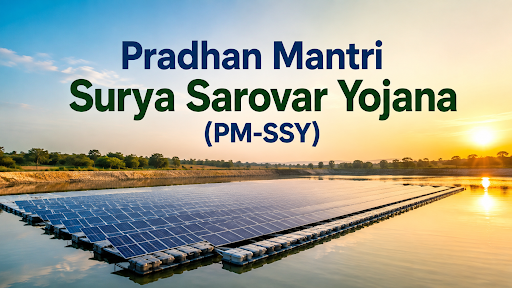
The Union Cabinet approves the Pradhan Mantri Surya Sarovar Yojana (PM-SSY) to generate clean electricity by deploying floating solar panels on lakes and dams.
What is PM-Surya Sarovar Yojana?
Core Objective: Establish Floating Solar Photovoltaic (FSPV) plants integrated with Battery Energy Storage Systems (BESS) to supply clean electricity during peak evening demand and enhance grid stability.
Nodal Ministry: Implemented by the Ministry of New and Renewable Energy (MNRE) through the Solar Energy Corporation of India (SECI), the nodal agency for large-scale renewable energy deployment.
Financial Allocation: Approved with a ₹5,070 crore outlay, including ₹1 crore/MW support for FSPV projects and ₹50 lakh/project for bathymetric and environmental studies.
Target Capacity: Aims to install 5,000 MW of floating solar capacity by 2030–31, significantly expanding India's operational floating solar base.
Battery Storage Mandate: Every project must integrate at least 2-hour Battery Energy Storage Systems (BESS), creating about 10,000 MWh of storage capacity to improve renewable energy integration and peak-load management.
Water Body Utilisation: Utilises reservoirs, dams and industrial water bodies, tapping India's estimated 102.18 GW floating solar potential without acquiring agricultural land.
Prominent Sites: Large reservoirs such as Hirakud (Odisha) and Omkareshwar (Madhya Pradesh) have been identified as key locations for large-scale deployment.
Supports National Targets: Contributes to India's target of 500 GW non-fossil fuel capacity by 2030 and Net Zero by 2070.
What is Floating Solar Photovoltaic (FSPV)?
Technology: Solar PV modules are mounted on floating platforms anchored on reservoirs, lakes and dams, with electricity transmitted through underwater cables to the grid.
Land Conservation: Saves productive agricultural land and reduces land acquisition conflicts, making renewable energy deployment more sustainable.
Higher Efficiency: Water cooling improves module efficiency by around 5–15% compared with ground-mounted systems. (Source: IRENA)
Water Conservation: Floating panels can reduce water evaporation by about 30–60%, benefiting irrigation and drinking-water reservoirs. (Source: World Bank)
Lower Carbon Emissions: Helps reduce dependence on fossil fuels and supports India's clean-energy transition.
Reduced Dust Accumulation: Water bodies minimise dust deposition, lowering maintenance costs and improving generation efficiency.
Grid Flexibility: Integration with Battery Energy Storage Systems (BESS) enhances grid reliability and supports renewable energy balancing.
Efficient Asset Utilisation: Converts idle water surfaces into productive clean-energy assets, improving resource efficiency.

Challenges
High Capital Expenditure: Floating Solar PV (FSPV) projects require higher upfront investment than ground-mounted plants due to floats, anchoring systems, corrosion-resistant structures and marine cables, although lifetime costs can become comparable because of higher energy yield.
Corrosion & Biofouling: Continuous exposure to water accelerates corrosion, algae growth (biofouling) and wear of anchoring systems, increasing maintenance complexity and operational costs.
Ecological Disruption: Excessive surface coverage can reduce sunlight penetration, alter dissolved oxygen levels and affect aquatic biodiversity, necessitating careful environmental impact assessment.
Grid Connectivity: Many suitable reservoirs are located in remote areas, requiring costly transmission infrastructure and grid augmentation.
Site Constraints: Reservoirs with high water-level fluctuations, strong winds, tourism activities, navigation or fisheries are less suitable for large-scale FSPV deployment.
Anchoring & Mooring Challenges: Designing reliable anchoring and mooring systems for varying water depths and seasonal fluctuations remains technically challenging.
Policy & Regulatory Gaps: Lack of standardised technical specifications, safety codes and reservoir-use guidelines slows project approvals and implementation.
Financing Constraints: High upfront costs and perceived technology risks increase the cost of capital for clean-energy projects in emerging economies.
Way Forward
Public-Private Partnerships (PPP): Promote PPP models to leverage private technology, innovation and investment while reducing fiscal burden.
Indigenous Manufacturing: Strengthen domestic production of floating platforms, HDPE floats, anchoring systems and marine-grade cables under Make in India to reduce import dependence.
Robust Environmental Safeguards: Mandate Environmental Impact Assessment (EIA), water-quality monitoring and biodiversity assessments, while limiting reservoir surface coverage to minimise ecological impacts.
Hydro–Solar Hybrid Projects: Integrate FSPV with hydropower reservoirs and Battery Energy Storage Systems (BESS) to improve grid stability and provide round-the-clock renewable power.
Investment in Energy Storage: Expand R&D in advanced battery technologies and hybrid renewable systems to improve reliability and peak-hour power supply.
Strengthen Grid Infrastructure: Upgrade transmission networks, smart grids and Green Energy Corridors for efficient evacuation of renewable power.
Occupational Safety Standards: Develop dedicated national standards for electrical safety, marine operations and emergency response for floating solar maintenance.
Lifecycle & Circular Economy: Establish mandatory Extended Producer Responsibility (EPR), recycling and safe disposal mechanisms for solar panels, floats and batteries after project life.
Research & Innovation: Support R&D on anti-corrosion materials, anti-biofouling coatings, lightweight floating structures and AI-based predictive maintenance through collaboration among MNRE, academia and industry.
Integrated Water-Energy Planning: Prioritise deployment on hydroelectric reservoirs, irrigation dams and abandoned mining pits, where existing infrastructure can reduce project costs and minimise land-use conflicts.
Conclusion
To secure a clean and water-rich future, the PM Surya Sarovar Yojana aims to transform India's water bodies into green powerhouses.
Source: PIB
|
PRACTICE QUESTION Q. Examine the technological and ecological challenges associated with the large-scale deployment of floating solar plants in India. 150 words |