Why In News?
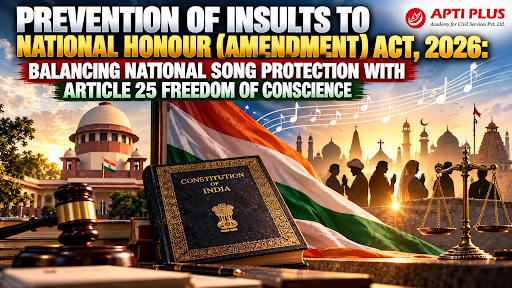
The debate over freedom of expression and the National Song has reached the Supreme Court of India following a challenge to the Prevention of Insults to National Honour (Amendment) Act, 2026
What Is the Legal Issue?
The core legal issue centers on whether the state can impose criminal penalties for non-participation in singing the National Song, and whether compelling individuals to recite religious verses violates constitutional freedoms.
National Song vs National Anthem: While Jana Gana Mana was designated as the National Anthem and explicitly protected under Section 3 of the Prevention of Insults to National Honour Act, 1971.
-
Vande Mataram was designated as the National Song through a statement by Constituent Assembly President Dr. Rajendra Prasad on 24 January 1950.
Statutory Expansion: The Prevention of Insults to National Honour (Amendment) Act, 2026 substituted Section 3 of the 1971 Act to place Vande Mataram on identical legal footing with the National Anthem.
Criminal Penalties: Under the amended Section 3, intentionally preventing the singing of Vande Mataram or causing a disturbance to an assembly engaged in its singing carries a penalty of up to 3 years imprisonment, a fine, or both.
-
Under Section 3A (inserted in 2003), repeat offenders face a mandatory minimum sentence of 1 year.
The Stanza Dispute: Written by Bankim Chandra Chattopadhyay in his 1882 novel Anandamath, Vande Mataram contains 6 stanzas. While the first 2 stanzas use secular natural imagery, stanzas 3 to 6 contain explicit devotional invocations to Hindu deities (Durga, Lakshmi, and Saraswati).
-
Critics argue that criminalizing non-singing compels a non-secular affirmation, contradicting the secular character of the Constitution.
Constitutional Provisions Involved
Article 19(1)(a) (Freedom of Speech and Expression): Encompasses the fundamental "right to silence". Compelling a citizen to vocalize specific words or religious verses under threat of penal sanctions infringes on negative speech liberties.
Article 25 (Freedom of Conscience and Religion): Protects an individual's right to freely profess, practice, and adhere to their religious conscience. Adherents of monotheistic faiths maintain that singing deity-invoking stanzas violates their core religious beliefs.
Article 26 (Freedom to Manage Religious Affairs): Safeguards religious denominations from state-enforced religious orthodoxy or mandatory participation in rites inconsistent with their doctrine.
Article 51A(a) (Fundamental Duties): Mandates every citizen to abide by the Constitution and respect the National Flag and the National Anthem. Article 51A(a) noticeably omits any mention of the National Song. Moreover, Fundamental Duties cannot override or abridge Fundamental Rights.

How the Supreme Court Balanced Statutory Protection With The Right To Conscience?
Judicial Protection: Hearing a writ petition against the Ministry of Home Affairs (MHA) protocol requiring all 6 stanzas to be sung, a Supreme Court ruled that individuals refusing to sing on religious grounds cannot face criminal prosecution.
Bijoe Emmanuel Precedent: The Supreme Court held that the ruling in Bijoe Emmanuel vs State of Kerala (1986) remains the law of the land, safeguarding the right to stand respectfully in silence without being compelled to sing.
Harmonizing Article 25 And Article 19(1)(a): Compelling citizens to recite deity-invoking stanzas under threat of imprisonment under the Prevention of Insults to National Honour (Amendment) Act, 2026 would infringe fundamental rights under Article 19(1)(a) (freedom of speech including the right to silence), Article 25 (freedom of conscience), and Article 26 (religious freedom).
Limits Of State Authority: The Supreme Court clarified that while the democratic state holds exclusive authority to define national symbols and prescribe official protocol, it cannot enforce symbolic orthodoxy or penalize passive, respectful non-participation.
Source: NEWINDIANEXPRESS
|
PRACTICE QUESTION Q. How does the Prevention of Insults to National Honour (Amendment) Act, 2026 reframe national symbolism while impacting the right to freedom of conscience under Article 25? 150 words |