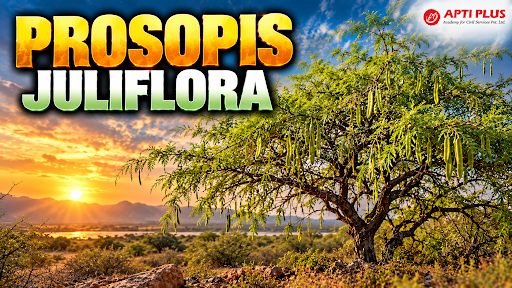
Why In News?
The Dharmapuri district administration in Tamil Nadu initiated a large-scale drive to eradicate 673.860 hectares of Prosopis juliflora across village panchayat water tanks, public channels, and government lands.
What Is Prosopis Juliflora?
Prosopis juliflora is an aggressive invasive alien plant species (a thorny shrub or small tree) belonging to the Fabaceae family, native to Mexico, South America, and the Caribbean.
Identity & Origin
-
Botanical Family: Fabaceae (legume family; a type of mesquite).
-
Native Range: Mexico, South America, and the Caribbean.
-
Introduction to India: Introduced by the British in the late 19th and early 20th centuries (notably in Delhi in the 1920s) for afforestation, firewood supply, and combating desertification.
-
Local Indian Names: Vilayati Kikar / Vilayati Babul (North India), Seemai Karuvelam (Tamil Nadu), Gando Baval (Gujarat), and Bellary Jaali (Karnataka).
Key Botanical Characteristics
-
Deep Root System: Functions as a phreatophyte, with taproots penetrating up to 50 meters deep to tap groundwater tables.
-
High Adaptability: Thrives in arid, semi-arid, rocky, and highly saline or alkaline soils with wide rainfall ranges (50–1,500 mm).
-
Reproductive Success: Prolific seed producer; seeds disperse rapidly through livestock droppings.
-
Allelopathy: Releases toxic biochemical compounds into the soil that inhibit the germination and growth of neighboring native flora.
Ecological & Environmental Impacts
-
Biodiversity Depletion: Forms impenetrable monocultures that suppress and replace indigenous vegetation and native grasses (e.g., encroaching significantly on Gujarat's Banni Grasslands).
-
Groundwater Depletion: Consumes substantial volumes of groundwater per kilogram of biomass, drying out local aquifers.
-
Wildlife & Pasture Degradation: Destroys natural grazing habitats for desert and grassland fauna (e.g., Great Indian Bustard habitats, desert fox) and starves livestock of nutritional forage.
-
Disease Vector Promotion: Provides nectar sugars that have been noted to enhance the survival and transmission capacity of malaria vectors (Anopheles mosquitoes) during dry spells.
Source: THEHINDU
|
PRACTICE QUESTION Q. With reference to Prosopis juliflora, consider the following statements:
Which of the statements given above are correct? (a) 1 and 2 only (b) 2 and 3 only (c) 1 and 3 only (d) 1, 2, and 3 Answer: (b) Explanation: Statement 1 is incorrect: Prosopis juliflora (commonly known as Seemai Karuvelam or Vilayati Kikar) is an invasive alien species native to Mexico, Central America, and South America, not the Mediterranean region of Southern Europe. It was introduced to India by the British in the late 19th and early 20th centuries to meet fuelwood shortages and green arid zones. Statement 2 is correct: The species exhibits strong allelopathic properties (negative allelopathy). It releases biochemical toxins through its leaves and roots into the soil, which actively suppress germination and inhibit the growth of surrounding native plants, leading to a loss of local biodiversity. Statement 3 is correct: Recognizing its severe ecological threat to groundwater tables and native flora, the Madras High Court has issued multiple directives and timelines for its systematic eradication across public and private lands in Tamil Nadu. It has mandated projects like Sezhumai Karuvoolam to uproot the species mechanically and restore native ecosystems. |