Why In News?
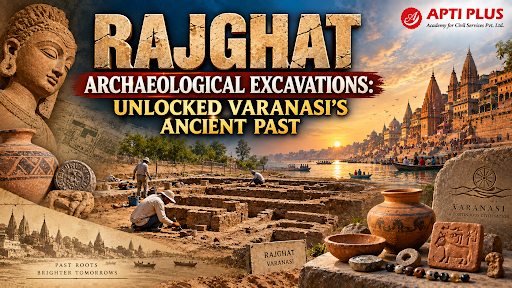
Banaras Hindu University (BHU) recently examined 22 boxes of Rajghat excavations stored for nearly 70 years, uncovering over 10,000 artefacts—including 3,000-year-old painted black pottery.
About Rajghat Site
-
Ganga-Varuna Confluence: Located on a high clay cliff at the Ganga and Varuna confluence in northern Varanasi.
-
Ancient Varanasi's Nucleus: The original archaeological mound and core settlement from which historic Varanasi expanded southward.
-
Material Link to Ancient Kashi: Serves as the physical capital of the Kashi Mahajanapada, recorded in Vedic and Buddhist texts.
-
Key Gangetic Heritage Site: Archaeological Survey of India (ASI)-protected urban archaeological site under the The Ancient Monuments and Archaeological Sites and Remains (AMASR) Act, 1958.
Rajghat Excavation
-
Accidental Railway Discovery (1940): Discovered in late 1940 during soil digging for the remodeling of the Kashi Railway Station near Malviya Bridge.
-
Preliminary ASI Salvage Digging (1940): Archaeologist conducted immediate rescue operations, unearthing hundreds of terracotta seals.
-
Systematic BHU Excavations (1957–1969): Banaras Hindu University archaeologists executed multi-season scientific excavations across six stratigraphic periods.
-
Modern Chronometric Re-Excavations (2000s): Re-excavations using radiocarbon dating, establishing that human occupation dates back to at least the 9th century BCE.
Key Archaeological Findings
-
Pre-NBPW Stratigraphic Layers: Uncovered Period I layers yielding coarse Red Ware and Black-and-Red Ware shards pre-dating the urban Iron Age.
-
Continuous Settlement from 800 BCE: Documented continuous occupational stratigraphy from the early Iron Age through the Mauryan, Shunga, Kushana, Gupta, and Gahadavala periods.
-
Northern Black Polished Ware (NBPW): Recovered exquisite, mirror-like glossy NBPW ceramic luxury bowls symbolizing the height of Second Urbanisation.
-
Silver & Copper Punch-Marked Coins: Unearthed punch-marked coinage and cast copper tokens demonstrating early monetized trade in the Mahajanapada era.
-
Terracotta Masterpieces: Discovered delicate human figurines depicting Mother Goddesses, animals, and fashionable Gupta-era coiffures.
-
Craft Tools in Ivory and Iron: Recovered iron spearheads, axes, chisels, bone styluses, and finely carved ivory combs indicating specialized artisan quarters.
-
Thousands of Clay Seals and Sealings: Collected over 2,000 clay seal impressions inscribed in Brahmi script across Mauryan, Kushana, and Gupta strata.
-
Gupta & Medieval Monumental Remains: Traced burnt-brick residential foundations, drainage systems, ring-wells, and temple fragments dating up to the 12th century CE.
Significance of the Seals
|
What Do the Artefacts Tell Us About Ancient Varanasi?
-
Second Urbanisation Nucleus: Confirms Varanasi emerged as a fortified economic metropolis alongside Pataliputra and Kaushambi in the 6th century BCE.
-
Thriving Industrial Craft Production: Proves the city was a renowned hub for metallurgy, glass bead manufacturing, textile weaving, and ivory carving.
-
Cross-Regional Riverine Trade Networks: Demonstrated by finding non-local semi-precious lapis lazuli from Badakhshan and carnelian from Gujarat in Rajghat trenches.
-
Unbroken Cultural and Religious Continuity: Documents 3,000 years of continuous cultural worship, featuring Shiva lingas, Nandi seals, and Buddhist votive tablets.
Source: INDIANEXPRESS
|
PRACTICE QUESTION Q. Consider the following pairs of ancient ceramic wares and their corresponding cultural periods: 1. Ochre Coloured Pottery (OCP) — Bronze Age / Copper Hoard Culture 2. Painted Grey Ware (PGW) — Early to Mature Iron Age 3. Northern Black Polished Ware (NBPW) — Second Urbanisation and Mahajanapada Period Which of the pairs given above are correctly matched? (a) 1 and 2 only (b) 2 and 3 only (c) 1 and 3 only (d) 1, 2, and 3 Answer: (d) 1, 2, and 3 Explanation:
|