Why In News?
Kolkata’s renowned Chaltabagan Durga Puja unveiled its 2026 festival theme ‘Nishan’, conceptualized around the socio-religious resistance and body-tattooing tradition of Chhattisgarh’s Ramnami Samaj.
What is the Ramnami Samaj?
Origin: The Ramnami Samaj (also known as Ramramiyas) is a Bhakti-centered reformist sect founded in the 1890s by Sant Parasuram in the rural plains of Chhattisgarh.
Geographical Distribution: Concentrated primarily along the Mahanadi river basin across the districts of Janjgir-Champa, Raipur, Bilaspur, Raigarh, and Baloda Bazar.
Caste Mobilization: Emerged among marginalized Dalit communities (primarily from the Chamar caste cluster) who faced institutionalized untouchability, strict spatial segregation, and bans on entering orthodox Hindu temples or reading Vedic scriptures.
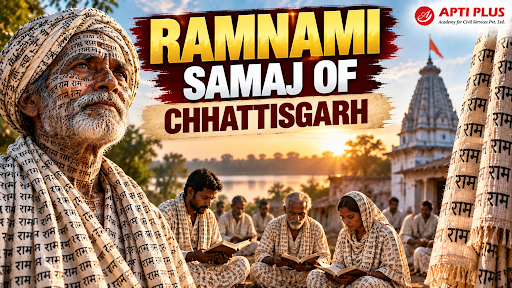
Radical Subversion through Tattoos: Denied entry into temples, community members permanently inscribed the sacred name "राम" (Ram) across their skin, transforming their physical bodies into inviolable, living temples of God.
Cultural and Devotional Practices of Ramnamis
Sacred Body Inscription (Godna): The tattooing process is performed using two wooden needles bound together, applying soot (Kajal) collected from kerosene lamps mixed with water. Devotees are categorized into hierarchical spiritual tiers based on tattoo coverage:
-
Shiromani: Devotees bearing the name of Ram tattooed only on the forehead or crown.
-
Sarvang Ramnami: Devotees whose entire bodies—arms, chest, back, and legs—are tattooed.
-
Nakhshikh Ramnami: The highest ascetic tier, completely tattooed from the crown of the head to the tip of the toenails, including eyelids, lips, and gums.
Devotional Regalia and Attire:
-
Ramnami Odhani (Chadar): Pure white hand-woven cotton shawls hand-block printed in red or black ink with the word "Ram" in Devanagari script.
-
Mor Mukut: A ceremonial crown crafted from naturally molted peacock feathers worn during congregations.
-
Ghungroos & Khartals: Ankle bells and wooden cymbals played rhythmically during day-long devotional singing.
Non-Temple Liturgical Practice: The sect does not construct temples, worship stone idols, or employ Brahmin priests; their worship consists entirely of collective community chanting (bhajan) and moral recitations from Tulsidas’s Ramcharitmanas.
Significance of the Ramnami Movement
Resistance against Untouchability: By inscribing the divine name permanently on their skin, the Ramnamis dismantled the purity-pollution binary of the caste system, asserting that their bodies were purer than orthodox sacred spaces.
Historic Legal Emancipation (1910s): When local upper-caste landlords (Malguzars) filed lawsuits against the community for "desecrating" the sacred name on untouchable bodies, colonial courts ruled in favor of the Ramnamis, recognizing their fundamental right to practice their faith and wear their inscribed attire.
Egalitarian Community Ethics: Ramnamis strictly adhere to non-violence (Ahimsa), vegetarianism, teetotalism, and gender equality, encouraging women to undergo godna, wear the Mor Mukut, and participate equally in scriptural recitation
How is the Ramnami Tradition Interlinked with the Bhakti Movement?
Nirguna Ram Philosophy: While they recite verses from Tulsidas's Ramcharitmanas, their philosophical understanding of "Ram" aligns with the Nirguna Bhakti tradition of Sant Kabir and Guru Ravidas—worshipping an unmanifest, omnipresent, formless divine consciousness rather than a mythological king or idol.
Vernacular Democratization: Replaces elite Sanskrit liturgical rituals with accessible Chhattisgarhi folk singing and vernacular Hindi poetry.
Spiritual Universalism: Affirms the medieval Bhakti tenet that true devotion requires no lineage, wealth, or ritual status: "Jat-pat poochhe na koi, Hari ko bhaje so Hari ka hoi" (None asks of caste or creed; whoever worships the divine belongs to the divine)
Source: THEPRINT
|
PRACTICE QUESTION Q. With reference to the 'Ramnami Samaj' of Chhattisgarh, consider the following statements: 1. The sect was founded in the late 19th century by Sant Parasuram as a reformist movement among marginalized Dalit communities. 2. Followers of the Ramnami Samaj practice elaborate idol worship inside consecrated temples dedicated to Lord Rama. 3. The practice of full-body tattooing (godna) was historically adopted as a peaceful corporeal protest against upper-caste exclusion from temples. Which of the statements given above are correct? (a) 1 and 2 only (b) 2 and 3 only (c) 1 and 3 only (d) 1, 2, and 3 Answer: (c) Explanation: Statement 1 is correct: The Ramnami Samaj was founded in the 1890s by Sant Parasuram in the Chhattisgarh region among Dalits who faced caste-based discrimination. Statement 2 is incorrect: The Ramnamis do not build temples or worship physical stone idols. Their devotion is non-institutional and centered on chanting the formless (Nirguna) name of Ram and reciting Tulsidas's Ramcharitmanas. Statement 3 is correct: Banned from entering temples by orthodox upper castes, the community tattooed the name "Ram" across their bodies, turning their physical forms into sacred spaces beyond upper-caste control. |