Why In News?
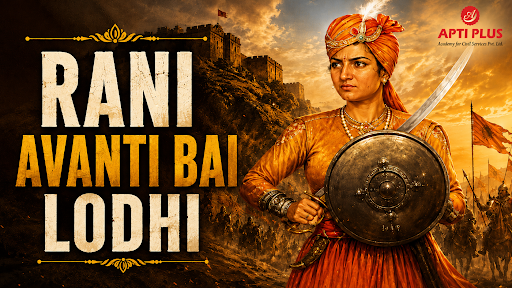
Defence Minister Rajnath Singh paid tribute to Rani Avanti Bai Lodhi, highlighting her courage, patriotism and leadership during the Revolt of 1857.
Who was Rani Avanti Bai Lodhi?
-
She was born on 16 August 1831 in Manakhedi village, Seoni, Madhya Pradesh.
-
Her father Rao Jujhar Singh was a zamindar and her mother was Krishna Bai.
-
She married Vikramaditya Singh, son of Ramgarh ruler Lakshman Singh.
-
Administrative Role: Due to her husband's illness, she took over the administration of Ramgarh State.
-
Military Skills: She developed expertise in horse riding and sword fighting, which later supported her armed resistance.
Role in the Revolt of 1857
-
Court of Wards: The British declared her husband incapable of ruling and her sons minors, bringing Ramgarh under the Court of Wards system.
-
Resistance: She expelled British-appointed officials and resumed control over Ramgarh's administration.
-
Peasant Mobilisation: She urged farmers to resist British revenue-related orders, linking political resistance with local economic grievances.
-
Black Bangles: She sent letters and two black bangles to local rulers, zamindars and malguzars, challenging them to join the struggle or accept humiliation.
-
Battle of Kheri: On 23 November 1857, her forces defeated the British force led by Mandla Deputy Commissioner Waddington.
-
Martyrdom: In March 1858, surrounded by British forces, she chose self-sacrifice rather than surrender.
Historical Significance
-
Regional Resistance: Her struggle demonstrates that the Revolt of 1857 extended beyond major centres such as Delhi, Kanpur and Lucknow.
-
Women in Resistance: She represents the important role played by women leaders in India's anti-colonial struggle.
-
Peasant Participation: Her appeal to farmers shows how revenue policies and political subordination helped mobilise local communities.
-
Tribal-Rural Linkages: Her resistance also highlights the participation of rural and regional communities in the broader uprising.
-
Leadership: She combined political administration, military mobilisation and popular support against colonial authority.
-
Memory and Legacy: Madhya Pradesh continues to commemorate her through institutions and public memory; Rani Avanti Bai Lodhi University in Sagar carries her name.
Conclusion
Her resistance transformed Ramgarh's political dispossession into a wider regional challenge to British authority, making her an important symbol of courage and anti-colonial leadership.
Source: TIMESOFINDIA
|
PRACTICE QUESTION Q. With reference to Rani Avanti Bai Lodhi and the 1857 Uprising, consider the following statements:
Which of the statements given above are correct? (a) 1 and 2 only (b) 2 and 3 only (c) 1 and 3 only (d) 1, 2, and 3 Answer: (a) 1 and 2 only Explanation: Statement 1 is correct: Rani Avantibai Lodhi was the queen and regent of the estate of Ramgarh (located in present-day Dindori/Mandla region of Madhya Pradesh). She took over the administration after her husband, King Vikramaditya Singh, fell ill and her sons were minors. Statement 2 is correct: During the 1857 Uprising, she raised an army of approximately 4,000 fighters. In November 1857, at the Battle of Kheri (near Mandla), her forces routed the British contingent commanded by Deputy Commissioner Captain Waddington, forcing the British to retreat. Statement 3 is incorrect: She never surrendered nor did she sign a subsidiary treaty with the British. When the British returned with reinforcements and surrounded her near the hills of Devharigarh, she chose self-sacrifice over captivity and fell upon her own sword on March 20, 1858, achieving martyrdom. |