Why In News?
The Gujarat Forest Department facilitates the breeding of the Indian Grey Hornbill for the fourth consecutive year in Gir National Park, following a reintroduction of 40 birds translocated from the Aravalli forests.
What is the Indian Grey Hornbill?
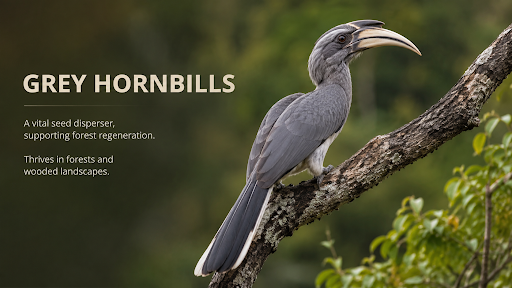
The Indian Grey Hornbill (Ocyceros birostris) is a medium-sized, brownish-grey bird characterized by a heavy, curved bill and a prominent casque.
Arboreal Nature: These birds spend the majority of their time on tall trees, though they descend to the ground to forage for food and collect mud pellets for nesting purposes.
Social Structure: They appear in pairs and engage in complex social activities, including bill-grappling and aerial jousting.
Vocalization: The species maintains a noisy presence, frequently producing distinct squealing calls.
Physical Characteristics and Appearance
Plumage: The bird features grey feathers across its entire body, contrasted by a light grey or dull white belly.
Horn Structure: A black or dark grey horn defines its profile, featuring a casque that extends to the point of curvature.
Sexual Dimorphism: Unlike many other avian species, the male and female exhibit a similar physical appearance.
Habitat and Distribution
Primary Habitats: The species thrives in deciduous forests, open woodlands, and thorn forests.
Human-Modified Landscapes: They successfully inhabit rural cultivation areas, urban gardens, and public parks.
Geographic Range: The population spans from north-east Pakistan and south Nepal to north-west Bangladesh, covering most of India, with the notable exception of Assam.
Diet and Ecological Role
Dietary Habits: The bird consumes a diet consisting primarily of fruits, with a strong preference for figs.
Seed Dispersal: They act as prime dispersers of seeds, facilitating forest regeneration by transporting the seeds of fruit-bearing trees across expansive territories.
Conservation Status
The International Union for Conservation of Nature (IUCN) lists the species under the Least Concern category, reflecting a stable population status across its range.
Source: THEHINDU
|
PRACTICE QUESTION Q. Consider the following statements regarding the Indian Grey Hornbill: 1. It is endemic exclusively to the Western Ghats of India. 2. It is classified as 'Endangered' under the IUCN Red List. 3. It exhibits a unique nesting behaviour where the female incarcerates herself within a tree cavity during the breeding cycle. Which of the statements given above is/are correct? (a) 1 and 2 only (b) 3 only (c) 2 and 3 only (d) 1, 2 and 3 Answer: (b) Explanation: Statement 1 is incorrect: The Indian Grey Hornbill (Ocyceros birostris) is not endemic to the Western Ghats; it is widely distributed across the entire Indian subcontinent, including dry plains, deciduous forests, and urban areas. A similar species, the Malabar Grey Hornbill, is restricted to the Western Ghats. Statement 2 is incorrect: It is classified as 'Least Concern' on the IUCN Red List. Statement 3 is correct: Like many hornbill species, the Indian Grey Hornbill exhibits the unique nesting behaviour of incarcerating the female. The female seals herself inside a tree cavity using mud, droppings, and fruit pulp, leaving only a narrow slit, while the male feeds her and the chicks throughout the breeding cycle. |