Why In News?
Elected leaders of Jammu & Kashmir recently staged protests in New Delhi to demand the immediate restoration of full statehood.
What is the Background?
Constitutional Reorganisation
On 5 August 2019, the President issued the Constitution (Application to Jammu and Kashmir) Order, 2019, making all provisions of the Constitution of India applicable to Jammu & Kashmir. Parliament also adopted a resolution under Article 370(3), rendering the special status inoperative.
Bifurcation of the State
The Jammu and Kashmir Reorganisation Act, 2019 received Presidential assent on 9 August 2019 and came into force on 31 October 2019. The erstwhile State was bifurcated into:
-
Union Territory of Jammu & Kashmir (with a Legislative Assembly)
-
Union Territory of Ladakh (without a Legislative Assembly).
Constitutional Integration
-
Following the reorganisation:
-
The Constitution of India became fully applicable to the region.
-
The separate Constitution of Jammu & Kashmir ceased to operate.
-
The separate State flag was abolished.
-
All Central laws became applicable to both Union Territories.
Institutional Changes
-
The Legislative Council of Jammu & Kashmir was abolished, making the UT Legislature unicameral.
-
The High Court of Jammu & Kashmir and Ladakh continues to serve both Union Territories.
-
Parliamentary representation became:
-
Jammu & Kashmir UT: 5 Lok Sabha seats
-
Ladakh UT: 1 Lok Sabha seat.
Why is Statehood Restoration Significant?
Democratic Governance
Restoration of statehood would return full legislative and executive powers over the State List, except those constitutionally reserved, unlike the current UT arrangement where 'Public Order' and 'Police' remain under the Lieutenant Governor (LG) under the Jammu & Kashmir Reorganisation Act, 2019.
Federal Balance
Jammu & Kashmir became the first full-fledged State in independent India to be downgraded into a Union Territory (2019), raising debates on cooperative and asymmetric federalism under Article 1.
Political Stability
An elected State Government with greater legislative competence can frame policies on employment, land, agriculture and local development, strengthening democratic legitimacy and addressing regional aspirations.
Developmental Impact
The 2024 J&K Assembly Elections recorded a 63.88% voter turnout, compared with 58.58% in the 2024 Lok Sabha elections, reflecting strong public participation and demand for representative governance.
Democratic Mandate
The 2024 Assembly Elections were the first in a decade and the first after the 2019 constitutional reorganisation, involving 90 elected Assembly seats and witnessing peaceful participation across the Union Territory.
Constitutional Commitment
The Supreme Court upheld the abrogation of Article 370 but directed the Union Government to restore statehood to Jammu & Kashmir at the earliest, recognising that Union Territory status should not become permanent.

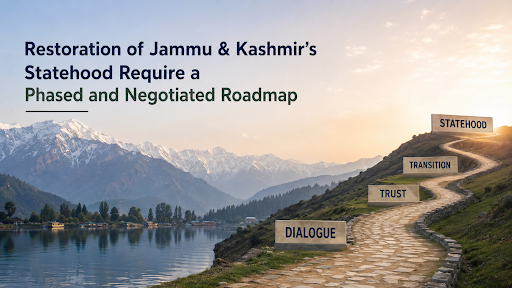
Why is a Phased and Negotiated Roadmap Suggested?
Security Considerations: The Union Government prioritizes complete normalcy before transitioning, as the 2025 Pahalgam terror attack—which claimed 25 lives—underscores the need for unified command over security.
Consensus Building: A structured roadmap prevents statehood demands from becoming mere political slogans by establishing non-negotiable security benchmarks.
Institutional Preparedness: The region requires time to re-establish vital statutory bodies like the State Human Rights Commission and the Women's Commission.
Constitutional Continuity: The Solicitor General assures the Supreme Court that the government will restore statehood in progressive, phased stages.
Major Challenges
Security Threats: Terror groups like The Resistance Front actively target civilians, necessitating a centralized security presence.
Political Polarisation: Although the Union Government assured the Supreme Court (December 2023) that statehood would be restored "at the earliest", no fixed timeline has been announced.
Trust Deficit: Although the Union Government assured the Supreme Court (December 2023) that statehood would be restored "at the earliest", no fixed timeline has been announced.
Regional Aspirations: Ladakh continues to demand full statehood, Sixth Schedule protection, constitutional safeguards and separate representation.
Executive Control: The Centre seeks to retain control over anti-terror operations while the local assembly demands full executive authority.
Way Forward
Structured Dialogue: Institutionalise continuous dialogue between the Union Government and the elected J&K Government
Area Domination: Continue counter-infiltration measures, smart border surveillance and intelligence-led operations while gradually expanding civilian governance.
Institutional Accountability: Re-establish statutory institutions such as the State Human Rights Commission, Women's Commission and other oversight bodies to improve grievance redressal, accountability and public trust.
Grassroots Empowerment: Strengthening Panchayati Raj Institutions deepens local governance and decentralizes power.
Transparent Benchmarks: Announce a time-bound roadmap with clearly defined benchmarks relating to security normalisation, institutional readiness and administrative capacity for restoring full statehood
Economic Revitalization: Prioritise employment generation, tourism, infrastructure and investment to consolidate peace dividends and reduce youth alienation.
Constitutional Safeguards: Examine region-specific constitutional and legislative safeguards for protecting local land rights, employment and cultural identity, drawing lessons from provisions such as Article 371 while remaining within the constitutional framework.
Regional Stability: Address Ladakh's four-point demand for Statehood, Sixth Schedule protection, job reservation and separate parliamentary representation through sustained and inclusive dialogue with the Leh Apex Body (LAB) and Kargil Democratic Alliance (KDA).
Conclusion
Restoring Jammu & Kashmir's statehood through a phased roadmap will strengthen India's democratic federalism while ensuring absolute regional security and sustainable economic growth.
Source: INDIANEXPRESS
|
PRACTICE QUESTION "The restoration of Jammu & Kashmir's statehood involves constitutional, political and security considerations that require a calibrated approach." Discuss. 150 words |