Why In News?
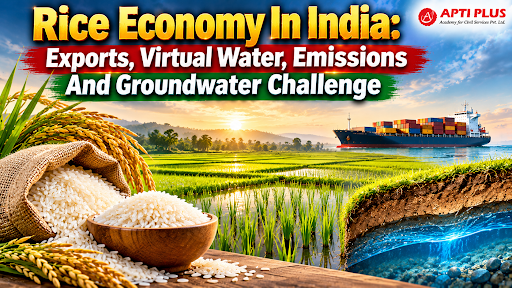
While India's projected 16% rise in rice exports reinforces its global trade dominance, this success creates a resource paradox by severely depleting groundwater through virtual water exports, requiring a policy shift toward value and sustainability.
What Is The Rice Export Paradox?
-
India produced an estimated 154.02 million tonnes of rice in 2025-26.
-
Export Volume: Rice exports rose from 17.73 million tonnes in 2020-21 to 21.57 million tonnes in 2025-26. Export value rose from $8.82 billion to $11.54 billion over the same period.
-
Export Value: The Agricultural and Processed Food Products Export Development Authority (APEDA) reported 2025-26 Basmati exports of 6.52 million tonnes, worth $5.67 billion. Non-Basmati exports reached 15.04 million tonnes, worth $5.86 billion.
-
Unit Value Gap: Basmati earned about $0.87 per kilogram and non-Basmati about $0.39 per kilogram in 2025-26. This is derived from APEDA figures. Non-Basmati volume therefore carries most of the water and energy cost for less value per tonne.

Rice Cultivation
|
Why Is Water Central To The Debate?
-
Virtual Water: Every tonne of exported rice carries the water used to grow it. This flow is known as virtual water trade, and it is invisible in standard trade statistics.
-
Green And Blue Water: Green water is rainfall used by the crop and places little strain on local resources. Blue water is pumped from aquifers, rivers and reservoirs, and it draws down a scarce stock.
-
Groundwater Hotspots: Punjab, Haryana and western Uttar Pradesh face the highest pressure. Groundwater-fed paddy in West Bengal, Bihar, Odisha, Chhattisgarh, Telangana, Andhra Pradesh, Tamil Nadu and Karnataka adds to it.
What are The Climate Concerns Of Rice Production?
-
Methane From Flooded Fields: Continuously flooded paddy fields produce methane, a potent greenhouse gas (GHG). Flooding creates anaerobic conditions in the soil.
-
Nitrogen Overuse: Excess nitrogen fertiliser raises nitrous oxide emissions. Energy-intensive operations such as pumping and tillage add further emissions.
-
Mitigation Practices: Alternate Wetting and Drying (AWD), Direct-Seeded Rice (DSR) and Integrated Nutrient Management (INM) can cut emissions and raise resource-use efficiency. Their effect varies by soil and agroclimatic zone, and some practices trade one gas for another.
Initiatives Taken By Government For Sustainable Rice Production
-
Per Drop More Crop: This component of the Pradhan Mantri Krishi Sinchayee Yojana (PMKSY) promotes micro-irrigation and water-use efficiency. It targets water productivity per unit of crop output.
-
Atal Bhujal Yojana: It is a community-led groundwater management scheme. It covers 8,350 water-stressed gram panchayats across seven States with a central outlay of ₹6,000 crore.
-
Punjab Preservation Of Subsoil Water Act, 2009: It restricts the date of paddy transplanting in Punjab to delay pumping during peak heat. It was designed to reduce groundwater depletion.
-
Paddy Diversification Incentives: States incentivise farmers to shift from paddy to pulses, millets and oilseeds in water-stressed districts. This is a direct response to blue water pressure.
-
PM-PRANAM: The Pradhan Mantri Programme for Restoration, Awareness, Nourishment and Amenity (PM-PRANAM) encourages balanced fertiliser use and organic alternatives. It addresses nitrogen overuse.
-
National Mission On Natural Farming: It was approved in November 2024 with an outlay of ₹2,481 crore. It promotes low-input cultivation that cuts chemical and energy use.
What Are The Key Challenges In Rebalancing The Rice Economy?
Groundwater Depletion In Core Paddy Belts
-
Stage Of Extraction: The Central Ground Water Board (CGWB) assessed 6,762 units in 2025. It classified 730 units, or 10.8%, as over-exploited.
-
Punjab's Deficit: Punjab recorded groundwater extraction of 156% of its annual recharge in 2024. This is the highest among all States.
-
Haryana's Blocks: Of Haryana's 143 assessed units, 88 are over-exploited. Punjab has 115 over-exploited units out of 153.
Blue Water Embedded In Exports
-
Hidden Subsidy: Export prices do not reflect the cost of pumped groundwater. Exports of blue-water-intensive rice therefore draw down aquifers at no charge to exporters.
-
Volume Focus: Policy tracks tonnes shipped rather than water used per tonne. This hides the depletion linked to non-Basmati volume.
Low Value Per Tonne In Non-Basmati Exports
-
Price Gap: Non-Basmati rice earns about $0.39 per kilogram against about $0.87 for Basmati. Non-Basmati volume is over twice Basmati volume but earns only marginally more value.
-
Commodity Pricing: Non-Basmati grades compete mainly on price in African and Asian markets. Branding and differentiation remain limited.
Export Policy Volatility
-
Past Curbs: Exports fell to 16.35 million tonnes in 2023-24 after trade restrictions on certain non-Basmati varieties. Sudden curbs disrupt foreign buyers and contracts.
-
West Asia Shock: Rice exports fell 7.5% to $11.53 billion in 2025-26. Basmati shipments to Gulf and Iranian markets were hit by the West Asia crisis.
Methane And Nitrogen Emissions
-
Flooded Cultivation: Continuous flooding keeps paddy fields anaerobic and releases methane. The trade-off with irrigation efficiency is seldom quantified.
-
Fertiliser Overuse: Nitrogen applied beyond crop need raises nitrous oxide and reduces nutrient-use efficiency.
Climate Vulnerability And Output Risk
-
Projected Decline: The United States Department of Agriculture (USDA) projects India's rice production to fall from about 154 million tonnes in 2025-26 to about 147 million tonnes in 2026-27. Adverse weather is the main reason.
-
Monsoon Dependence: Rice output depends on the monsoon for both rainfed and irrigated fields. Erratic rain shifts demand onto groundwater.
Weak Measurement And Policy Integration
-
Missing Metric: Export policy has no indicator for water, carbon or value per unit of input. Trade and agriculture data remain separate.
-
Fragmented Schemes: PMKSY, Atal Bhujal Yojana and export promotion run in separate silos. Their targets rarely overlap.
What Is The Way Forward For A Sustainable Rice Economy?
Adopt A Water-Carbon-Value Framework
-
Tracking Indicators: Track export value per tonne and per cubic metre of blue water. Track groundwater used per tonne and irrigation water productivity.
-
District Reporting: Publish these indicators for major rice districts each year. Link them to APEDA export registration.
Shift From Volume To Value
-
Premium Positioning: Expand GI-tagged and branded varieties beyond Basmati. Promote traceability and quality certification in export markets.
-
Processing Investment: Support milling, parboiling and value-added products such as ready-to-eat rice. This raises income per tonne without raising tonnage.
Crop Diversification In Water-Stressed Districts
-
Targeted Incentives: Pay minimum support and input subsidies for pulses, millets and oilseeds in over-exploited blocks. Use the Kharif and Rabi procurement cycles.
-
Market Linkage: Link diversified crops to assured procurement and export contracts. Farmers shift only when the alternative pays.
Scale Water-Saving Technologies
-
Direct-Seeded Rice: Expand DSR and AWD through the PMKSY Per Drop More Crop component. Pilot them first in Punjab and Haryana.
-
Laser Levelling: Subsidise laser land levelling to cut irrigation water. Combine it with efficient pumping and solar irrigation.
Strengthen Groundwater Governance
-
Pricing Reform: Introduce metering and volumetric pricing for power used in pumping. Cut free electricity in over-exploited blocks.
-
Community Management: Scale up Atal Bhujal Yojana to all over-exploited blocks. Use gram panchayat water budgets and monitoring.
Lower Emissions Through Better Inputs
-
Nutrient Efficiency: Promote soil testing and balanced nitrogen use through PM-PRANAM. Pair it with the INM approach.
-
Carbon Credits: Design a carbon-credit method for AWD and DSR under national climate schemes. Reward farmers for verified methane cuts.
Build Policy Coherence Between Trade And Resources
-
Integrated Export Policy: Add water and carbon criteria to rice export promotion schemes. Give higher incentives to low-water, high-value shipments.
-
Stable Trade Rules: Avoid abrupt export bans. Set predictable export corridors tied to stock levels and groundwater status.
Conclusion
India's rice economy must move from more tonnes to more value per drop of water, unit of energy and kilogram of carbon. Exports are a strength, but they carry hidden costs in aquifers and emissions. A water-carbon-value framework can make competitiveness sustainable.
Source: THEHINDU
|
PRACTICE QUESTION Q. Consider the following statements: Statement-I: Non-Basmati rice accounts for less than half of India's total rice export volume. Statement-II: Non-Basmati rice has a larger share of export volume than Basmati rice. Which one of the following is correct? (a) Both Statement-I and Statement-II are correct and Statement-II explains Statement-I (b) Both Statement-I and Statement-II are correct, but Statement-II does not explain Statement-I (c) Statement-I is correct, but Statement-II is incorrect (d) Statement-I is incorrect, but Statement-II is correct Answer: (d) Explanation: Statement-I is incorrect: Non-Basmati rice makes up the vast majority of India's total rice export volume, accounting for around 70% to 80% of total shipments. Since 70% is well above 50%, it accounts for more than half—not less than half—of the total volume. Statement-II is correct: Because India's rice exports are divided into Basmati and Non-Basmati varieties, Non-Basmati rice holds a significantly larger share of export volume (around 70%) compared to Basmati rice (around 30%). |