Why In News?
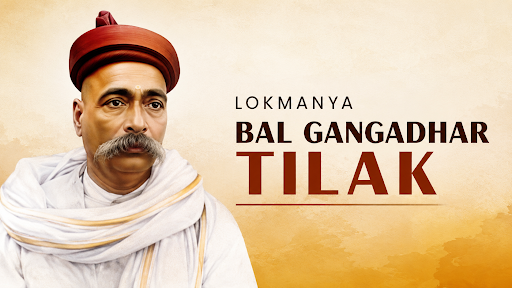
The Prime Minister of India paid tributes to Lokmanya Tilak on his birth anniversary.
Who Was Lokmanya Tilak?
-
Lokmanya Tilak was a great Indian nationalist, educator, journalist, and social reformer.
-
British authorities famously called him the "Father of the Indian Unrest" because he constantly challenged their power.
-
The title "Father of the Indian Unrest" was given to Bal Gangadhar Tilak by the British journalist Sir Valentine Chirol in his 1910 book Indian Unrest.
Early Life
-
He was born as Keshav Gangadhar Tilak on July 23, 1856, in Ratnagiri, Maharashtra.
-
He grew up in a very cultured middle-class family and earned a Bachelor's degree in Mathematics and a law degree.
What Was Tilak's Contribution to the Freedom Movement?
Popularised the Demand for Swaraj
-
Tilak transformed the freedom struggle into a mass movement by giving the famous slogan, "Swaraj is my birthright, and I shall have it!".
-
He shifted the Indian National Congress from a weak strategy of "prayer and petition" to a strong strategy of assertion and action.
Leader of the Extremist Wing
-
He formed the highly popular Lal-Bal-Pal trio along with Lala Lajpat Rai and Bipin Chandra Pal.
-
He strongly proposed a three-point program: Swaraj (Self-rule), Swadeshi (using local goods), and Nationalist Education.
National Education
-
Tilak believed that modern, nationalistic education was the only way to awaken the Indian spirit.
-
He co-founded the Deccan Education Society in 1884 to provide affordable, high-quality education rooted in Indian values.
-
He helped establish the famous Fergusson College in Pune.
Journalism
-
Tilak used his newspapers to educate the masses and criticize British misrule.
-
He founded two major newspapers: Kesari (a Marathi daily) and The Mahratta (an English weekly).
Political Awakening
-
He organized the mill workers in Bombay, successfully linking the labour rights movement with the freedom struggle.
-
He founded the All India Home Rule League in 1916, which rapidly grew to over 32,000 members by 1917.
How Did Tilak Mobilise the Masses?
Ganesh Utsav
-
In 1893, he converted the private household worship of Lord Ganesha into the Sarvajanik Ganeshotsav, a grand public festival.
-
This festival successfully brought together artisans, peasants, and traders, providing a safe cover to discuss politics and bypass strict British bans on public gatherings.
Shivaji Festival
-
He started the Shivaji Jayanti festival in 1895 to inspire common people with the incredible bravery of Chhatrapati Shivaji Maharaj.
-
By blending religious devotion with pride in Indian heritage, he shifted the nationalist movement from the educated elite to the common masses.
What are Tilak's Major Literary Contributions?
Gita Rahasya
-
Tilak wrote in 1915 while serving a tough six-year sentence in the Mandalay Prison in Burma.
-
It is a brilliant commentary on the Bhagavad Gita that emphasizes Karma Yoga (the philosophy of selfless action for the nation).
The Arctic Home in the Vedas
-
Published in 1903, this scholarly book proposed a novel theory regarding the ancestral home of the Aryans.
Editorials in Kesari and The Mahratta
-
He wrote articles to challenge the government, which led the British to charge him with sedition three times (1897, 1908, 1916).
Legacy of Lokmanya Tilak
Promotion of National Unity
-
His innovative use of community festivals teaches us how to unite diverse sections of society for a common cause.
Democratic Political Mobilisation
-
He proved that real political strength comes from involving the common people—including workers and farmers—in national building.
Value of Education
-
His focus on starting institutions like the Deccan Education Society highlights that accessible education is the true foundation of a strong nation.
Cultural Confidence
-
He taught Indians to take immense pride in their cultural roots rather than accepting foreign ideas.
Citizen Participation in Nation-Building
-
The immense love people had for him was visible when the Tilak Swaraj Fund collected over 1 crore rupees in 1921 to support the Non-Cooperation Movement.
Source: PIB
|
PRACTICE QUESTION Q. For what main purpose was the "Tilak Swaraj Fund" announced by Mahatma Gandhi? A) To build a grand memorial for Bal Gangadhar Tilak B) To aid India's freedom struggle and resistance against British rule C) To help war widows of Indian soldiers who died in the First World War D) To build own buildings for Congress throughout the country Answer: B Explanation: The correct answer is B) To aid India's freedom struggle and resistance against British rule. Mahatma Gandhi announced the Tilak Swaraj Fund as a tribute on Bal Gangadhar Tilak's first death anniversary to finance the Non-Cooperation Movement. |