Why In News?
The 22nd Meeting of the Chemical Review Committee (CRC-22) of the Rotterdam Convention convened in Rome, Italy, and formally adopted the draft Decision Guidance Document (DGD) for the organophosphorus insecticide methyl-parathion.
What Is Rotterdam Convention?
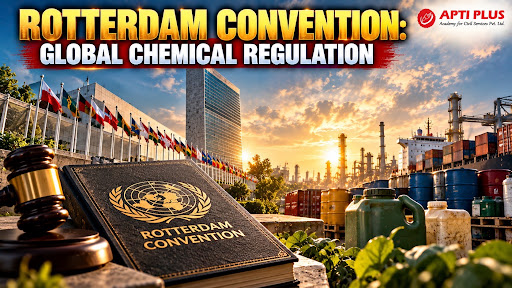
It is a multilateral treaty jointly administered by the United Nations Environment Programme (UNEP) and the Food and Agriculture Organization (FAO) to promote shared responsibility in international chemical trade.
Adopted in September 1998, it became legally effective in February 2004. Its official full name is the Rotterdam Convention on the Prior Informed Consent Procedure for Certain Hazardous Chemicals and Pesticides in International Trade.
Prior Informed Consent (PIC): Under Article 5 and Article 10, when a hazardous chemical is listed in Annex III, exporting nations are legally obligated to provide detailed toxicity dossiers and secure explicit consent from importing nations prior to export.
Coverage: Worldwide, out of nearly 350,000 registered chemical substances, approximately 4,600 account for the vast majority of industrial volume, making structured trade oversight essential for developing countries lacking toxicological screening facilities.
What Is The Chemical Review Committee (CRC)?
|
What Is Methyl-Parathion?
Methyl Parathion is an organophosphate insecticide classified by the World Health Organization (WHO) as Class Ia (Extremely Hazardous) due to severe acetylcholinesterase inhibition, neurotoxicity, and respiratory paralysis.
-
Due to severe occupational hazards officially banned by the EU and regulated globally under Annex III of the Rotterdam Convention.
It has been used worldwide to control chewing and sucking insects across a broad array of agricultural crops, including cotton, rice, corn, wheat, soybeans, garlic, onions, potatoes, citrus, vines, and vegetables.
Toxic: Overexposure causes severe neurotoxicity, leading to behavioral changes, muscle twitching, excessive salivation, respiratory depression, respiratory paralysis, intermediate syndrome, delayed polyneuropathy, coma, and death.
Reproductive Harm: Evaluated as mutagenic in in vitro tests, causing endocrine disruption, reduced litter size, increased post-implantation loss, and impaired neurodevelopment.
Occupational Risk: Predictive Operator Exposure Models (POEM) established that operator exposure during mixing, loading, and manual spraying exceeds Acceptable Operator Exposure Levels (AOEL), even when full Personal Protective Equipment (PPE) is worn.
Source: DOWNTOEARTH
|
PRACTICE QUESTION Q. Consider the following statements regarding the Rotterdam Convention on the Prior Informed Consent (PIC) Procedure:
Which of the statements given above are correct? (a) 1 and 2 only (b) 2 and 3 only (c) 1 and 3 only (d) 1, 2 and 3 Answer: (c) Explanation: Statement 1 is correct: The Rotterdam Convention is a legally binding multilateral treaty designed to promote shared responsibility in the international trade of hazardous chemicals. Its secretariat is jointly administered by the United Nations Environment Programme (UNEP) and the Food and Agriculture Organization (FAO). Statement 2 is incorrect: Inclusion of a chemical in Annex III does not impose an absolute global ban on its manufacturing or use. Instead, it makes the chemical subject to the Prior Informed Consent (PIC) procedure. This means that international trade of the chemical requires the explicit, informed consent of the importing country, allowing individual signatory nations to decide whether to permit, restrict, or ban its import based on local conditions. Statement 3 is correct: The Chemical Review Committee (CRC) is a subsidiary body of the Conference of the Parties (COP). It consists of government-designated experts tasked with reviewing national regulatory actions on hazardous chemicals and preparing the Decision Guidance Documents (DGD) used to help nations make informed import decisions. |