Why In News?
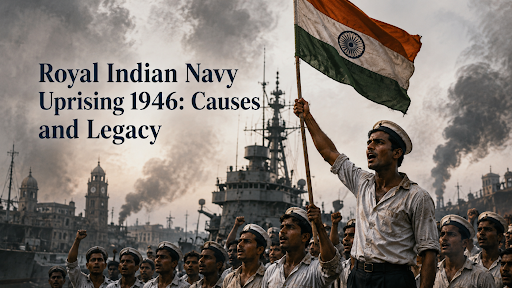
The 80th anniversary of the Royal Indian Navy (RIN) revolt has triggered fresh academic and political attention on the role of armed forces personnel in the freedom struggle.
What Was the Royal Indian Navy Uprising?
-
Indian naval ratings (junior sailors) of the Royal Indian Navy revolted against British officers in February 1946.
-
The revolt began at HMIS Talwar, a signals training establishment in Colaba, Bombay, on 18 February 1946.
-
Sailors declared a hunger strike and refused duty, protesting poor food, racial abuse, and colonial mistreatment.
-
The revolt spread rapidly to Bombay harbour and Castle Barracks, then to naval establishments across India.
-
Ratings and ships surrendered on 23 February 1946, though the Karachi units held out till 25 February 1946.
Immediate Causes of the Revolt
-
Racial discrimination: British officers routinely insulted Indian ratings; Commander Arthur King's racial slurs against HMIS Talwar sailors acted as the final trigger.
-
Poor food quality: Sailors were served watery dal and half-cooked chapattis, which sparked the initial hunger strike.
-
Low wages and unequal pay: Ratings demanded Royal Navy scales of pay on par with British counterparts.
-
Discriminatory service conditions: Indian ratings did menial tasks — cleaning toilets, serving officers — that British sailors were exempt from.
-
Nationalist sentiment: The Quit India spirit of 1942 and the ongoing INA trials (1945–46) had already radicalised the ranks; a rating had painted "Quit India" on HMIS Talwar's hull in early February 1946.
Major Features of the Uprising
-
Scale: The revolt began with about 1000 ratings at HMIS Talwar and eventually involved nearly 20,000 sailors across 74–78 ships and about 20 shore establishments.
-
Geographic spread: The revolt touched Bombay, Karachi, Calcutta, Madras, Vizag and even bases as far as Aden.
-
Political symbolism: Sailors hoisted the flags of the Congress, the Muslim League and the Communist Party together on ship masts — a rare act of cross-party unity.
-
Slogans raised: Ratings shouted "Jai Hind," "Quit India," and demanded release of the Indian National Army (INA) prisoners.
-
Civilian solidarity: Bombay workers observed a sympathy strike, and street clashes with British troops broke out, killing and injuring civilians.
-
Discipline maintained: Despite the scale, not a single British or Indian officer was physically harmed — the revolt targeted the colonial system, not individuals.
-
Central leadership: A Naval Central Strike Committee formed, electing M.S. Khan as President and Madan Singh as Vice-President.
Role of the Indian National Congress
-
The Congress leadership showed political caution, viewing an armed mutiny as unpredictable and potentially violent.
-
Senior leaders, notably Sardar Vallabhbhai Patel, appealed to the ratings to surrender, fearing a wider, uncontrolled military conflict.
-
Congress preferred a negotiated, constitutional transfer of power over an armed uprising that could invite brutal British reprisal.
Role of the Muslim League
-
The League also issued an appeal for surrender, mirroring the Congress position.
-
Its response reflected the communal politics of 1946, as the League focused on Pakistan demand negotiations rather than backing a spontaneous revolt.
-
Like Congress, it favoured an orderly transfer of power through political dialogue.
Role of the Communist Party of India
-
The CPI was the only major party to openly support the uprising.
-
It mobilised Bombay's mill workers and dock labour for a sympathy strike.
-
The CPI framed the revolt as part of wider anti-colonial, working-class politics, linking naval ratings with civilian labour movements.
Why Did the Uprising Worry the British?
-
It exposed cracks in military loyalty, the very foundation of colonial control in India.
-
Coming after World War II had exhausted Britain financially and militarily, the revolt added to post-war imperial overstretch.
-
British planners feared the unrest could spread to the Army and Air Force, given that the INA trials had already stirred sympathy within the armed forces.
-
It shook British confidence that Indian forces would remain a reliable instrument of control.
How It Contributed to British Withdrawal
-
The revolt demonstrated that even the armed forces — the last pillar of colonial authority — could no longer be trusted.
-
It raised the political and financial cost of continued British rule at a time when Britain was already negotiating an exit.
-
It added to the pressure created by the INA trials, the 1946 elections, and worsening communal tension, all pushing London toward the Cabinet Mission (1946) and eventual transfer of power in 1947.
-
Prime Minister Clement Attlee's government sent the Cabinet Mission to India within months of the revolt, in March 1946.
Historical Significance
-
It challenged colonial military authority at its core, in a way no earlier mutiny had since 1857.
-
It displayed Hindu-Muslim unity, with ratings across religious lines jointly raising nationalist and religious flags together.
-
It showed rare civil-military solidarity, as workers and sailors coordinated protest action.
-
It weakened British confidence in India as a stable, controllable colony just a year before independence.
Why Is the Uprising Less Prominent in Public Memory?
-
Short duration: The revolt lasted less than a week (18–25 February 1946), unlike prolonged movements such as Quit India.
-
No unified political leadership: Major parties kept their distance, denying the sustained political narrative given to Congress-led movements.
-
Surrender, not victory: The ratings' surrender on Congress and League appeals meant it lacked a dramatic climax for popular memory.
-
Limited institutional recognition: The Indian Navy has no official annual commemoration for the revolt.
-
Dominant non-violent narrative: Post-independence historiography privileged Gandhian non-violence, sidelining armed and semi-armed resistance episodes.
-
Limited primary sources: Much of the material remains in British archival records (such as Hansard), less accessible to Indian researchers and the public.
Lessons for Modern India
-
Institutional morale matters: Grievances over pay, food, and dignity, if ignored, can escalate into full-blown crises of authority.
-
Equality within the armed forces must be actively maintained to preserve trust between ranks.
-
Respect for personnel is central to discipline — the revolt shows how humiliation, not just material hardship, can trigger mass unrest.
-
Healthy civil-military relations require transparent grievance-redress mechanisms.
-
The episode reinforces national integration, since sailors across regions and religions acted together.
-
It underlines the historical plurality of the freedom movement — non-violent, armed, and institutional resistance all contributed.
Source: INDIANEXPRESS
|
PRACTICE QUESTION Q. With reference to the Royal Indian Navy Uprising of 1946, consider the following statements:
Which of the statements given above is/are correct? (a) 1 and 3 only (b) 2 only (c) 1, 2 and 3 (d) 3 only Answer: (a) Explanation: Statement 1 is correct: The uprising began on February 18, 1946, when ratings (sailors) on the signal training ship HMIS Talwar in Bombay (now Mumbai) went on strike to protest against poor food, racial discrimination, and abusive treatment by British officers. Statement 2 is incorrect: The Indian National Congress, along with the Muslim League, officially opposed the armed revolt. Senior leaders like Sardar Vallabhbhai Patel and Mahatma Gandhi condemned the violence and mutiny, urging the ratings to surrender because they believed an undisciplined army would be a liability to an independent nation. Statement 3 is correct: The Communist Party of India (CPI) was the only major political party that actively backed the uprising. They organized a massive general strike (hartal) in Bombay, mobilizing hundreds of thousands of working-class people to support the ratings, which led to intense street battles with British troops. |