Why In News?
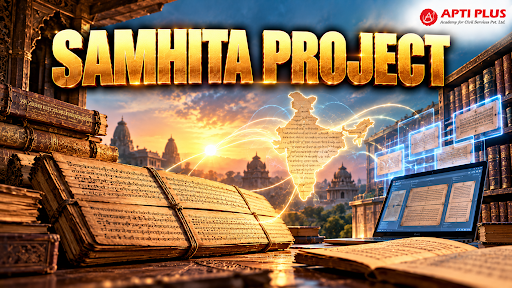
The Government of India launched the SAMHiTA Project at the Gangaramaya Temple in Colombo, Sri Lanka.
What Is SAMHiTA Project?
SAMHiTA stands for South Asian Manuscript Histories and Textual Archive. In Sanskrit, the word 'Samhita' means 'collection' or 'compilation'.
It is an international cultural heritage initiative to create a centralized relational database and digital archive of ancient South Asian manuscripts housed in repositories, archives, and libraries outside India.
Implementing Agencies: Executed by the India International Centre (IIC), New Delhi, through its International Research Division.
-
The project is supported with grant assistance from the Ministry of External Affairs (MEA), Government of India, under its Development Partnership Administration (DPA IV) framework for global heritage preservation.
Database Integration: All catalogued manuscript metadata and prosopographical records are integrated into PANDiT (Prosopographical Database of Indic Texts and Records), establishing a standardized open-access platform for South Asian intellectual history.
Inaugural Sri Lanka Phase: In October, officially launched, at the Gangaramaya Temple in Colombo, Sri Lanka, following a Memorandum of Understanding (MoU) signed in July 2026.
-
Target: Focuses on the physical conservation, high-resolution photography, cataloguing, and digital conversion of 100 ancient palm-leaf manuscripts (Ola leaf texts) preserved at the temple.
Significance Of The SAMHiTA Project
-
Preservation of Intangible Heritage: Prevents irreversible textual loss of delicate, organic palm-leaf manuscripts that are vulnerable to tropical decay and physical handling.
-
Safeguarding primary records on Theravada Buddhist philosophy, Pali and Sanskrit literature, traditional medicine, rituals, and regional history.
-
Democratisation of Knowledge Consolidates historically dispersed texts onto a common online platform (PANDiT), making primary source material accessible to global scholars, linguists, and historians without risking physical wear to the original artifacts.
-
Soft Power Diplomacy: Institutionalises India's soft power outreach by leveraging a 2,000+ year shared Buddhist heritage and spiritual connection with Sri Lanka, reinforcing bilateral people-to-people relations and civilisational links.
Conclusion
The SAMHiTA Project establishes an institutional benchmark for digital heritage preservation, transforming shared Buddhist civilisational ties into enduring soft-power cooperation across South Asia.
Source: DDNEWS
|
PRACTICE QUESTION Q. With reference to the SAMHiTA Project, recently seen in the news, consider the following statements:
Which of the statements given above is/are correct? (a) 1 and 2 only (b) 2 and 3 only (c) 1 and 3 only (d) 1, 2, and 3 Answer: (c) Explanation: Statement 1 is correct: SAMHiTA (South Asian Manuscript Histories and Textual Archive) aims to create a digital archive and database of South Asian manuscripts housed outside India. Statement 2 is incorrect: The project is implemented by the India International Centre (IIC), New Delhi, with grant assistance from the Ministry of External Affairs (MEA) under its Development Partnership Administration (DPA IV), not the ASI. Statement 3 is correct: Information collected through SAMHiTA is integrated into PANDiT (Prosopographical Database of Indic Texts and Records). |