Why In News?
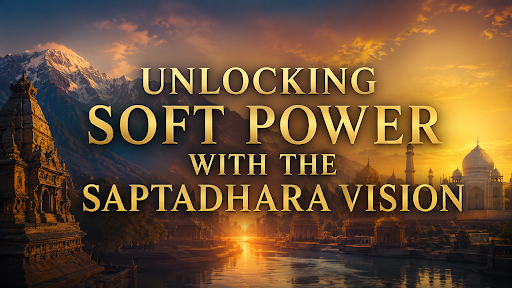
Prime Minister Narendra Modi’s "Shakti Ki Saptadhara" vision, unveiled on Independence Day from the Red Fort, outlines a seven-stream roadmap to propel India toward a developed nation (Viksit Bharat) by 2047 and enhance soft power.
What is Soft Power?
Coined by political scientist Joseph Nye, Soft Power is the ability of a country to persuade, attract, and shape the preferences of other nations and global citizens through culture, political values, and foreign policy, rather than through military coercion (hard power) or economic payments.
-
Attraction Over Force: Relies on intangible civilisational appeal, shared ethical principles, cultural storytelling, arts, educational prestige, and humanitarian partnerships.
-
India’s Inherent Civilisational Strength: Grounded in the ancient philosophy of Vasudhaiva Kutumbakam (The World is One Family), non-violence (Ahimsa), spiritual tolerance, and universal welfare (Sarve Bhavantu Sukhinah).
What is the Saptadhara Vision?
The Saptadhara Vision (Seven Streams of National Power) is a holistic national development roadmap articulated by Prime Minister Narendra Modi to drive India's transformation toward Viksit Bharat @2047:
-
Manufacturing Excellence: Transforming India into a global supply chain and production hub by focusing on cost, quality, scale, and zero-defect manufacturing.
-
Agriculture and Food Processing: Raising agricultural productivity, strengthening food security, and building farm-to-export value chains.
-
Technology and Innovation: Positioning India as a leader in artificial intelligence, quantum computing, indigenous 6G, and semiconductors.
-
Gati Shakti & Connectivity: Expanding integrated multimodal infrastructure—such as high-speed rail, roadways, and modern ports—to lower logistics costs.
-
Raksha Shakti (Defense Power): Promoting domestic manufacturing of defense equipment, drones, and counter-drone systems to achieve strategic self-reliance.
-
Green and Blue Economy: Combining sustainable growth through renewable energy and green hydrogen with the utilization of marine and ocean resources (blue economy).
-
Soft Power and Creative Economy: Expanding India's global cultural footprint through yoga, Ayurveda, gaming, animation, film production, and tourism.
What is the Orange Economy?
|
Why is Soft Power Important for India?
Geopolitical Goodwill & Diplomatic Leverage: Builds enduring international partnerships, neutralizes geopolitical hostility, and garners multilateral support for permanent membership in the United Nations Security Council (UNSC).
Expanding Inbound Tourism & Forex Inflows: Enhances spiritual, heritage, wellness (Ayurveda), and medical tourism under the Heal in India and PRASHAD schemes.
Catalysing Foreign Direct Investment (FDI): A positive, vibrant global image increases investor confidence, facilitating multinational investments into India’s services and technology hubs.
Activating the 32-Million Strong Indian Diaspora: Converts the global Indian diaspora into cultural ambassadors and philanthropic investors in homeland development.
Massive Creative Exports: Commercializes Indian stories, gaming IP, and music across global consumer markets.
What are India’s Major Soft Power Assets?
Yoga & Ayurveda (AYUSH): Universal adoption of the International Day of Yoga (June 21) and establishment of the WHO Global Traditional Medicine Centre in Jamnagar, Gujarat.
Indian Cinema & Visual Storytelling: World’s largest film producer (over 2,000 films annually across 20+ languages); global box office and Oscar successes (e.g., RRR, The Elephant Whisperers).
Culinary Diplomacy: Global popularity of Indian regional gastronomy, spices, and championing the UN International Year of Millets (Shree Anna).
Buddhist Heritage Diplomacy: Maintaining sacred Buddhist pilgrimage circuits (Bodh Gaya, Sarnath, Kushinagar, Nalanda) connecting Southeast Asian and East Asian democracies.
Cricket Diplomacy: Global financial and operational leadership through the Indian Premier League (IPL), using sports as a bridge across the Commonwealth.
Digital Public Infrastructure (DPI) as Modern Soft Power: Exporting the India Stack (UPI, DigiLocker, CoWIN) to 9+ countries as an open-source, inclusive public good.
Major Government Initiatives to Boost Soft Power & Creative Industries
WAVES (World Audio Visual & Entertainment Summit): Flagship international media and entertainment summit convened by MIB to connect Indian content creators with global studios, venture capitalists, and streaming platforms.
Indian Institute of Creative Technologies (IICT), Mumbai: Established as an apex national institution on the lines of IITs/IIMs to nurture world-class talent in AVGC-XR, setting up Content Creator Labs in 15,000 schools and 500 colleges.
National AVGC-XR Policy: Comprehensive strategy to capture 5% of the global AVGC market ($40 billion) by 2030, generating over 20 lakh skilled jobs.
MyWAVES Portal & Creator Economy Empowerment: Digital onboarding framework providing independent digital creators with copyright registration, monetization channels, and international showcase opportunities.
National AI Skilling in Creative Technologies: Integrating generative AI tools, virtual production stages, and real-time rendering into national vocational skill frameworks under Skill India.
Economic Benefits of the Orange Economy
|
Challenges In India's Soft Power Strategy
Low Global Market Share in AVGC: India currently captures less than 1.5% of the global creative economy market, operating largely as a back-office outsourcing hub rather than an intellectual property owner.
Severe Skill Deficits in High-End Creative Tech: Shortage of specialized talent in 3D character rigging, game physics engines (Unreal/Unity), and advanced virtual production.
Inadequate Institutional Financing for Creative Startups: Banks and venture capital funds hesitate to lend against intangible creative IP without physical collateral.
Intellectual Property (IP) Piracy & Weak Enforcement: Digital copyright infringement and slow judicial adjudication of IP disputes discourage long-term creative investments.
Fragmented Institutional Governance: Creative industries are split across multiple ministries (MIB, Culture, Tourism, Commerce, MEA, IT) without a single unified nodal authority.
Way Forward: Unlock India’s Soft Power Potential
Implement “Kala to Kaushal, Bazaar to Vishwa Prabhav” Roadmap
Transform India’s cultural assets into market-ready skills. Certify traditional arts through skilling missions like PMKVY. Link artisans to structured employment schemes to ensure sustained and dignified livelihoods.
Set Up Regional AVGC-XR Hubs in Tier-2/3 Cities
Establish animation, VFX, gaming, comics, and extended reality (AVGC-XR) clusters in smaller cities. Integrate gaming incubation labs, motion-capture studios, and rendering farms within defence and industrial corridors to boost local creative economies.
Strengthen AI-Based Copyright and Anti-Piracy Measures
Deploy AI-powered tracking systems on digital platforms to detect IP theft. Fast-track resolution of creative rights disputes by setting up specialized IP Dispute Tribunals under the Commercial Courts Act.
Leverage Embassies for Global Cultural Market Access
Task Indian embassies with organizing publishing fairs, film distribution tie-ups, and culinary exhibitions. Use diplomatic outreach to open foreign markets to Indian creators and storytellers.
Create a National Creative Industries Development Council (NCIDC)
Establish a statutory, inter-ministerial body under the PMO. Coordinate tourism, culture, exports, and digital economy policies to grow India’s cultural industries in a unified way.
Promote Multilingual Digital Storytelling
Subsidize translation, dubbing, and adaptation of Indian epics, folklore, and literature into Spanish, Arabic, French, Japanese, and other global languages to expand their global reach.
Conclusion
Transforming India’s soft power through the Saptadhara vision bridges ancient civilisational heritage with modern digital technology, turning cultural assets into high-value economic opportunities and global influence.
Source: INDIANEXPRESS
|
PRACTICE QUESTION Q. India possesses immense civilisational soft power, but converting cultural attraction into tangible economic exports and geopolitical influence requires a structural policy shift toward the creative economy. Discuss (15 Marks, 250 Words) |