Why In News?
The Standing Committee of the National Board for Wildlife (SC-NBWL) gave in-principle clearance to a third railway line cutting through the Satpura-Melghat tiger corridor.
What is the Satpura-Melghat Tiger Corridor?
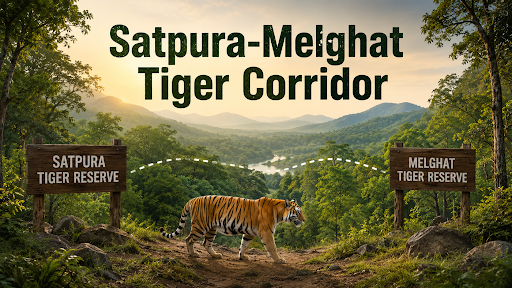
It is a wildlife corridor connecting Satpura Tiger Reserve and Melghat Tiger Reserve, forming part of the larger Satpura-Pench-Melghat landscape.
Satpura Tiger Reserve: Located in Narmadapuram district (formerly Hoshangabad), MP; comprising Satpura National Park, Bori Wildlife Sanctuary, and Pachmarhi Wildlife Sanctuary.
Melghat Tiger Reserve: Located in Amravati district, Maharashtra.
Satpura-Melghat Tiger Corridor lies mainly in the Satpuda Hill Range, spread across roughly 9,000 sq. km of hilly, rugged terrain, dominated by dry deciduous teak forest.
Other species: Supports leopards, dhole (wild dogs), sloth bears, gaur, nilgai, sambar, muntjac, four-horned antelope, and wild boar.
The corridor is home to tribal communities — Korku, Gond, Yadav, Gawli, and Pardhi — who are economically marginalised and depend significantly on forest resources.

Source: INDIATODAY
|
PRACTICE QUESTION Q. Consider the following statements regarding the Satpura-Melghat Tiger Corridor:
Which of the statements given above is/are correct? (a) 1 and 3 only (b) 2 and 3 only (c) 1 only (d) 1, 2 and 3 Answer: (a) Statement 1 is Correct: The Satpura-Melghat Tiger Corridor lies within the Satpura Hill Range (specifically connecting the Satpura Tiger Reserve in Madhya Pradesh and the Melghat Tiger Reserve in Maharashtra). The forest type in this landscape, particularly in Melghat and the corridor areas like Betul, is characterized as dry deciduous forest dominated by teak (Tectona grandis). Statement 2 is Incorrect: The National Tiger Conservation Authority (NTCA) has not recommended dam projects to improve habitat; rather, it has warned that proposed projects, such as the Morand-Ganjal Irrigation Project, would submerge vital tiger habitats and destroy the crucial corridor connecting Satpura and Melghat. The NTCA noted that such projects could reverse conservation gains and has recommended exploring alternative sites to minimize ecological damage, rather than endorsing them for habitat improvement. Statement 3 is Correct: There are documented instances of tigers using this corridor. Specifically, a radio-collared tigress (often referred to in reports from early 2022) was tracked walking approximately 250 km from the Satpura Tiger Reserve to the Melghat Tiger Reserve via this corridor. |