Why In News?
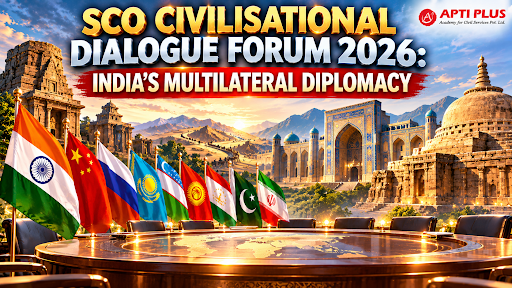
India will host the inaugural Shanghai Cooperation Organisation (SCO) Civilisational Dialogue Forum in New Delhi from 20 to 22 November 2026, aimed at cultural exchange and people-to-people ties.
What Is The Shanghai Cooperation Organisation (SCO)?
-
Origin: The SCO was founded in 2001 by China, Russia, Kazakhstan, Kyrgyzstan, Tajikistan and Uzbekistan. It grew out of the earlier "Shanghai Five" border-confidence grouping.
-
Membership: India and Pakistan became full members at the Astana Summit in 2017. Iran joined in 2023 and Belarus in 2024, taking the total to 10 members.
-
Observers And Partners: Afghanistan and Mongolia are observer states. The bloc also has 15 dialogue partners.
-
Reach: The 10-member bloc covers about 3.4 billion people. It includes China, Russia, India and Iran among its members.
-
Mandate: The SCO covers security, counter-terrorism, trade, energy, connectivity and cultural cooperation. Its Regional Anti-Terrorist Structure (RATS) is based in Tashkent.
-
Latest Summit: The 26th Council of Heads of State met in Bishkek on 1 September 2026, approving 28 documents including the Bishkek Declaration. The summit marked the organisation's 25th anniversary.
-
Presidency: Kyrgyzstan handed over the 2026–27 SCO presidency to Pakistan at Bishkek.
Why Should India Use Multilateral Fora To Advance Bilateral Cooperation?
-
Structured Contact: The SCO is among the few platforms that bring India, China and Pakistan to the same table. It offers space for diplomatic signalling and conflict management during bilateral tensions.
-
Collective Accountability: Placing terrorism on a multilateral agenda converts a bilateral India–Pakistan dispute into regional accountability. The 2025 Tianjin Declaration condemned the Pahalgam attack.
-
Economy Of Effort: A single summit lets the Prime Minister meet many leaders at once. At the 18th BRICS Summit in New Delhi in September 2026, India held 15 bilateral meetings in three days.
-
Neutral Venues: Rivals can meet on a shared agenda without the political cost of a bilateral initiative. At Bishkek, Defence Minister Rajnath Singh met his Russian and Chinese counterparts in separate meetings.
-
Cultural Reach: A civilisational dialogue builds goodwill that formal security talks cannot. It draws on shared Buddhist, Sufi and Silk Route heritage across Eurasia.
How India Used SCO Sidelines For Bilateral Engagement?
-
Russia And Iran: At the 26th Summit, Modi held bilateral talks with the leaders of Russia, Iran, Armenia and Kyrgyzstan. The talks covered energy, defence, trade and the West Asian conflict.
-
Central Asia: India signed a framework for long-term uranium supplies with Uzbekistan during its SCO engagements. Meetings with Kyrgyzstan and Kazakhstan reviewed regional connectivity and economic cooperation.
-
China: The 2025 Tianjin Summit produced a Modi–Xi meeting on 31 August 2025, which began a thaw in ties after the 2020 border crisis. India again used the SCO calendar for India–China contact in 2026.
-
Security Channels: India's Deputy National Security Adviser held bilateral meetings with Iran, Russia and Kyrgyzstan at the SCO security council meeting in Bishkek in May 2026. Such officials-level contact prepares the ground for leader meetings.
Initiatives Taken By India For Advancing Bilateral Ties Through Multilateral Platforms
-
SCO Membership And SECURE Vision: India has engaged the SCO as a full member since 2017. At Qingdao in 2018, Modi articulated the SECURE vision: Security, Economic development, Connectivity, Unity, Respect for sovereignty and Environment.
-
India's SCO Presidency (2022–23): India chaired the Council of Heads of State for the first time and adopted the New Delhi Declaration. It covered countering radicalisation and digital transformation, though the summit was held virtually in July 2023.
-
SCO Civilisational Dialogue Forum: The forum is India's own proposal to build cultural and people-to-people links across Eurasia. Hosting it at Purana Qila gives it historical symbolism and offers Pakistan a non-political entry point.
-
BRICS Chairship 2026: India chairs BRICS under the theme "Building for Resilience, Innovation, Cooperation and Sustainability". The 18th Summit in New Delhi allowed bilateral meetings with the Russian, Chinese and Iranian presidents.
-
Quad Hosting Role: India is the host of the Quad in 2026, with foreign ministers' and leaders' level meetings planned. It uses the grouping for maritime domain awareness and resilient ports cooperation.
-
Voice Of Global South Summits: India convened these summits during its 2023 G20 presidency to amplify developing-country concerns. The African Union's admission to the G20 in New Delhi added to its standing among developing partners.
-
Connectivity Through Chabahar And INSTC: India operates the Chabahar port in Iran through a long-term contract signed in 2024. It forms a gateway to Central Asia and links with the International North–South Transport Corridor (INSTC).
-
Connect Central Asia Policy: Launched in 2012, it uses the India–Central Asia Dialogue and Summit to build trade, energy and security ties. Central Asian states then reinforce these in the SCO.
What Are The Key Challenges In Using Multilateral Fora For Bilateral Gains?
China's Weight Inside The SCO
-
Structural Dominance: The SCO was created with China at the head of the table and is shaped by its security and economic interests. India has declined to endorse the Belt and Road Initiative (BRI) in SCO documents since 2017.
-
Connectivity Conflict: India objects to the China–Pakistan Economic Corridor (CPEC) passing through Pakistan-occupied Jammu and Kashmir. Bishkek documents on connectivity reopened this disagreement.
Pakistan's Presidency Of The SCO
-
Agenda Control: Pakistan now chairs the SCO for 2026–27 under the theme "Turning Vision into Action". It will host the next summit and set the agenda.
-
Terrorism Language: In June 2025, India declined to sign the SCO Defence Ministers' joint statement at Qingdao because it omitted the Pahalgam attack. A Pakistani chair may again dilute terrorism language.
Bilateral Disputes Spill Into Forums
-
Border Standoffs: India–China border disputes and India–Pakistan cross-border terrorism limit deep consensus. Security cooperation in the SCO therefore stays limited.
-
Suspended Bilateral Frameworks: Bilateral mechanisms with Pakistan remain frozen. The Indus Waters Treaty was placed in abeyance in April 2025, which narrows the room for multilateral goodwill to translate into bilateral progress.
Strategic Autonomy And Conflicting Alignments
-
Dual Alignment: India sits in both the Quad and the SCO, the G7 outreach and BRICS. This invites suspicion from each side about its commitments.
-
Great-Power Wars: India shifted its stances on the US-Israel war against Iran and Russia's war in Ukraine in 2026. It risks Moscow seeing New Delhi as unreliable even as it keeps the West engaged.
Limited Institutional Delivery
-
Declarations Over Action: The Bishkek Declaration and 28 documents show many pledges but few binding obligations. The SCO has no mechanism to resolve disputes between members.
-
Virtual Presidency Precedent: The 2023 India-hosted summit was cut to a brief virtual meeting amid divergence between members. It showed how fragile the platform is for Indian goals.
Soft Power Without Follow-Through
-
Event-Based Diplomacy: A one-off forum can create goodwill but not lasting ties without funding and follow-up. Past cultural outreach has often lapsed after the initial event.
-
Participation Level: Pakistan's choice of a Climate Minister signals limited political commitment. The forum's value will depend on the seniority and sincerity of delegations.
Domestic And Capacity Constraints
-
Diplomatic Bandwidth: India is hosting BRICS and the Quad in the same year, besides the SCO forum. The Ministry of External Affairs must manage a heavy calendar with a small cadre.
-
Follow-Through On Sideline Talks: Leaders' meetings on sidelines often end in joint statements without tracked deliverables. Few of them are linked to ministry-level review mechanisms.
What Is The Way Forward For India's Multilateral-Bilateral Strategy?
Prepare Sideline Diplomacy As A Planned Tool
-
Pre-Agreed Agendas: Identify two or three deliverables per bilateral meeting before each summit. Track them through the Ministry of External Affairs' regional divisions.
-
Sequenced Meetings: Keep engagement with both Russia and China, as done at the Bishkek defence ministers' meeting. Avoid creating the impression of favouring one over the other.
Turn The Civilisational Forum Into A Standing Platform
-
Institutional Home: Create a small secretariat or recurring calendar for the forum under the Ministry of Culture. Rotate it among members to avoid it being seen as an Indian event.
-
Concrete Projects: Launch joint heritage conservation, Buddhist circuit tourism and translation projects. Fund student and scholar exchanges through the Indian Council for Cultural Relations.
-
Low-Cost Opening With Pakistan: Use the forum for cultural and climate contact without conceding on terrorism or Jammu and Kashmir. Treat attendance as a signal to be assessed, not as a policy shift.
Keep Terrorism At The Centre Of SCO Work
-
RATS Cooperation: Press for information-sharing and joint action against listed terrorist groups through RATS. Insist on explicit condemnation of cross-border terrorism in every declaration.
-
Collective Accountability: Build a coalition with Central Asian states on narco-terror and radicalisation. Use shared threats to isolate states that sponsor terrorism.
Reinforce Central Asia Through Bilateral Tracks
-
Beyond The SCO: Strengthen the India–Central Asia Summit mechanism and bilateral energy deals such as the uranium framework with Uzbekistan. Bilateral tracks insulate India's interests from SCO deadlock.
-
Connectivity Alternatives: Complete Chabahar and INSTC links as a route that bypasses Pakistan. Offer Central Asian states access to Indian ports and markets.
Use Issue-Based Coalitions Alongside Large Forums
-
Pragmatic Platforms: Use BRICS, the Quad and the International Solar Alliance for specific deliverables such as New Development Bank financing and maritime awareness. Avoid treating any forum as an alliance.
-
Consensus Building: Use SCO and BRICS consultations to align positions on terrorism, energy security and global governance reform. Several members, including China, Russia and Iran, sit in both groups.
Calibrate Strategic Autonomy Transparently
-
Predictable Positions: Explain India's positions on the Ukraine and Iran conflicts through consistent public statements. Predictability reduces the risk of partners reading shifts as unreliability.
-
Equal Footing: Seek tangible gains from each grouping, such as defence cooperation with Russia and technology cooperation through the Quad. Review them annually against national priorities.
Strengthen Diplomatic Capacity
-
Cadre Expansion: Expand the Indian Foreign Service and create dedicated desks for the SCO, BRICS and Quad. Train officers in Eurasian languages and regional history.
-
Outcome Tracking: Publish an annual review of bilateral outcomes from multilateral meetings. Share it with the Parliamentary Standing Committee on External Affairs.
Conclusion
India's best returns from multilateral fora come when summits are treated as stages for planned bilateral work. The SCO Civilisational Dialogue Forum gives a low-risk setting for cultural and climate contact, even with a difficult neighbour. Success will depend on follow-through, firm positions on terrorism and a clear sense of strategic autonomy.
Source: THEHINDU
|
PRACTICE QUESTION Q. Multilateral forums can be effective tools for advancing India's bilateral ties. Critically examine this statement with reference to the SCO and BRICS. (15 Marks, 250 Words) |