Why In News?
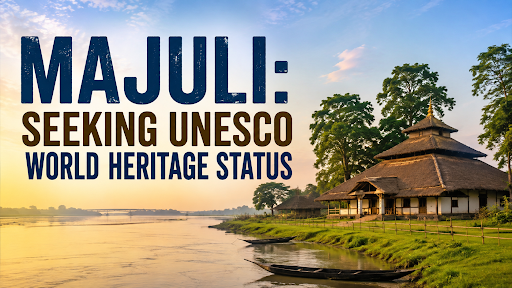
The Assam government announced a renewed roadmap to secure UNESCO recognition for Majuli's Vaishnavite heritage.
About Majuli
River island in the Brahmaputra: Majuli sits mid-stream in the Brahmaputra River, one of the world's largest river systems.
Location in Assam: situated in Jorhat district, separated from the mainland by about 2.5 km of water.
Riverine ecosystem: characterised by varied habitat, heavy rainfall, rich biodiversity, and a complex drainage pattern of lateral and transverse valleys dissected by major rivers.
First river island district of India: Majuli was declared India's first island district, and has also been recognised as Assam's first Biodiversity Heritage Site and first carbon-neutral district.
Cultural Importance of Majuli
Neo-Vaishnavite tradition: Majuli has functioned as the cultural capital of Assamese civilization since the 16th century, when the social reformer Sankardeva established a form of Hinduism known as Vaishnavism on the island.
Satras: Sankardeva and his followers founded monasteries and hermitages called "satras" across Majuli, which remain active centres of Vaishnavite religious and cultural life today.
Sattriya culture: the classical performing art tradition Sattriya — one of India's recognised classical dance forms — originated and continues to be preserved within Majuli's satras.
Traditional mask-making: Majuli's satras are renowned for producing crafted traditional masks used in ritual theatrical performances, a distinctive living craft tradition.
Bhaona: a traditional form of Vaishnavite theatre performed within the satras, combining drama, music, and dance to convey religious and moral narratives.
Manuscript and cultural heritage: satras preserve historic manuscripts, religious texts, and artefacts documenting centuries of continuous Vaishnavite scholarship and practice.

What Is the UNESCO World Heritage Process?
Tentative List: Majuli was formally added to India's Tentative List in 2004, submitted by the Archaeological Survey of India, Ministry of Culture, in the Cultural category.
Nomination dossier: a comprehensive nomination dossier was first submitted in 2006, with additional information provided in 2008; the process has since required multiple rounds of revision.
Evaluation by advisory bodies: nominations are assessed by UNESCO's advisory bodies — for cultural sites, the International Council on Monuments and Sites (ICOMOS) — which conducts field evaluation missions before the Committee's decision.
UNESCO World Heritage Committee: The Committee examined Majuli's cultural nomination in 2006 and referred it back to India for additional information rather than approving or rejecting it outright.
Outstanding Universal Value: every successful nomination must demonstrate Outstanding Universal Value (OUV) — so exceptional as to transcend national boundaries — the central substantive bar Majuli's dossier must clear.
Source: NEWSONAIR
|
PRACTICE QUESTION Q. The Neo-Vaishnavite tradition central to Majuli's cultural heritage was established in the 16th century by which social reformer? (a) Chaitanya Mahaprabhu (b) Sankardeva (c) Ramanuja (d) Madhavacharya Answer: (b) Answer: The Neo-Vaishnavite movement (Ekasarana Dharma) in Assam and Majuli was established in the 15th and 16th centuries by the saint-scholar and social reformer Srimanta Sankardeva. |