Why In News?
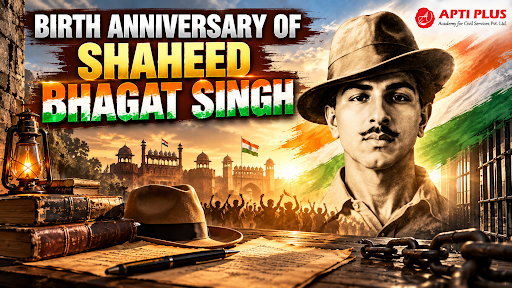
India observed the 119th birth anniversary of Shaheed Bhagat Singh on September 28, with nationwide tributes honoring his supreme sacrifice.
Who Was Bhagat Singh?
Early Life: Born on September 28, 1907, in Banga village, Lyallpur district (now in Punjab, Pakistan), into a patriotic Sandhu Jat Sikh family steeped in anti-colonial activism.
Initial Influences:
-
Family Legacy: His father, Sardar Kishan Singh, and uncle, Sardar Ajit Singh (architect of the historic Pagdi Sambhal Jatta peasant agitation of 1907 and founder of the Bharat Mata Society), instilled early anti-British defiance.
-
Catalytic Historical Shocks: The 1919 Jallianwala Bagh Massacre (which he visited as a 12-year-old child) and the brutal 1921 Nankana Sahib Massacre radicalized his political consciousness.
-
Non-Cooperation Movement (1920–22): Left formal schooling to participate in Mahatma Gandhi's call, joining the nationalist National College in Lahore founded by Lala Lajpat Rai.
Intellectual Maturation: Reading on the French Revolution, the Russian Bolshevik Revolution (1917), Marxism, European anarchist traditions, and international liberation movements, emerging as one of the foremost intellectual theoreticians of the Indian freedom movement.
What Were His Major Revolutionary Activities?
Founding of Naujawan Bharat Sabha (March 1926):
-
Established an open, legal mass youth organization in Lahore to foster patriotic fervor, promote communal harmony, organize agrarian laborers, and propagate rationalist, anti-superstitious thinking.
-
Served as its founding general secretary, mandating that members pledge to place national freedom above religious sectarianism.
Transformation of the Revolutionary Movement into HSRA (September 1928):
-
Together with Chandrashekhar Azad, Sukhdev Thapar, and Bhagwati Charan Vohra, restructured the erstwhile Hindustan Republican Association (HRA) into the Hindustan Socialist Republican Association (HSRA) at Feroz Shah Kotla, Delhi.
-
Formally embedded Socialism as the ultimate programmatic objective of the Indian revolution, shifting the movement from individual acts of terror toward mass mobilization of workers and peasants.
Hindustan Republican Association (HRA, 1924) vs Hindustan Socialist Republican Association (HSRA, 1928)
|
The Saunders Assassination / Lahore Conspiracy Case (December 1928)
-
Following the fatal lathi-charge on Lala Lajpat Rai during peaceful anti-Simon Commission demonstrations in Lahore, the HSRA resolved to avenge the national insult.
-
On December 17, 1928, Bhagat Singh, Shivaram Rajguru, and Chandrashekhar Azad assassinated Assistant Superintendent of Police John P. Saunders (mistaking him for Police Superintendent James A. Scott who ordered the assault).
Central Legislative Assembly Bombing (April 8, 1929)
-
Along with Batukeshwar Dutt, threw two low-intensity, non-lethal smoke bombs into the vacant benches of the Central Legislative Assembly in New Delhi.
-
Surrendered voluntarily on the spot to convert colonial courtrooms into platforms for revolutionary ideological dissemination.
Significance Of The Central Legislative Assembly Bombing
|
Lahore Jail Hunger Strike (1929)
-
Indefinite fast demanding that Indian revolutionary undertrials be treated as political prisoners rather than ordinary common criminals, demanding decent food, hygiene, newspapers, and access to books.
-
The strike lasted 116 days, capturing national support; comrade Jatindra Nath Das attained martyrdom on September 13, 1929, after a 63-day hunger strike.
Martyrdom (March 23, 1931)
-
Following an irregular trial before a Special Tribunal constituted under the Lahore Conspiracy Case Ordinance, 1930, Bhagat Singh, Rajguru, and Sukhdev were awarded capital punishment.
-
In defiance of legal norms, the trio was secretly hanged 11 hours ahead of schedule on the evening of March 23, 1931, in Lahore Central Jail and cremated on the banks of the Sutlej River at Hussainiwala.
What Was Bhagat Singh’s Ideological Position?
Redefining "Revolution": In their historic joint statement before the Delhi Sessions Court (June 1929), Bhagat Singh and B.K. Dutt clarified that revolution does not necessarily involve physical strife or personal revenge:
"Revolution is not the cult of the bomb and the pistol... Revolution means that the present order of things, which is based on manifest injustice, must change."
Anti-Imperialism and Anti-Capitalism: Argued that replacing British white masters with Indian brown exploiters would not bring genuine freedom to the masses. Real independence required abolishing the "exploitation of man by man and of nation by nation".
Uncompromising Secularism: Maintained that communalism was as dangerous an enemy to India as foreign imperialism. The Naujawan Bharat Sabha strictly prohibited members from joining communal organizations, advocating universal fraternity across religious lines.
Scientific Rationalism and Atheism: In his seminal jail essay, Why I Am An Atheist (1930), written in response to fellow prisoner Baba Randhir Singh, he explained that his rejection of religion was not born of youthful arrogance, but was the outcome of methodical reading, scientific skepticism, and rational inquiry.
Culture of Critical Thinking: Emphasized that every revolutionary must cultivate a merciless capacity to question all established dogmas, traditions, and authorities through reason and empirical scrutiny.
What Was The Significance Of His Ideas And Historic Impact?
Catalyzed the Demand for Purna Swaraj: The radical popularity of Bhagat Singh and the HSRA forced the Indian National Congress under Jawaharlal Nehru to shed dominion status ambiguity and formally declare complete independence (Purna Swaraj) at the Lahore Session of December 1929.
Universal Youth Radicalisation: Mobilized student communities through youth leagues across Punjab, the United Provinces, Bihar, and Bengal, establishing students as the vanguard of direct anti-colonial action.
Intellectual Synthesis of Indian Nationalism: Bridged traditional Indian patriotic valor with modern global political philosophy, proving that revolutionaries were sophisticated political theorists rather than anarchic gunmen.
Redefined Patriotism as Selfless Service: Elevated political martyrdom (shahadat) to a conscious, pedagogical instrument designed to shake the Indian populace out of fatalistic resignation.
What Is The Contemporary Relevance Of His Legacy?
Preserving Constitutional Secularism: His warnings against mixing religion with statecraft serve as an enduring defense of the secular foundations of the Indian Republic and Article 25–28 protections.
Cultivating Scientific Temper (Article 51A(h)): His rationalist essay Why I Am An Atheist embodies the fundamental duty to develop a scientific temper, humanism, and the spirit of inquiry and reform.
Prioritizing Socio-Economic Justice: His insistence on prioritizing labor and agrarian rights aligns with the Directive Principles of State Policy (Articles 38, 39, and 43), emphasizing equitable wealth distribution and protection against corporate exploitation.
Democratic Citizenship and Dissent: Upheld the moral obligation of citizens to fearlessly critique injustice and question systemic flaws, reinforcing democratic accountability in contemporary public governance.
Conclusion
Shaheed Bhagat Singh remains an eternal symbol of supreme sacrifice and intellectual enlightenment, whose vision of freedom went beyond the departure of the British to demand an egalitarian, exploitation-free, and secular Indian republic.
Source: ECONOMICTIMES
|
PRACTICE QUESTION Q. Examine the role of Bhagat Singh and revolutionary nationalism in shaping the Indian freedom movement. 150 words |